Question
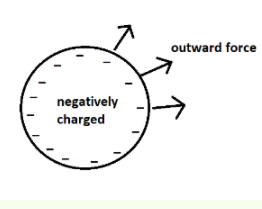
A soap bubble is given negative charge, its radius will:

Answer

  1. Increase
Explanation:

The charge will be distributed uniformly over the surface of the bubble by symmetry.
As we know, they want to step much farther apart, as charges repel, the only path outward, taking with them the soap surface.
At the same point, the rise in the restored force of the soap film (surface tension) would be equal and contrary to the electrostatic force, which will result in a new (larger) radius of equilibrium.
Because of the ionic similarities, this can happen to both positive and negatively charged bubbles.Therefore, when a negative charge is given to the soap bubble, then its radius will increase.

Need a full question paper?

Generate a complete, print-ready paper with questions like this in minutes — across 16+ boards, with answer keys.

Start Generating Free

Similar questions

In vacuum an electron of energy 10 keV hits tungsten target, then emitted radiation will be        (a) Cathode rays(b) X-rays(c) Infrared rays(d) Visible spectrum
       
The relation between the linear magnification $m,$ the object distance $u$ and the focal length $f$ is
In an hydrogen atom, the electron revolves around the nucleus in an orbit of radius $0.53 \times 10^{-10} m.$ Then the electrical potential produced by the nucleus at the position of the electron is
Magnetic dipole moment is a vector quantity directed from :
The photoelectric effect can be understood on the basis of(a) The principle of superposition(b) The electromagnetic theory of light(c) The special theory of relativity(d) Line spectrum of the atom
   
   
Two free parallel wires carrying currents in opposite direction(a) Attract each other(b) Repel each other(c) Neither attract nor repel(d) Get rotated to be perpendicular to each other


When a battery is connected across a series combination of self inductance $L$ and resistance $R,$ the variation in the current $i$ with time $t$ is best represented by
Cutoff wavelength of $X-$rays coming from a Coolidge tube depends on the:
An electron in the n = 1 orbit of hydrogen atom is bound by 13.6 eV. If a hydrogen atom is in the n = 3 state, how much energy is required to ionize it(a) 13.6 eV(b) 4.53 eV(c) 3.4 eV (d) 1.51 eV
       
A perpendicular material is place in a magnetic fields. Consider the following statemetns:
  1. If the magnetic field is increased, the magnetization is increased.
  2. If the temperature is increased, the magnetization is increased.