A solenoid of $1.5$ $metre$ length and $4.0\, cm$ diameter posses $10$ $turn$ per $cm$. A current of $5$ $ampere$ is flowing through it. The magnetic induction at axis inside the solenoid is
Easy


Download our appand get started for free
Experience the future of education. Simply download our apps or reach out to us for more information. Let's shape the future of learning together!No signup needed.*
Similar Questions
- 1A thin circular frame of radius $'a'$ is made of insulating material. A square loop is constructed with in it. If loop carrying current $I$ , then magnetic induction at geometrical centre $'O'$ will beView Solution

- 2A beam of well collimated cathode rays travelling with a speed of $5 \times {10^6}\,m{s^{ - 1}}$ enter a region of mutually perpendicular electric and magnetic fields and emerge undeviated from this region. If $| B |=0.02\; T$, the magnitude of the electric field isView Solution
- 3View SolutionIn a cyclotron, the angular frequency of a charged particle is independent of
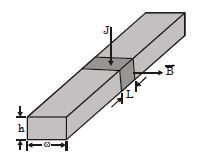
- 4Heart-lung machines and artifical kidney machines employ blood pumps. A mechanical pump can mangle blood cells.Figure represents an electromagnetic pump. The blood is confined to an electrically insulating tube, represented as a rectangle of width $\omega$ and height $h.$ Two electrodes fit into the top and the bottom of the tube. The potential difference between them establishes an electric current through the blood, with current density $J$ over a section of length $L.$ A perpendicular magnetic field exists in the same region. The section of liquid in the magnetic field experiences a pressure increase given by :-View Solution
- 5View SolutionIf an ammeter is to be used in place of a voltmeter then we must connect with the ammeter a
- 6A rectangular loop carrying a current $i$ is placed in a uniform magnetic field $B$. The area enclosed by the loop is $A$. If there are n turns in the loop, the torque acting on the loop is given byView Solution
- 7A proton and an electron both moving with the same velocity $v$ enter into a region of magnetic field directed perpendicular to the velocity of the particles. They will now move in circular orbits such thatView Solution
- 8A voltmeter has resistance of $2000\, ohms$ and it can measure upto $2\,V$. If we want to increase its range to $10\, V$, then the required resistance in series will be ........... $\Omega $View Solution
- 9View SolutionIf an ammeter is connected in parallel to a circuit, it is likely to be damaged due to excess
- 10A proton and an alpha particle both enter a region of uniform magnetic field $B,$ moving at right angles to the field $B.$ If the radius of circular orbits for both the particles is equal and the kinetic energy acquired by proton is $1\,\, MeV,$ the energy acquired by the alpha particle will be......$MeV$View Solution