A voltmeter has resistance of $2000\, ohms$ and it can measure upto $2\,V$. If we want to increase its range to $10\, V$, then the required resistance in series will be ........... $\Omega $
Medium


Download our appand get started for free
Experience the future of education. Simply download our apps or reach out to us for more information. Let's shape the future of learning together!No signup needed.*
Similar Questions
- 1The electrostatic force $\left(\vec{F}_1\right)$ and magnetic force $\left(\vec{F}_2\right)$ acting on a charge $q$ moving with velocity $v$ can be written :View Solution
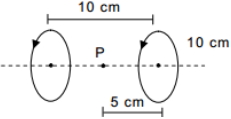
- 2Two circular loops having same radius $[ R =10\, cm ]$ and same current $\frac{7}{2} A$ are placed along same axis as shown. If distance between their centre is $10\, cm$, find net magnetic field at of point $P.$View Solution
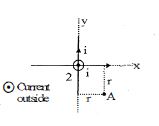
- 3Three infinite wires are arranged in space in three dimensions.(along $x, y$ and $z$ axis) as shown. Each wire carries current $i$ . Find magnetic field at $A$View Solution
- 4View SolutionTesla is the unit of
- 5An electron (charge $q$ $coulomb$) enters a magnetic field of $H$ $weber/{m^2}$ with a velocity of $v\,m/s$ in the same direction as that of the field the force on the electron isView Solution
- 6A galvanometer of $50\, ohm$ resistance has $25$ divisions. A current of $4 \times 10^{-4}$ ampere gives a deflection of one division. To convert this galvanometer into a voltmeter having a range of $25\, volts$, it should be connected with a resistance ofView Solution
- 7The strength of the magnetic field at a point $r$ near a long straight current carrying wire is $B$. The field at a distance $\frac{r}{2}$ will beView Solution
- 8View SolutionMark out the correct options.
- 9A charge particle is moving in a uniform magnetic field $(2 \hat{i}+3 \hat{j}) T$. If it has an acceleration of $(\alpha \hat{i}-4 \hat{j}) m / s ^{2}$, then the value of $\alpha$ will be.View Solution
- 10The force exerted by a magnetic field on a wire having length $L$ and current $I$ is perpendicular to the wire and given as $\left| F \right| = IL\left| B \right|$ . An experimental plot shows $(\vec F)$ as function of $L$ . The plot is a straight line with a slope $S = \left( {10 \pm 1} \right) \times {10^{ - 5}}\ AT$. The current in the wire is $\left( {15 \pm 1} \right)\ mA$ . The percentage error in $B$ isView Solution