d
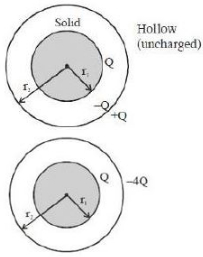
As given in the first condition:
Both conducting spheres are shown.
${V_{in}} - {V_{{\text{out }}}} = \left( {\frac{{{\text{kQ}}}}{{{r_1}}}} \right) - \left( {\frac{{{\text{kQ}}}}{{{{\text{r}}_2}}}} \right)$
$ = {\text{kQ}}\left( {\frac{1}{{{{\text{r}}_1}}} - \frac{1}{{{{\text{r}}_2}}}} \right) = V$
In the second condition:
Shell is now given charge $-4 Q$
${V_{in}} - {V_{out}} = \left( {\frac{{kQ}}{{{r_1}}} - \frac{{4kQ}}{{{r_2}}}} \right) - \left( {\frac{{kQ}}{{{r_2}}} - \frac{{4kQ}}{{{r_2}}}} \right)$
$ = \frac{{kQ}}{{{r_1}}} - \frac{{kQ}}{{{r_2}}}$
$=\mathrm{kQ}\left(\frac{1}{\mathrm{r}_{1}}-\frac{1}{\mathrm{r}_{2}}\right)=\mathrm{V}$
Hence, we also obtain that potential difference does not depend on charge of outer sphere.
$\therefore $ $P.d.$ remains same.