Question
A solid disc and a ring, both of radius 10cm are placed on a horizontal table simultaneously, with initial angular speed equal to 10 π rad s-1. Which of the two will start to roll earlier? The co-efficient of kinetic friction is $\mu_\text{k}=0.2$
Answer

Given,
Radii of the ring and the disc, r = 5cm = 0.05m
Initial angular speed, $\omega_0=8\pi\text{rads}^{-1}$
Coefficient of kinetic friction, $\mu_\text{k}=0.2$
Initial velocity of both the objects, u = 0a
Motion of the two objects is caused by force of friction. According Newton’s second,
force of friction, $\text{f}=\text{ma}$
$\mu_\text{k}\text{mg}=\text{ma}$
Where,
a = Acceleration produced in the disc and the ring
m = Mass
$\therefore\ \text{a}=\mu_{\text{k}}\text{g}\ ...(\text{i})$
Using the first equation of motion,
$\text{v}=\text{u}+\text{at}$
$=0+\mu_\text{k}\text{gt}$
$=\mu_\text{k}\text{gt}\ ...(\text{ii})$
The frictional force applies a torque in perpendicularly outward direction and reduces the initial angular speed.
Torque, $\text{T}=-\text{I}\alpha$
Where, $\alpha=$ Angular acceleration
$\mu_\text{k}\text{mgr}=-\text{I}\alpha$
$\therefore\alpha=\frac{-\mu_\text{k}\text{mgr}}{\text{I}}\ ...(\text{iii})$
According to the first equation of rotational motion, we have,
$\omega=\omega_0+\alpha\text{t}$
$=\omega_0+\Big(\frac{-\mu_\text{k}\text{mgr}}{\text{I}}\Big)\text{t}\ ...(\text{iv})$
Rolling starts when linear velocity, $\text{v}=\text{r}\omega$
$\therefore\ \text{v}=\text{r}\Big(\omega_0-\frac{\mu_\text{k}\text{mgrt}}{\text{I}}\Big)\ ...(\text{v})$
Using equation (ii) and equation (v), we have,
$\mu_\text{k}\text{gt}=\text{r}\Big(\omega_0-\frac{\mu_\text{k}\text{mgrt}}{\text{I}}\Big)$
$=\text{r}\omega_0-\frac{\mu_\text{k}\text{mgr}^2\text{t}}{\text{I}}\ ....(\text{vi})$
For the ring,
$\text{I}=\text{mr}^2$
$\therefore\ \mu_\text{k}\text{gt}=\text{r}\omega_0-\frac{\mu_\text{k}\text{mgr}^2\text{t}}{\text{mr}^2}$
$=\text{r}\omega_0-\mu_\text{k}\text{gt}$
$2\mu_\text{k}\text{gt}=\text{r}\omega_0$
$\therefore\ \text{t}=\frac{\text{r}\omega_0}{2\mu_\text{k}\text{g}}$
$=\frac{(0.05\times8\times3.14)}{(2\times0.2\times9.8)}=0.32\text{s}\ ...(\text{vii})$
For the disc, $\text{I}=\Big(\frac{1}{2}\Big)\text{mr}^2$
$\therefore\ \mu_\text{k}\text{gt}=\text{r}\omega_0-\frac{\mu_\text{k}\text{mgr}^2\text{t}}{\big(\frac{1}{2}\big)\text{mr}^2}$
$=\text{r}\omega_0-2\mu_\text{k}\text{gt}$
$3\mu_\text{k}\text{gt}=\text{r}\omega_0$
$\therefore\ \text{t}=\frac{\text{r}\omega_0}{3\mu_\text{k}\text{g}}$
$=\frac{(0.05)\times8\times3.14}{(3\times0.2\times9.8)}=0.213\text{s}\ ...(\text{viii})$
Since $\text{t}_\text{D}>\text{t}_\text{R},$ the disc will start rolling before the ring.

Need a full question paper?

Generate a complete, print-ready paper with questions like this in minutes — across 16+ boards, with answer keys.

Start Generating Free

Similar questions

Prove that when the vector sum of all external forces acting on a system is zero, then the center of mass remains constant.
Two glass bulbs of equal volume are connected by a narrow tube and are filled with a gas at 0°C at a pressure of 76cm of mercury. One of the bulbs is then placed in melting ice and the other is placed in a water bath maintained at 62°C. What is the new value of the pressure inside the bulbs? The volume of the connecting tube is negligible.
A new system of units is proposed in which unit of mass is $\alpha\text{kg},$ unit of length $\beta$ m and unit of time $\gamma\text{ s}.$ How much will 5J measure in this new system?
Prove that the total speed of a particle in simple harmonic motion energy is directly proportional to the square of the particle's amplitude and the square of its frequency.
A parallel-plate capacitor has plate area 100cm2 and plate separation 1.0cm. A glass plate (dielectric constant 6.0) of thickness 6.0mm and an ebonite plate (dielectric constant 4.0) are inserted one over the other to fill the space between the plates of the capacitor. Find the new capacitance.
A suitcase kept on a shop's rack is measured 50cm × 25cm × 10cm by the shop's owner. A traveller takes this suitcase in a train moving with velocity 0.6c.
If the suitcase is placed with its length along the train's velocity, find the dimensions measured by:
  1. The traveller and.
  2. A ground observer.
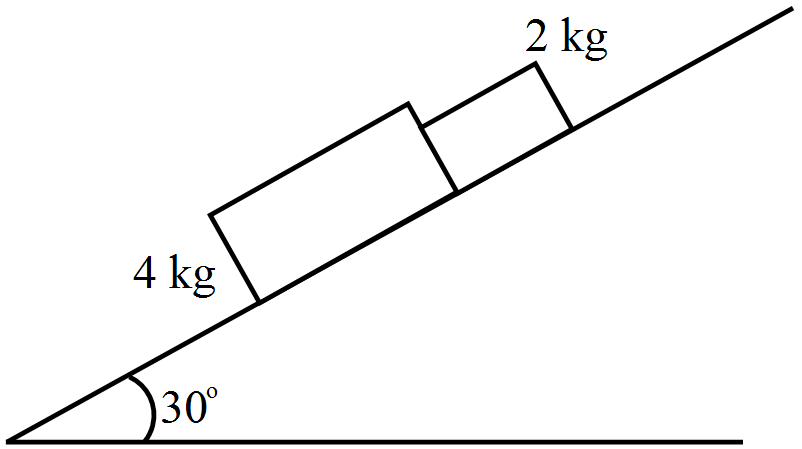
Figure shows two blocks in contact sliding down an inclined surface of inclination 30°. The friction coefficient between the block of mass 2.0kg and the incline is $\mu_1,$ and that between the block of mass 4.0kg and the incline is $\mu_2.$ Calculate the acceleration of the 2.0kg block if:

  1. $\mu_1=0.20$ and $\mu_2=0.30$
  2. $\mu_1=0.30$ and $\mu_2=0.20$ Take $\text{g}=10\text{m/s}^2.$

A thin rod having length L0 at 0°C and coefficient of linear expansion $\alpha$ has its two ends maintained at temperatures $\theta_1$ and $\theta_2,$ respectively. Find its new length.
The displacement of two particles executing simple harmonic motion are represented by equations, $\text{y}=4\sin(10\text{t}+\theta)$ and $\text{y}=5\cos10\text{t}$ What is the phase difference between the velocities of these particles?
Establish the relationship between Torque and Moment of Inertia.