Question
The displacement of two particles executing simple harmonic motion are represented by equations, $\text{y}=4\sin(10\text{t}+\theta)$ and $\text{y}=5\cos10\text{t}$ What is the phase difference between the velocities of these particles?

Answer

For 1st particle

$\text{y}_1=4\sin(10\text{t}+\theta);$

Velocity $\frac{\text{dy}_1}{\text{dt}}$

$=4\times10\cos(10\text{t}+\theta)$

$=40\cos(10\text{t}+\theta)$

For second particle 

$\text{y}_2=5\cos10\text{t}=5\sin(10\text{t}+\frac{\pi}{2})$

Velocity $\frac{\text{dy}_2}{\text{dt}}$

$=5\cos\times10\cos(10\text{t}+\frac{\pi}{2})$

$=5\cos(10\text{t}+\frac{\pi}{2})$

Phase difference between velocities 

$=(10\text{t}+\theta)-(10\text{t}+\frac{\pi}{2})$

$=\Big(\theta-\frac{\pi}{2}\Big)$

Need a full question paper?

Generate a complete, print-ready paper with questions like this in minutes — across 16+ boards, with answer keys.
Start Generating Free

Similar questions

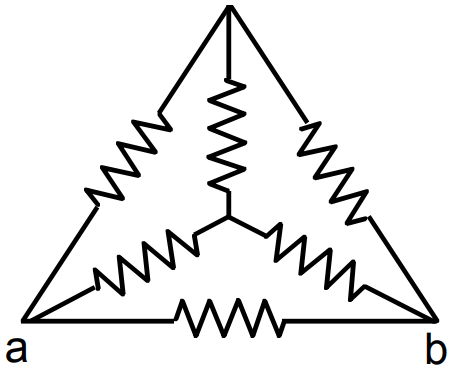
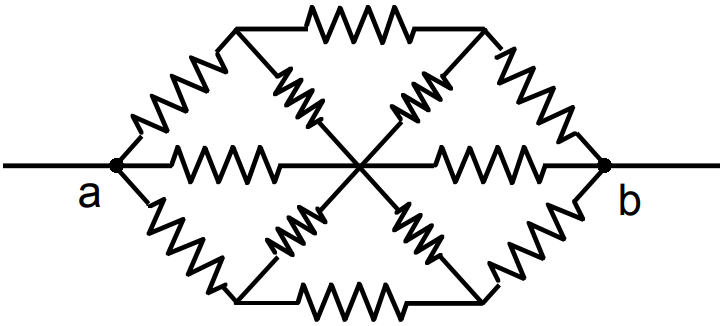
Find the equivalent resistance of the circuits shown in the figure. between the points a and b. Each resistor has resistance r.


A fighter plane flying horizontally at an altitude of 1.5km with speed 720km/h passes directly overhead an anti-aircraft gun. At what angle from the vertical should the gun be fired for the shell with muzzle speed 600ms-1 to hit the plane? At what minimum altitude should the pilot fly the plane to avoid being hit? (Take g = 10ms-2).
One end of a V-tube containing mercury is connected to a suction pump and the other end to atmosphere. The two arms of the tube are inclined to horizontal at an angle of 45 PHA° each. A small pressure difference is created between two columns when the suction pump is removed. Will the column of mercury in V-tube execute simple harmonic motion? Neglect capillary and viscous forces.Find the time period of oscillation.
An equilateral triangle ABC is formed by two Cu rods AB and BC and one Al rod. It is heated in such a way that temperature of each rod increases by $\Delta\text{T}$. Find change in the angle ABC. $[$Coeff. of linear expansion for 1 Cu is $\alpha_1$ Coeff. of linear expansion for 2Al is $\alpha_2]$
  1. Define viscosity. Write SI units of coefficient of viscosity.
  2. Define terminal velocity. Establish an expression for it.
A 14.5kg mass, fastened to the end of a steel wire of unstretched length 1.0m, is whirled in a vertical circle with an angular velocity of 2rev/s at the bottom of the circle. The cross-sectional area of the wire is 0.065cm2. Calculate the elongation of the wire when the mass is at the lowest point of its path.
In deriving Bernoulli’s equation, we equated the work done on the fluid in the tube to its change in the potential and kinetic energy.
  1. What is the largest average velocity of blood flow in an artery of diameter 2 × 10⁻³m if the flow must remain laminar?
  2. Do the dissipative forces become more important as the fluid velocity increases? Discuss qualitatively.
A geostationary satellite is orbiting the earth at a height of 6R above the surface of earth. Here R is the radius of the earth. What is the time period of another satellite at a height of 2.5R from the surface of the earth?
A body of mass 0.40kg moving initially with a constant speed of 10ms-1 to the north is subject to a constant force of 8.0 N directed towards the south for 30s. Take the instant the force is applied to be t = 0, the position of the body at that time to be x = 0, and predict its position at t = –5s, 25s, 100s.
An object of mass 0.4kg moving with a velocity of 4ms-1 collides with another object of mass 0.6kg moving in same direction with a velocity of 2ms-1. If the collision is prefectly inelastic, what is the loss of K.E. due to impact?