Question
A solid disc and a ring, both of radius 10cm are placed on a horizontal table simultaneously, with initial angular speed equal to 10 π rad s-1. Which of the two will start to roll earlier? The co-efficient of kinetic friction is $\mu_\text{k}=0.2$
Answer

Given,
Radii of the ring and the disc, r = 5cm = 0.05m
Initial angular speed, $\omega_0=8\pi\text{rads}^{-1}$
Coefficient of kinetic friction, $\mu_\text{k}=0.2$
Initial velocity of both the objects, u = 0a
Motion of the two objects is caused by force of friction. According Newton’s second,
force of friction, $\text{f}=\text{ma}$
$\mu_\text{k}\text{mg}=\text{ma}$
Where,
a = Acceleration produced in the disc and the ring
m = Mass
$\therefore\ \text{a}=\mu_{\text{k}}\text{g}\ ...(\text{i})$
Using the first equation of motion,
$\text{v}=\text{u}+\text{at}$
$=0+\mu_\text{k}\text{gt}$
$=\mu_\text{k}\text{gt}\ ...(\text{ii})$
The frictional force applies a torque in perpendicularly outward direction and reduces the initial angular speed.
Torque, $\text{T}=-\text{I}\alpha$
Where, $\alpha=$ Angular acceleration
$\mu_\text{k}\text{mgr}=-\text{I}\alpha$
$\therefore\alpha=\frac{-\mu_\text{k}\text{mgr}}{\text{I}}\ ...(\text{iii})$
According to the first equation of rotational motion, we have,
$\omega=\omega_0+\alpha\text{t}$
$=\omega_0+\Big(\frac{-\mu_\text{k}\text{mgr}}{\text{I}}\Big)\text{t}\ ...(\text{iv})$
Rolling starts when linear velocity, $\text{v}=\text{r}\omega$
$\therefore\ \text{v}=\text{r}\Big(\omega_0-\frac{\mu_\text{k}\text{mgrt}}{\text{I}}\Big)\ ...(\text{v})$
Using equation (ii) and equation (v), we have,
$\mu_\text{k}\text{gt}=\text{r}\Big(\omega_0-\frac{\mu_\text{k}\text{mgrt}}{\text{I}}\Big)$
$=\text{r}\omega_0-\frac{\mu_\text{k}\text{mgr}^2\text{t}}{\text{I}}\ ....(\text{vi})$
For the ring,
$\text{I}=\text{mr}^2$
$\therefore\ \mu_\text{k}\text{gt}=\text{r}\omega_0-\frac{\mu_\text{k}\text{mgr}^2\text{t}}{\text{mr}^2}$
$=\text{r}\omega_0-\mu_\text{k}\text{gt}$
$2\mu_\text{k}\text{gt}=\text{r}\omega_0$
$\therefore\ \text{t}=\frac{\text{r}\omega_0}{2\mu_\text{k}\text{g}}$
$=\frac{(0.05\times8\times3.14)}{(2\times0.2\times9.8)}=0.32\text{s}\ ...(\text{vii})$
For the disc, $\text{I}=\Big(\frac{1}{2}\Big)\text{mr}^2$
$\therefore\ \mu_\text{k}\text{gt}=\text{r}\omega_0-\frac{\mu_\text{k}\text{mgr}^2\text{t}}{\big(\frac{1}{2}\big)\text{mr}^2}$
$=\text{r}\omega_0-2\mu_\text{k}\text{gt}$
$3\mu_\text{k}\text{gt}=\text{r}\omega_0$
$\therefore\ \text{t}=\frac{\text{r}\omega_0}{3\mu_\text{k}\text{g}}$
$=\frac{(0.05)\times8\times3.14}{(3\times0.2\times9.8)}=0.213\text{s}\ ...(\text{viii})$
Since $\text{t}_\text{D}>\text{t}_\text{R},$ the disc will start rolling before the ring.

Need a full question paper?

Generate a complete, print-ready paper with questions like this in minutes — across 16+ boards, with answer keys.

Start Generating Free

Similar questions

A steel rod 100cm long is clamped at its middle. The fundamental frequency of longitudinal vibrations of the rod are given to be 2.53 kHz. What is the speed of sound in steel?
What do you understand by beat? Explain beats analytically.
Suppose the $19\Omega$ resistor of the previous problem is disconnected. Find the current through P2Q2 in the two situations:
  1. Both the wires move towards right.
  2. If P1Q1 moves towards left but P2Q2 moves towards right.
A gun is mounted on a railroad car. The mass of the car, the gun, the shells and the operator is 50m where m is the mass of one shell. If the velocity of the shell with respect to the gun (in its state before firing) is 200m/s, what is the recoil speed of the car after the second shot? Neglect friction.
A 400kg satellite is in a circular orbit of radius 2RE about the earth. How much energy is required to transfer it to circular orbit of radius 4RE? What are the changes in the kinetic energy and potential energy?
At what temperature is the root mean square speed of an atom in an argon gas cylinder equal to the rms speed of a helium gas atom at-20°C? (atomic mass of Ar = 39.9u, of He = 4.0u).
Read statement below carefully and state with reasons and examples, if it is true or false;
A particle in one-dimensional motion.
With positive value of acceleration must be speeding up.
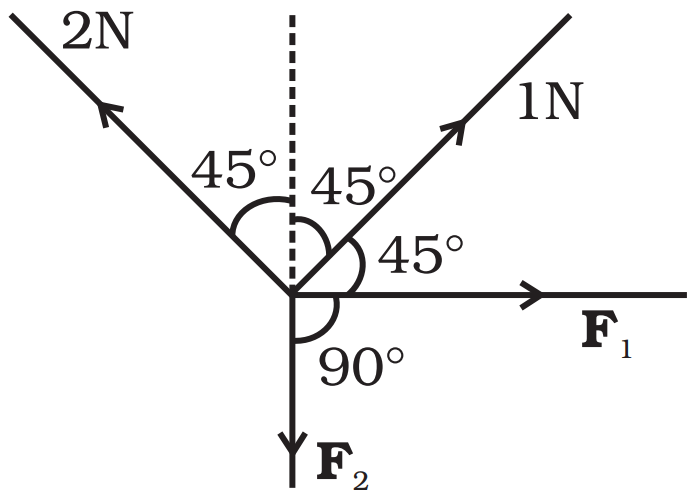
There are four forces acting at a point P produced by strings as shown in which is at rest. Find the forces F1 and F2.

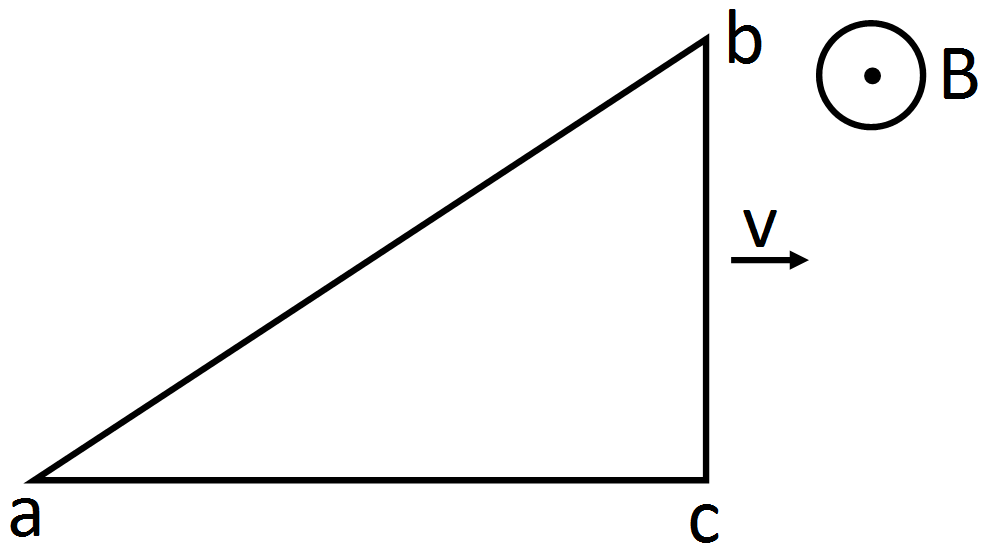
A right-angled triangle abc, made from a metallic wire, moves at a uniform speed v in its plane as shown in figure. A uniform magnetic field B exists in the perpendicular direction. Find the emf induced:
  1. In the loop abc.
  2. In the segment bc.
  3. In the segment ac.
  4. In the segment ab.

k transparent slabs are arranged one over another. The refractive indices of the slabs are $\mu_1,\mu_2,\mu_3, \ ...\mu_{\text{k}}$ and the thicknesses are t1, t2, t3, ... tk . An object is seen through this combination with nearly perpendicular light. Find the equivalent refractive index of the system which will allow the image to be formed at the same place.