Question
Read statement below carefully and state with reasons and examples, if it is true or false;
A particle in one-dimensional motion.
With positive value of acceleration must be speeding up.
Answer

False.
Explanation:
This statement is false in the situation when acceleration is positive and velocity is negative at the instant time taken as origin. Then, for all the time before velocity becomes zero, there is slowing down of the particle. Such a case happens when a particle is projected upwards.
This statement is true when both velocity and acceleration are positive, at the instant time taken as origin. Such a case happens when a particle is moving with positive acceleration or falling vertically downwards from a height.

Need a full question paper?

Generate a complete, print-ready paper with questions like this in minutes — across 16+ boards, with answer keys.

Start Generating Free

Similar questions

A large steel wheel is to be fitted on to a shaft of the same material. At 27°C, the outer diameter of the shaft is 8.70cm and the diameter of the central hole in the wheel is 8.69cm. The shaft is cooled using ‘dry ice’. At what temperature of the shaft does the wheel slip on the shaft? Assume coefficient of linear expansion of the steel to be constant over the required temperature range: asteel = 1.20 × 10⁻⁵ K–1.
A neutron star has a density equal to that of the nuclear matter. Assuming the star to be spherical, find the radius of a neutron star whose mass is 4.0 × 1030kg (twice the mass of the sun).
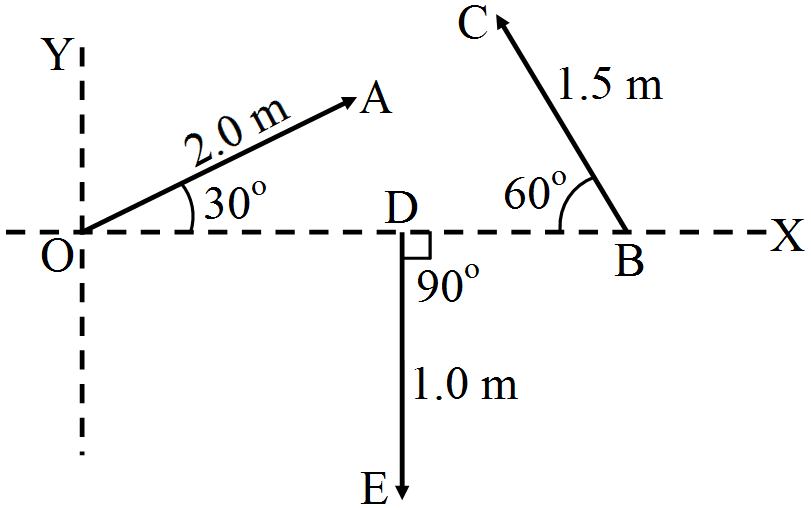
Refer to figure. Find
  1. The magnitude.
  2. x and y components
  3. The angle with the X-axis of the resultant of $\overrightarrow{\text{OA}},\overrightarrow{\text{BC}}$ and $\overrightarrow{\text{DE}}.$
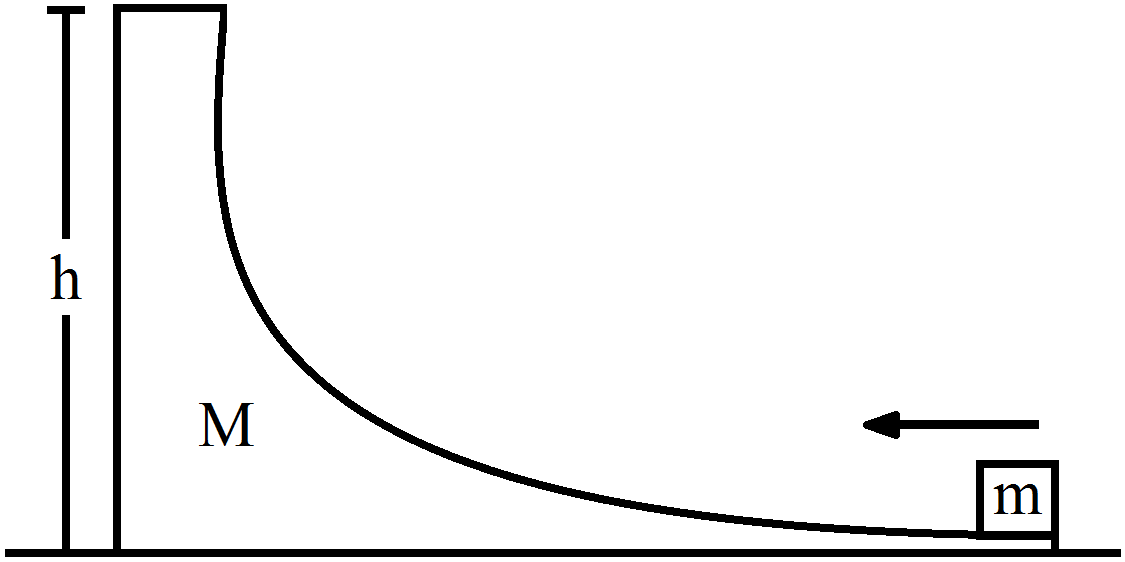
Figure shows a small body of mass m placed over a larger mass M whose surface is horizontal near the smaller mass and gradually curves to become vertical. The smaller mass is pushed on the longer one at a speed v and the system is left to itself. Assume that all the surfaces are frictionless.
  1. Find the speed of the larger block when the smaller block is sliding on the vertical part.
  2. Find the speed of the smaller mass when it breaks off the larger mass at height h.
  3. Find the maximum height (from the ground) that the smaller mass ascends.
  4. Show that the smaller mass will again land on the bigger one. Find the distance traversed by the bigger block during the time when the smaller block was in its flight under gravity.
​​​​​​​
A plane is in level flight at constant speed and each of its two wings has an area of 25m2. If the speed of the air is 180km/ h over the lower wing and 234km/ h over the upper wing surface, determine the plane’s mass. (Take air density to be 1kg m–3).
A 2kg body and a 3kg body are moving along the x-axis. At a particular instant, the 2kg body is 1m from the origin and has a velocity of 3ms-1 and the 3kg body is 2m from the origin and has velocity of -1 ms-1. Find the position and velocity of the centre of mass and also find the total momentum.
Prove that :
(i) Inside the liquid the pressure is higher than on the open surface of the liquid.
(ii) The pressure difference between any two points in a vertical line inside the liquid occurs only due to the effect of gravity.
A parallel-plate capacitor of capacitance $5\mu\text{F}$ is connected to a battery of emf 6V. The separation between the plates is 2mm:
  1. Find the charge on the positive plate.
  2. Find the electric field between the plates.
  3. A dielectric slab of thickness 1mm and dielectric constant 5 is inserted into the gap to occupy the lower half of it. Find the capacitance of the new combination.
  4. How much charge has flown through the battery after the slab is inserted?
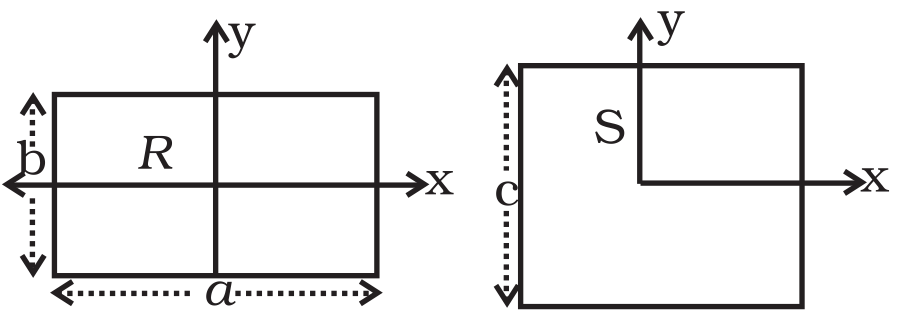
A uniform square plate S(side c) and a uniform rectangular plate R(sides b, a) have identical areas and masses:

Show that:
  1. $\frac{\text{I}_\text{xR}}{\text{I}_\text{xS}}<1$
  2. $\frac{\text{I}_\text{ys}}{\text{I}_\text{ys}}>1$
  3. $\frac{\text{I}_{2\text{R}}}{\text{I}_{2\text{s}}}>1$
Two bodies of masses m1 and m2 and specific heat capacities s1 and s2 are connected by a rod of length l, cross-sectional area A, thermal conductivity K and negligible heat capacity. The whole system is thermally insulated. At time t = 0, the temperature of the first body is T1 and the temperature of the second body is T2 (T2 > T1). Find the temperature difference between the two bodies at time t.