MCQ
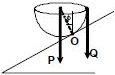
A solid hemisphere of weight $P$ rests with its curved surface in contact with a rough inclined plane. A weight $Q$ is placed at some point on the rim of the hemisphere to keep its plane surface horizontal then its minimum coefficient of friction is
  • $\mu  = \,\frac{Q}{{\sqrt {P(P + 2Q)} }}$
  • B
    $\mu  = \,\frac{Q}{{\sqrt {P(Q + 2P)} }}$
  • C
    $\mu  = \,\frac{P+Q}{{\sqrt {P(P + 2Q)} }}$
  • D
    $\mu  = \,\frac{P-Q}{{\sqrt {P(P + 2Q)} }}$
Answer

Correct option: A.
$\mu  = \,\frac{Q}{{\sqrt {P(P + 2Q)} }}$
a
At $O$

$\mathrm{P}(\mathrm{R} \sin \phi)=\mathrm{Q}(1-\sin \phi) \mathrm{R}$

$\sin \phi=Q /(P+Q)$

$\mu=\tan \phi=\frac{\mathrm{Q}}{\sqrt{\mathrm{P}(\mathrm{P}+2 \mathrm{Q})}}$

Need a full question paper?

Generate a complete, print-ready paper with questions like this in minutes — across 16+ boards, with answer keys.

Start Generating Free

Similar questions

The two gases with the ratio $3 : 2$ of their masses in a container are at a temperature $T.$ The ratio of the kinetic energies of the molecule of two gases is:
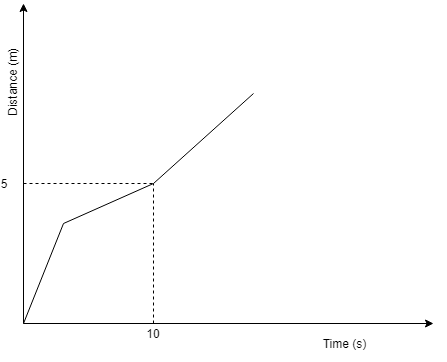
What is the velocity for a body following the graph below at $10s?$
The displacement of the interfering light waves are ${y_1} = 4\sin \omega \,t$ and ${y_2} = 3\sin \left( {\omega \,t + \frac{\pi }{2}} \right)$. What is the amplitude of the resultant wave
Ice at $0^o C$ is added to $200 \,\,g$ of water initially at $70^o C$ in a vacuum flask. When $50\,\, g$ of ice has been added and has all melted the temperature of the flask and contents is $40^o C$. When a further $80\,\,g$ of ice has been added and has all metled, the temperature of the whole is $10^o C$. Calculate the specific latent heat of fusion of ice.[Take $S_w =1\,\, cal /gm ^o C$.]
Two cars are moving in the same direction with the same speed $30 \,km/hr$. They are separated by a distance of $5\, km$, the speed of a car moving in the opposite direction if it meets these two cars at an interval of $4$ minutes, will be.......$km/hr$
Select the incorrect statement$(s)$
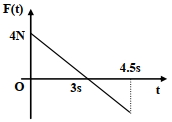
A block of mass $2 \mathrm{~kg}$ is free to move along the $\mathrm{x}$-axis. It is at rest and from $\mathrm{t}=0$ onwards it is subjected to a time-dependent force $\mathrm{F}(\mathrm{t})$ in the $\mathrm{x}$ direction. The force $\mathrm{F}(\mathrm{t})$ varies with $\mathrm{t}$ as shown in the figure. The kinetic energy of the block after $4.5$ seconds is
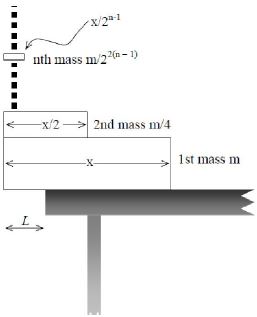
Infinite numbers of blocks are placed on $a$ table edge as shown in the diagram. What is the minimum value of $L$ so that the blocks are just going to topple over the table ?
The specific heat capacity of a metal at low temperature $(T)$ is given as $C_p=32\left(\frac{ T }{400}\right)^{3}\;kJ\,k ^{-1}\, kg ^{-1}$. A $100\; g$ vessel of this metal is to be cooled from $20 \;K$ to $4\; K$ by a special refrigerator operating at room temperature $27^\circ c$). The amount of work required to cool the vessel is
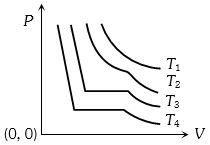
The change in volume $V$ with respect to an increase in pressure $P$ has been shown in the figure for a non-ideal gas at four different temperatures ${T_1},\,{T_2},\,{T_3}$ and ${T_4}$. The critical temperature of the gas is