MCQ
The specific heat capacity of a metal at low temperature $(T)$ is given as $C_p=32\left(\frac{ T }{400}\right)^{3}\;kJ\,k ^{-1}\, kg ^{-1}$. A $100\; g$ vessel of this metal is to be cooled from $20 \;K$ to $4\; K$ by a special refrigerator operating at room temperature $27^\circ c$). The amount of work required to cool the vessel is
  • A
    equal to $0.002\; KJ$
  • B
     greater than $0.148\; KJ$
  • between $0.148\; KJ$ and $0.028 KJ$
  • D
    less than $0.028\; KJ$

Answer

Correct option: C.
between $0.148\; KJ$ and $0.028 KJ$
c
Specific heat at low is

$C_{P}=32\left(\frac{T}{400}\right)^{3}$

$Q=\int m \cdot c . d T=\int_{20}^{4} \frac{100}{1000} \times 32\left(\frac{T}{400}\right)^{3} d T$

$=\frac{32}{10} \times \frac{1}{(400)^{3}}\left(\frac{T^{4}}{4}\right)^{3}$

$=\frac{32}{10 \times(400)^{3}} \times \frac{1}{4}\left(20^{4}-4^{4}\right)$

$=\frac{32}{10 \times(400)^{3}} \times \frac{1}{4} \times(160000-256)$

$=0.002 W$

$\beta=\frac{T_{2}}{T_{1}-T_{2}}=\frac{Q_{3}}{W}$

$\Rightarrow \frac{20}{300-20}=\frac{0.2}{W} \Rightarrow W=0.028 kJ$

$\Rightarrow \frac{4}{300-4}=\frac{0.002}{W} \Rightarrow W=0.0148 kJ$

Need a full question paper?

Generate a complete, print-ready paper with questions like this in minutes — across 16+ boards, with answer keys.

Start Generating Free

Similar questions

A $0.10\, kg$ block oscillates back and forth along a horizontal surface. Its displacement from the origin is given by: $x = (10\,cm)\cos [(10\,rad/s)\,t + \pi /2\,rad]$. What is the maximum acceleration experienced by the block
If the present units of length. time and mass $(m, s, k g)$ are changed to $100\; m, 100\; s$. $\frac{1}{10} \;k g$ then
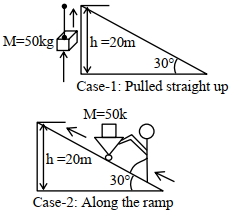
A body of mass $50 \mathrm{~kg}$ is lifted to a height of $20 \mathrm{~m}$ from the ground in the two different ways as shown in the figures. The ratio of work done against the gravity in both the respective cases, will be:
The dimensions of the area $A$ of a black hole can be written in terms of the universal gravitational constant $G$, its mass $M$ and the speed of light $c$ as $A=G^\alpha M^\beta c^\gamma$. Here,
Two sinusoidal waves given below are superposed

$y_1=A \sin \left(k x-\omega t+\frac{\pi}{6}\right), \quad y_2=A \sin \left(k x-\omega t-\frac{\pi}{6}\right)$

The equation of resultant wave is

Statement$-1:$ Two longitudinal waves given by equations $y _{1}( x , t )=2 a \sin (\omega t - kx )$ and $y _{2}( x , t )= a \sin (2 \omega t -2 kx )$ will have equal intensity.

Statement$-2:$ Intensity of waves of given frequency in same medium is proportional to square of amplitude only.

The diameter of a cylinder is measured using a vernier callipers with no zero error. It is found that the zero of the vernier scale lies between $5.10 \ cm$ and $5.15 \ cm$ of the main scale. The vernier scale has $50$ division equivalent to $2.45 \ cm$. The $24^{\text {th }}$ division of the vernier scale exactly coincides with one of the main scale divisions. The diameter of the cylinder is :
A body covers a distance of $2\,m$ under the influence of a force $F = 15 -4x$ $newton$ , where $x$ is the distance covered by the particle in metre. The work done by the force is ............ $\mathrm{J}$
On a foggy day, two drivers spot each other when $80\, m$ apart. They were travelling at $70\, km/h$ and $60\, km/h$. Both apply brakes simultaneously which retard the cars at the rate of $5\, ms^{-2}$. Which of the following statements is correct ?
The displacement of a particle is given by $x = 3\sin (5\pi \,t) + 4\cos (5\pi \,t)$The amplitude of the particle is