Question
A solid sphere, a hollow sphere and a disc, all having same mass and radius, are placed at the top of a smooth incline and released. Least time will be taken in reaching the bottom by:
  1. The solid sphere.
  2. The hollow sphere.
  3. The disc.
  4. All will take same time.

Answer

  1. All will take same time.
Explanation:
The incline is smooth; therefore, all bodies will slip on the incline. Also, as the mass of bodies is same, they will reach the bottom in equal time.

Need a full question paper?

Generate a complete, print-ready paper with questions like this in minutes — across 16+ boards, with answer keys.

Start Generating Free

Similar questions

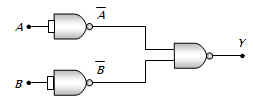
The combination of the gates shown in the figure below produces
In a process on a system, the initial pressure and volume are equal to the final pressure and volume.
  1. The initial temperature must be equal to the final temperature.
  2. The initial internal energy must be equal to the final internal energy.
  3. The net heat given to the system in the process must be zero.
  4. The net work done by the system in the process must be zero.
The de$-$Broglie wavelength of a tennis ball of mass $66 g$ moving with the velocity of $10$ metre per second approximately:
Which of one is correct
Electric charges are distributed in a small volume. The flux of the electric field through a spherical surface of radius $10\ cm$ surrounding the total charge is $25V-m.$ The flux over a concentric sphere of radius $20\ cm$ will be:
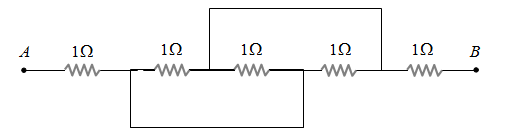
Equivalent resistance between the points $A$ and $B$ is $($in $\Omega)$
The activity of a sample of a radioactive material is $A,$ at time $\mathrm{t}_1$ and $\mathrm{A}_2$ at time $\mathrm{t}_2\left(\mathrm{t}_2>\mathrm{t}_1\right)$. If  its mean life $T,$ then
The radius of the nucleus is smaller than the radius of the atom, approximately :
The radius of a circular loop is $r$ and $a$ current $i$  is flowing in it. The equivalent magnetic moment will be
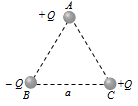
Three charges are placed at the vertices of an equilateral triangle of side $'a\ '$ as shown in the following figure. The force experienced by the charge placed at the vertex $A$ in a direction normal to $BC$ is