- The solid sphere.
- The hollow sphere.
- The disc.
- All will take same time.
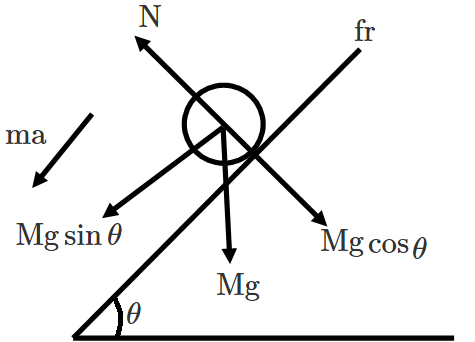
Explanation:
Let $\theta$ be the inclination angle.

From the free body diagram, we have:
$\text{N}=\text{mg}\cos\theta\ \dots(\text{i})$
$\text{ma}=\text{mg}\sin\theta-\text{f}_{\text{r}}\ \dots(\text{ii})$
Putting $\text{f}_{\text{r}}=\mu\text{N}$ in (ii) we get,
$\text{a}=\text{g}(\sin\theta-\mu\cos\theta)$
The friction coefficients between the objects and the incline are same and not sufficient to allow pure rolling; therefore, all the bodies come down with the same acceleration.
Generate a complete, print-ready paper with questions like this in minutes — across 16+ boards, with answer keys.
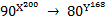
What is the respective number of α and β particles emitted in the following radioactive decay ![]()
|
(a) 6 and 8 |
(b) 8 and 8 |
(c) 6 and 6 |
(d) 8 and 6 |
Which of the following rays are not electromagnetic waves
|
(a) g-rays |
(b) b-rays |
(c) Heat rays |
(d) X-rays |
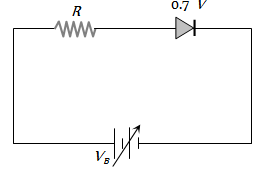
The junction diode in the following circuit requires a minimum current of 1 mA to be above the knee point (0.7 V) of its I-V characteristic curve. The voltage across the diode is independent of current above the knee point. If VB = 5V, then the maximum value of R so that the voltage is above the knee point, will be

|
(a) 4.3 kW |
(b) 860 kW |
(c) 4.3 W |
(d) 860 W |
A bar magnet has coercivity 4 . It is desired to demagnetise it by inserting it inside a solenoid 12 cm long and having 60 turns. The current that should be sent through the solenoid is
|
(a) 2 A |
(b) 4 A |
(c) 6 A |
(d) 8 A |
E.C.E. of Cu and Ag are and 1.2
A certain current deposits 14 gm of Cu. Amount of Ag deposited is
|
(a) 1.2 gm |
(b) 1.6 gm |
(c) 2.4 gm |
(d) 1.8 gm |