MCQ
A solid sphere, a hollow sphere and a disc, all having same mass and radius, are placed at the top of an incline and released. The friction coefficients between the objects and the incline are same and not sufficient to allow pure rolling. Least time will be taken in reaching the bottom by:
  • A
    The solid sphere.
  • B
    The hollow sphere.
  • C
    The disc.
  • D
    All will take same time.

Answer

  1. All will take same time.

Explanation:

Let $\theta$ be the inclination angle.

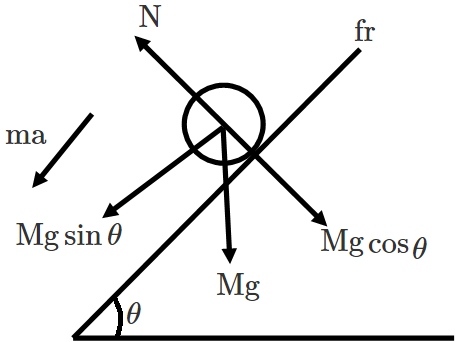
From the free body diagram, we have:

$\text{N}=\text{mg}\cos\theta\ \dots(\text{i})$

$\text{ma}=\text{mg}\sin\theta-\text{f}_{\text{r}}\ \dots(\text{ii})$

Putting $\text{f}_{\text{r}}=\mu\text{N}$ in (ii) we get,

$\text{a}=\text{g}(\sin\theta-\mu\cos\theta)$

The friction coefficients between the objects and the incline are same and not sufficient to allow pure rolling; therefore, all the bodies come down with the same acceleration.

Need a full question paper?

Generate a complete, print-ready paper with questions like this in minutes — across 16+ boards, with answer keys.

Start Generating Free

Similar questions

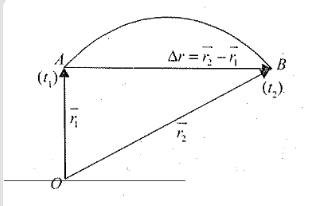
A person moves 30m North, then 20m East then $30\sqrt{2}$ South-West. His displacement from the original position is:
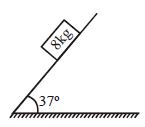
A block of mass $8\, kg$ is at rest on a rough inclined plane as shown in figure. The magnitude of net force exerted by the surface on the block will be ......... $N$
The excess pressure inside a soap bubble is thrice the excess pressure inside a second soap bubble. The ratio between the volume of the first and the second bubble is:
Which of the following statements regarding motion of particle is true?

The equation of stationary wave is

$\mathrm{y}=2 \mathrm{a} \sin \left(\frac{2 \pi \mathrm{nt}}{\lambda}\right) \cos \left(\frac{2 \pi \mathrm{x}}{\lambda}\right)$

Which of the following is NOT correct

No other thermometer is as suitable as a platinum resistance thermometer to measure temperature in the entire range of
One end of a thin uniform rod of length L and mass M1is riveted to the centre of a uniform circular disc of radius r and mass M2 so that both are coplanar. The centre of mass of the combination from the centre of the disc is (assume that the point of attachment is at the origin).
If temperature of $Sun =6000\, K ,$ radius of Sun is $7.2 \times 10^{5}\, Km$ radius of Earth $=6000 \,Km \&$ distance between earth and $Sum =15 \times 10^{7}\, Km .$ Find intensity of light on Earth.
A frictionless heat engine can be $100 \%$ efficient only if its exhaust temperature is ............
The range of a projectile when launched at angle $\theta$ is same as when launched at angle $2 \theta$. What is the value of $\theta$ ?