Question
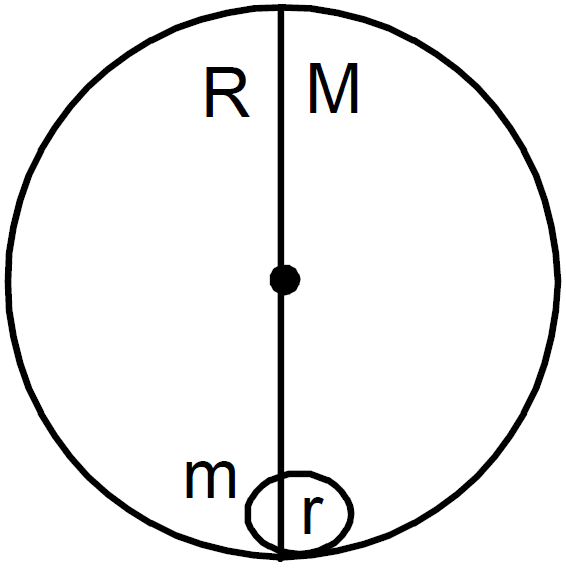
A solid sphere of mass m and radius r is placed inside a hollow thin spherical shell of mass M and radius R as shown in A particle of mass m' is placed on the line joining the two centres at a distance x from the point of contact of the sphere and the shell. Find the magnitude of the resultant gravitational force on this particle due to the sphere and the shell if,
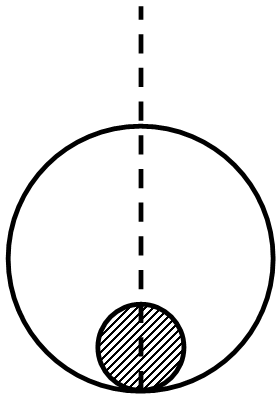
  1. r < x < 2r.
  2. 2r < x < 2R.
  3. x > 2R.

Answer

  1. m' is placed at a distance x from ‘O’.

If r < x, 2r, Let’s consider a thin shell of man

$\text{dm}=\frac{\text{m}}{\big(\frac{4}{3}\big)\pi\text{r}^2}\times\frac{4}{3}\pi\text{x}^3=\frac{\text{mx}^3}{\text{r}^3}$

Thus $\int\text{dm}=\frac{\text{mx}^3}{\text{r}^3}$

Then gravitational force $\text{F}=\frac{\text{Gmdm}}{\text{x}^2}=\frac{\frac{\text{Gmx}^3}{\text{r}^3}}{\text{x}^2}=\frac{\text{Gmx}}{\text{r}^3}$

  1. x < 2R, then F is due to only the sphere.

$\text{F}=\frac{\text{Gmm'}}{(\text{x}-\text{r})^2}$

  1. If x > 2R, then Gravitational force is due to both sphere & shell, then due to shell,

$\text{F}=\frac{\text{GMm'}}{(\text{x}-\text{R})^2}$

due to the sphere $=\frac{\text{Gmm'}}{(\text{x}-\text{r})^2}$

So, Resultant force $=\frac{\text{Gmm'}}{(\text{x}-\text{r})^2}+\frac{\text{GMm'}}{(\text{x}-\text{R})^2}$

Need a full question paper?

Generate a complete, print-ready paper with questions like this in minutes — across 16+ boards, with answer keys.

Start Generating Free

Similar questions

A wire of length 10cm translates in a direction making an angle of 60° with its length. The plane of motion is perpendicular to a uniform magnetic field of 1.0T that exists in the space. Find the emf induced between the ends of the rod if the speed of translation is 20cm/s-1.
A motorcycle has to move with a constant speed on an overbridge which is in the form of a circular arc of radius R and has a total length L. Suppose the motorcycle starts from the highest point.
  1. What can its maximum velocity be for which the contact with the road is not broken at the highest point?
  2. If the motorcycle goes at speed $\frac{1}{\sqrt2}$ times the maximum found in part (a), where will it lose the contact with the road?
  3. What maximum uniform speed can it maintain on the bridge if it does not lose contact anywhere on the bridge?
A tuning fork of unknown frequency makes 5 beats per second with another tuning fork which can cause a closed organ pipe of length 40cm to vibrate in its fundamental mode. The beat frequency decreases when the first tuning fork is slightly loaded with wax. Find its original frequency. The speed of sound in air is 320m/s.
A charged particle is accelerated through a potential difference of 12kV and acquires a speed of 1.0 × 10⁶m s−1. It is then injected perpendicularly into a magnetic field of strength 0.2T. Find the radius of the circle described by it.
Consider the situation shown in the figure of the previous problem. Suppose the wire connecting O and C has zero resistance but the circular loop has a resistance R uniformly distributed along its length. The rod OA is made to rotate with a uniform angular speed $\omega$ shown in the figure. Find the current in the rod when $\angle\text{AOC}=90^{\circ}$
Quite often, connecting wires carrying currents in opposite directions are twisted together in using electrical appliances. Explain how it avoids unwanted magnetic fields.
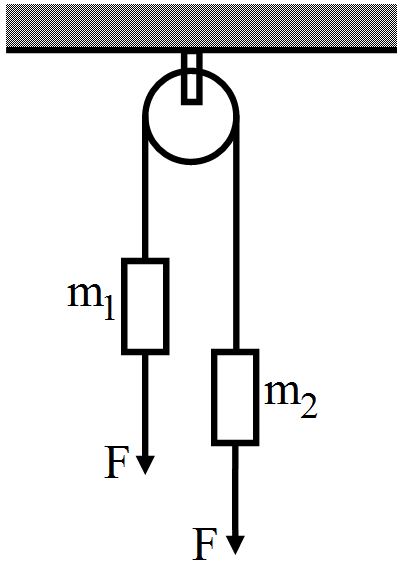
In figure m1 = 5kg, m1 = 2kg and F = 1N. Find the acceleration of either block. Describe the motion of m1 if the string breaks but F continues to act.

State Biot-Savart law. Use it to derive an expression for the magnetic field at the centre of a circular loop of radius R carrying a steady current I. Sketch the magnetic field lines for such a current carrying loop.
The bob of a pendulum at rest is given a sharp hit to impart a horizontal velocity $\sqrt{10\text{gl}},$ where l is the length of the pendulum. Find the tension in the string when,
  1. The string is horizontal.
  2. The bob is at its highest point.
  3. The string makes an angle of 60° with the upward vertical.
Four particles having masses m, 2m, 3m and 4m are placed at the four corners of a square of edge a. Find the gravitational force acting on a particle of mass m placed at the centre.