- Draw a ray diagram showing the image formation by a compound microscope. Hence obtain expression for total magnification when the image is formed at infinity.
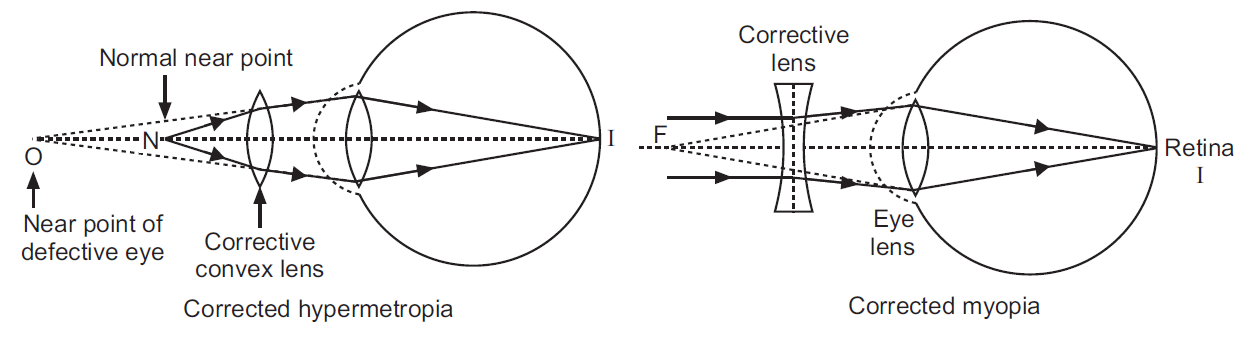
- Distinguish between myopia and hypermetropia. Show diagrammatically how these defects can be corrected.
CBSE DELHI - SET 1 2013
Download our app for free and get started
- Difference between myopia and hypermetropia
| Myopia | Hypermetropia |
|
|
|
|
- Myopic eye is corrected by interposing a concave lens between eye and object.
- Hypermetropia is corrected by interposing a convex lens between eye and object.
- If image A 'B' is exactly at the focus of the eyepiece, then image A "B" is formed at infinity. If the object AB is very close to the focus of the objective lens of focal length $f_o$, then magnification $M_o$ by the objective lens
where L is tube length (or distance between lenses $L_o$ and $L_e$)
Magnification $M_e$ by the eyepiece
$\text{M}_{e} = \frac{\text{D}}{\text{f}_{e}}$
where D = Least distance of distinct vision Total magnification $m = M_oM_e$
$ = \bigg(\frac{\text{L}}{\text{f}_{o}}\bigg)\bigg(\frac{\text{D}}{\text{f}_{e}}\bigg).$

Download our appand get started for free
Experience the future of education. Simply download our apps or reach out to us for more information. Let's shape the future of learning together!No signup needed.*
Similar Questions
- 1View SolutionA diverging lens of focal length 20cm and a converging lens of focal length 30cm are placed 15cm apart with their principal axes coinciding. Where should an object be placed on the principal axis so that its image is formed at infinity?
- 2View SolutionDraw the labelled ray diagram for the formation of image by a compound microscope.Derive the expression for the total magnification of a compound microscope. Explain why both the objective and the eyepiece of a compound microscope must have short focal lengths.
- 3A short object of length L is placed along the principal axis of a concave mirror away from focus. The object distance is u. If the mirror has a focal length f, what will be the length of the image? You may take $L < < |v - f|.$View Solution
- 4View Solution
- Draw the ray diagram of an astronomical telescope when the final image is formed at infinity. Write the expression for the resolving power of the telescope.
- An astronomical telescope has an objective lens of focal length 20m and eyepiece of focal length 1cm.
- Find the angular magnification of the telescope.
- If this telescope is used to view the Moon, find the diameter of the image formed by the objective lens. Given the diameter of the Moon is $3.5 \times 10^6m$ and radius of lunar orbit is $3.8 \times 10^8m.$
- 5View SolutionA professor reads a greeting card received on his 50th birthday with +2.5D glasses keeping the card 25cm away. Ten years later, he reads his farewell letter with the same glasses but he has to keep the letter 50cm away. What power of lens should he now use?
- 6View Solution
- Derive the mathematical relation between refractive indices $n_1$ and $n_2 $ of two radii and radius of curvature R for refraction at a convex spherical surface. Consider the object to be a point since lying on the principle axis in rarer medium of refractive index $n_1$ and a real image formed in the denser medium of refractive index $n_{2}$.Hence, derive lens maker's formula.
- Light from a point source in air falls on a convex spherical glass surface of refractive index 1.5 and radius of curvature 20 cm. The distance of light source from the glass surface is 100 cm. At what position is the image formed?
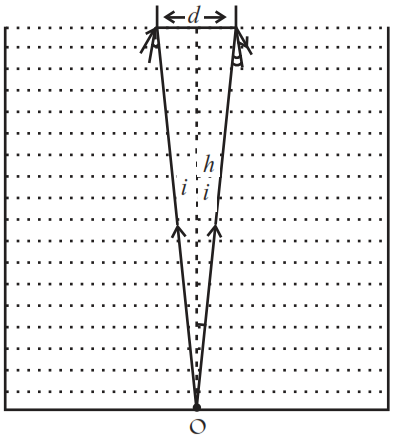
- 7View SolutionA jar of height h is filled with a transparent liquid of refractive index μ (Fig). At the centre of the jar on the bottom surface is a dot. Find the minimum diameter of a disc, such that when placed on the top surface symmetrically about the centre, the dot is invisible.
- 8View SolutionA double convex lens has focal length 25cm. The radius of curvature of one of the surfaces is double of the other. Find the radii, if the refractive index of the material of the lens is 1.5.
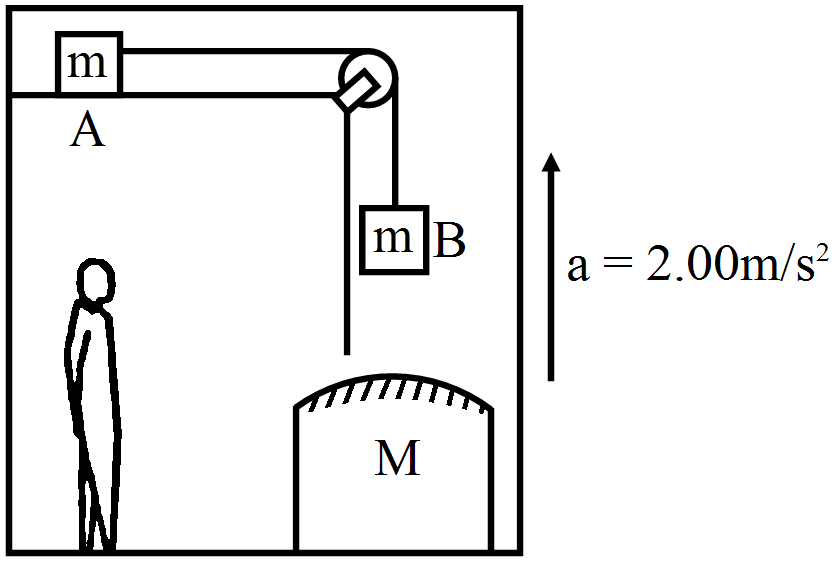
- 9Consider the situation shown in figure. The elevator is going up with an acceleration of $2.00m/s^2$ and the focal length of the mirror is 12.0cm. All the surfaces are smooth and the pulley is light. The mass-pulley system is released from rest (with respect to the elevator) at t = 0 when the distance of B from the mirror is 42.0cm. Find the distance between the image of the block B and the mirror at $t = 0.200s$. Take $g = 10m/s^2$.View Solution
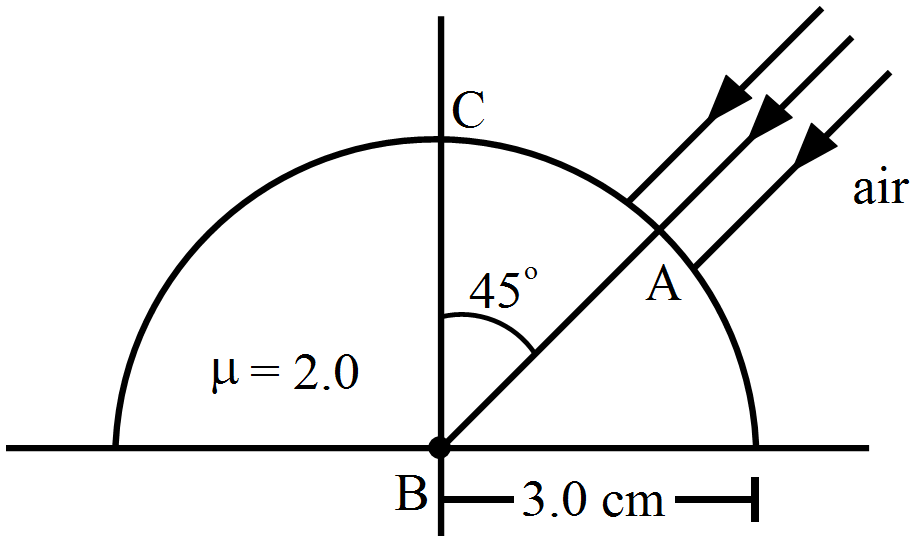
- 10View SolutionFigure shows a transparent hemisphere of radius 3.0cm made of a material of refractive index 2.0.
- A narrow beam of parallel rays is incident on the hemisphere as shown in the figure. Are the rays totally reflected at the plane surface?
- Find the image formed by the refraction at the first surface.
- Find the image formed by the reflection or by the refraction at the plane surface.
- Trace qualitatively the final rays as they come out of the hemisphere.