Question
A solid sphere rolling on a rough horizontal surface with a linear speed v collides elastically with a fixed, smooth, vertical wall. Find the speed of the sphere after it has started pure rolling in the backward direction.
Answer


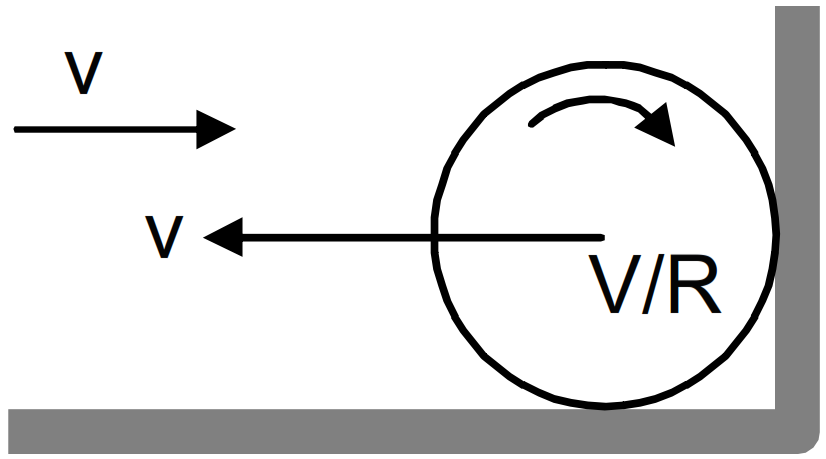
When the solid sphere collides with the wall, it rebounds with velocity ‘v’ towards left but it continues to rotate in the clockwise direction.

So, the angular momentum $=\text{mvR}-\Big(\frac{2}{5}\Big)\text{mR}^2\times\frac{\text{v}}{\text{R}}$

After rebounding, when pure rolling starts let the velocity be v' and the corresponding angular velocity is $\frac{\text{v}'}{\text{R}}$

Therefore angular momentum $=\text{mv}'\text{R}+\Big(\frac{2}{5}\Big)\text{mR}^2\Big(\frac{\text{v}'}{\text{R}}\Big)$

So, $\text{mvR}-\Big(\frac{2}5{}\Big)\text{mR}^2,\ \frac{\text{v}}{\text{R}}=\text{mvR}+\Big(\frac{2}{5}\Big)\text{mR}^2\Big(\frac{\text{v}'}{\text{R}}\Big)$

$\text{mvR}\times\Big(\frac{3}{5}\Big)=\text{mvR}\times\Big(\frac{7}{5}\Big)$

So, the sphere will move with velocity $\frac{\text{3v}}{7}.$

Need a full question paper?

Generate a complete, print-ready paper with questions like this in minutes — across 16+ boards, with answer keys.

Start Generating Free

Similar questions

A particle of mass m moves on a straight line with its velocity varying with the distance travelled according to the equation $\text{v}=\text{a}\sqrt{\text{x}},$ where a is a constant. Find the total work done by all the forces during a displacement from x = 0 to x = d.
If several forces act on a particle, the total torque on the particle may be obtained by first finding the resultant force and then taking torque of this resultant. Prove this. Is this result valid for the forces acting on different particles of a body in such a way that their lines of action intersect at a common point?
A person looks at different trees in an open space with the following details. Arrange the trees in decreasing order of their apparent sizes.
Tree Height(m) Distance form the eye(m)
A 2.8 50
B 2.5 80
C 1.8 70
D 2.8 100
A rope of negligible mass is wound round a hollow cylinder of mass 3 kg and radius 40 cm. What is the angular acceleration of the cylinder if the rope is pulled with a force of 30 N? What is the linear acceleration
of the rope? Assume that there is no slipping.
A monkey of mass 40 kg climbs on a rope which can stand a maximum tension 600 N . In which of the following cases will the rope break?
The monkey
a. climbs up with an acceleration of $6 m / s ^2$
b. climbs down with an acceleration of $4 m / s ^2$
c. climbs up with a uniform speed of $5 m / s$
d. falls down the rope freely under gravity. Take $g=10 m / s ^2$ and ignore the mass of the rope.
A bulb rated 60W at 220V is connected across a household supply of alternating voltage of 220V. Calculate the maximum instantaneous current through the filament.
If a car having speed $50 km / h$ can round the curve banked at an angle $\theta$. Find out the value of $\theta$, if radius of the curve is 40 m and consider the friction is negligible, $\left[\tan ^{-1}(0.5)=26.5\right]$
A particle starts rotating from rest and displaces according to the formula.
$\theta=\frac{3\text{t}^3}{20}-\frac{\text{t}^2}{3}$
Calculate the angular velocity and angular acceleration at the end of 5sec.
A small spherical ball is released from a point at a height h on a rough track shown in figure. Assuming that it does not slip anywhere, find its linear speed when it rolls on the horizontal part of the track.

Give the magnitude and direction of the net force acting on a stone of mass 0.1 kg ,
a. just after it is dropped from the window of a stationary train,
b. just after it is dropped from the window of a train running at a constant velocity of $36 km / h$.
c. just after it is dropped from the window of a train accelerating with $1 ms^{-2}$,
d. lying on the floor of a train which is accelerating with $1 ms^{-2}$, the stone being at rest relative to the train.
Neglect air resistance throughout.