Question
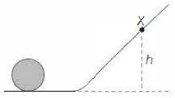
A solid sphere rolls without slipping, first horizontally and then up to a point $X$ at height $h$ on an inclined plane before rolling down, as shown in the figure below. The initial horizontal speed of the sphere is
Answer

(a)

Let initial horizontal speed of sphere is $v$.

Then, total kinetic energy of sphere on horizontal part

$=( KE )_{\text {translation }}+( KE )_{\text {rotation }}$

$=\frac{1}{2} m v^2+\frac{1}{2} I \omega^2$

$=\frac{1}{2} m v^2+\frac{1}{2} \times \frac{2}{5} m R^2 \times \frac{v^2}{R^2}=\frac{7}{10} m v^2$

If sphere rises upto height $h$ then, by conservation of energy, we have

$m g h=\frac{7}{10} m v^2$

$\text { or } \quad v=\sqrt{\frac{10}{7} g h}$

Need a full question paper?

Generate a complete, print-ready paper with questions like this in minutes — across 16+ boards, with answer keys.
Start Generating Free

Similar questions

A thin uniform stick of length $l$ and mass $m$ is held horizontally with its end $B$ hinged on the edge of a table. Point $A$ is suddenly released. The acceleration of the centre of mass of the stick at the time of release, is
A machine gun of mass $10\,kg$ fires $20\,g$ bullets at the rate of $180$ bullets per minute with a speed of $100\,m s ^{-1}$ each. The recoil velocity of the gun is $.............\,m/s$
A solenoid of length $0.5 \mathrm{~m}$ has a radius of $1 \mathrm{~cm}$ and is made up of ' $m$ ' number of turns. It carries a current of $5 \mathrm{~A}$. If the magnitude of the magnetic field inside the solenoid is $6.28 \times 10^{-3} \mathrm{~T}$, then the value of $m$ is :
$A$ particle of mass $0.5\, kg$ is rotating in a circular path of radius $2m$ and centrepetal force on it is $9$ Newtons. Its angular momentum (in $J·sec$) is:
A small body slips, subject to the force of friction, from point $A$ to point $B$ along two curved surfaces of equal radius, first along route $1,$ then along route $2$. Friction does not depend on the speed and the coefficient of friction on both routes is the same. In which case will the body’s speed at $B$ be greater?
In a hydrogen like atom, when an electron jumps from the $M -$ shell to the $L-$ shell the wavelength of emitted radiation is $\lambda $. If an electron jumps from $N-$ shell to the $L-$ shell the wavelength of emitted radiation will be
$Assertion :$ In pressure-temperature $(P-T)$ phase diagram of water, the slope of the melting curve is found to be negative.
$Reason :$ Ice contracts on melting to water.
Assertion : An electric motor will have maximum efficiency when back $emf$ becomes equal to half of applied $emf$ .

Reason : Efficiency of electric motor depends only on magnitude of back $emf$ .

Currents of a $10\, ampere$ and $2\, ampere$ are passed through two parallel thin wires $A$ and $B$ respectively in opposite directions. Wire $A$ is infinitely long and the length of the wire $B$ is $2\, m$. The force acting on the conductor $B$, which is situated at $10\, cm$ distance from $A$ will be
For a gas, the $r.m.s.$ speed at $800\, K$ is