Question
Assertion : An electric motor will have maximum efficiency when back $emf$ becomes equal to half of applied $emf$ .

Reason : Efficiency of electric motor depends only on magnitude of back $emf$ .

Answer

Efficiency of an electric motor is maximum when the back $emf$ setup in the armature is half the value of the applied battery $emf$

Efficiency, $\eta \, = \,\frac{{{P_{out}}}}{{{P_{in}}}} = \frac{e}{E} = \frac{{{\text{Back emf}}}}{{{\text{Supply voltage}}}}$

Need a full question paper?

Generate a complete, print-ready paper with questions like this in minutes — across 16+ boards, with answer keys.
Start Generating Free

Similar questions

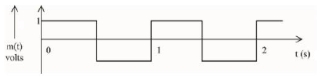
A modulating signal is a square wave, as shown in the figure.
If the carrier wave is given as $c ( t )=2 \sin (8 \pi t )$ volts, the modulation index is:
If two streams of protons move parallel to each other in the same direction, then they
Energy is being emitted from the surface of a black body at ${127^o}C$ temperature at the rate of $1.0 \times {10^6}J/\sec - {m^2}$. Temperature of the black body at which the rate of energy emission is $16.0 \times {10^6}J/\sec - {m^2}$ will be......... $^oC$
The height of a mercury barometer is $ 75 cm$ at sea level and $ 50 cm$  at the top of a hill. Ratio of density of mercury to that of air is $10^4$. The height of the hill is ....... $km$
A source of light emits a continuous stream of light energy which falls on a given area. Luminous intensity is defined as
At absolute zero temperature, pressure of a gas will be
The impedance of coaxial cable, when its inductance is $0.40 \mu H$ and capacitance is $1 \times 10^{-11} F$, can be
Light of wavelength $1824 Å$, incident on the surface of a metal, produces photo-electrons with maximum energy $5.3 eV.$ When light of wavelength $1216 Å$ is used, the maximum energy of photoelectrons is $8.7 eV$. The work function of the metal surface is .............. $eV$
The unit of permittivity of free space ${\varepsilon _0}$ is
A travelling wave is partly reflected and partly transmitted from a rigid boundary. Let $a_i, a_r$ and $a_t$ be the amplitude of incident wave, reflected wave and transmitted wave and $I_i, I_r$ and $I_t$ be the corresponding intensities. Then choose the correct alternatives