MCQ
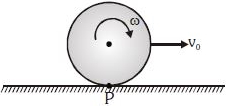
A solid sphere rolls without slipping on a rough surface and the centre of mass has a  constant speed $v_0$. If the mass of the sphere is $m$ and its radius is $R$, then find  the angular momentum of the sphere about the point of contact
  • A
    $\frac{3}{5}\,Mv_0R$
  • B
    $\frac{4}{5}\,Mv_0R$
  • $\frac{7}{5}\,Mv_0R$
  • D
    $\frac{7}{2}\,Mv_0R$

Answer

Correct option: C.
$\frac{7}{5}\,Mv_0R$
c
$\therefore \quad \overrightarrow{\mathrm{L}}_{\mathrm{P}}=\overrightarrow{\mathrm{L}}_{\mathrm{cm}}+\overrightarrow{\mathrm{r}} \times \overrightarrow{\mathrm{p}}_{\mathrm{cm}}=1_{\mathrm{cm}} \vec{\omega}+\overrightarrow{\mathrm{R}} \times \mathrm{m} \vec{v}_{\mathrm{cm}}$

here $v_{\mathrm{cm}}=v_0$

since sphere is in pure rolling motion hence $\omega=\mathrm{v}_{0} / \mathrm{R}$

$\Rightarrow \vec{\mathrm{L}}_{\mathrm{p}}=\left(\frac{2}{5} \mathrm{MR}^{2} \frac{\mathrm{v}_{0}}{\mathrm{R}}\right)(-\hat{\mathrm{k}})+\mathrm{M} \mathrm{v}_{\mathrm{o}} \mathrm{R}(-\hat{\mathrm{k}})$

$=\frac{7}{5} \mathrm{Mv}_{0} \mathrm{R}(-\hat{\mathrm{k}})$

Need a full question paper?

Generate a complete, print-ready paper with questions like this in minutes — across 16+ boards, with answer keys.

Start Generating Free

Similar questions

A shell of mass $m$ moving with velocity $ v$ suddenly breaks into $2$ pieces. The part having mass $m/4$ remains stationary. The velocity of the other shell will be
Sound travels in a mixture of two moles of helium and n moles of hydrogen. If rms speed of gas molecules in the mixture is $\sqrt{2}$ times the speed of sound, then the value of $n$ will be
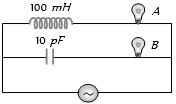
If $A$ and $B$ are identical bulbs which bulbs glows brighter
A ring, a solid sphere and a thin disc of different masses rotate with the same kinetic energy. Equal torques are applied to stop them. Which will make the least number of rotations before coming to rest
Two identical charged spheres are suspended by strings of equal lengths. The strings make an angle of $30^o$ with each other. When suspended in a liquid of density $1\, g\, cm^{-3}$, the angle remains the same. If density of the material of the sphere is $4/3\, g\, cm^{-3}$, the dielectric constant of the liquid is
In finding out refractive index of glass slab the following observations were made through travelling microscope $50$ vernier scale division $=$ $49 \mathrm{MSD} ; 20$ divisions on main scale in each $\mathrm{cm}$ For mark on paper

$\mathrm{MSR}=8.45 \mathrm{~cm}, \mathrm{VC}=26$

For mark on paper seen through slab

$\mathrm{MSR}=7.12 \mathrm{~cm}, \mathrm{VC}=41$

For powder particle on the top surface of the glass slab

$\mathrm{MSR}=4.05 \mathrm{~cm}, \mathrm{VC}=1$

$(\mathrm{MSR}=$ Main Scale Reading, $\mathrm{VC}=$ Vernier Coincidence)

Refractive index of the glass slab is:

Three waves of equal frequency having amplitudes $10\mu m,$ $4\mu m,$ $7\mu m$ arrive at a given point with successive phase difference of $\frac{\pi }{2},$ the amplitude of the resulting wave in $\mu m$ is given by
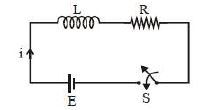
Consider the $LR$ circuit shown in the figure. If the switch $S$ is closed at $t = 0$ then the amount of charge that passes through the battery between $t = 0$ and $t = \frac{L}{R}$ is
A particle executes $S.H.M.$ of amplitude A along $x$-axis. At $t =0$, the position of the particle is $x=\frac{A}{2}$ and it moves along positive $x$-axis the displacement of particle in time $t$ is $x=A \sin (\omega t+\delta)$, then the value $\delta$ will be
If the acceleration due to gravity is $10\,m{s^{ - 2}}$ and the units of length and time are changed in kilometer and hour respectively, the numerical value of the acceleration is