MCQ
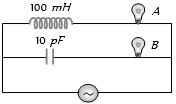
If $A$ and $B$ are identical bulbs which bulbs glows brighter
  • $A$
  • B
    $B$
  • C
    Both equally bright
  • D
    Cannot say

Answer

Correct option: A.
$A$
a
(a) $\because$  $(X_C) >> (X_L)$

Need a full question paper?

Generate a complete, print-ready paper with questions like this in minutes — across 16+ boards, with answer keys.

Start Generating Free

Similar questions

A solid cylinder of density $\rho_0$, cross-section area $A$ and length $l$ floats in a  liquid $\rho(> \rho_0)$ with its axis vertical, as shown. If it is slightly displaced downward  and released, the time period will be 
Two particles undergo $SHM$ along parallel lines with the same time period $(T)$ and equal amplitudes. At a particular instant, one particle is at its extreme position while the other is at its mean position. They move in the same direction. They will cross each other after a further time
Dispersion can take place for
The ratio of kinetic energy of a planet at perigee and apogee during its motion around the sun in elliptical orbit of eccentricity $e$ is ..........
A liquid film is formed in a loop of area $0.05$ $m^2$. Increase in its potential energy will be ($T = 0.2\, N/m$)
If $n$ drops, each of capacitance $C$, coalesce to form a single big drop, then the ratio of the energy stored in the big drop to that in each small drop will be
What is the time taken (in seconds) to cross a glass of thickness $4 mm$ and $\mu = 3$ by light
A steel rod of length $\ell$, cross sectional area $A$, young's modulus of elasticity $Y$, and thermal coefficient of linear expansion $'a'$ is heated so that its temperature increases by $t\,^oC$. Work that can be done by rod on heating will be
A charged particle of charge $Q $ is held fixed and another charged particle of mass $m$ and charge $q$ (of the same sign) is released from a distance $r.$ The impulse of the force exerted by the external agent on the fixed charge by the time distance between $Q$ and $q$ becomes $2r$ is
A particle of mass $m$ moves in a one-dimensional potential energy $U(x) = -ax^2 + bx^4,$ where $'a'$ and $'b'$ are positive constants. The angular frequency of small oscillations about the minima of the potential energy is equal to