Question
A solid that transmits light in visible region and has a very low melting point possesses

Answer

A solid that transmits light in visible region and has a very low melting point possess Vander Waal's bonding.

Need a full question paper?

Generate a complete, print-ready paper with questions like this in minutes — across 16+ boards, with answer keys.

Start Generating Free

Similar questions

Standing waves are generated on a sonometer string loaded with a cylindrical body. If the cylinder is completely immersed in water, the length of the loops changes by a factor of $2.2$ . The specific gravity of the material of the cylinder is 
A vertical spring with force constant $k$ is fixed on a table. A ball of mass $m$ at a height $h$ above the free upper end of the spring falls vertically on the spring so that the spring is compressed by a distance $d.$ The net work done in the process is
Two satellites $A$ and $B$ having masses in the ratio $4: 3$ are revolving in circular orbits of radii $3\,r$ and $4\,r$ respectively around the earth. The ratio of total mechanical energy of $A$ to $B$ is.
The angular momentum of a particle performing uniform circular motion is $L$. If the kinetic energy of partical is doubled and frequency is halved, then angular momentum becomes
One Tesla is equal to
A circular road of radius $1000 \,m$ has banking angle ${45^o}$. The maximum safe speed of a car having mass $2000 \,kg$ will be, if the coefficient of friction between tyre and road is $0.5$ ....... $m/s$
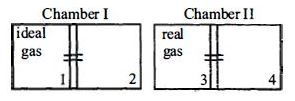
There are two identical chambers, completely thermally insulated from surroundings. Both chambers have a partition wall dividing the chambers in two compartments. Compartment $1$ is filled with an ideal gas and Compartment $3$ is filled with a real gas. Compartments $2$ and $4$ are vacuum . A small hole (orifice) is made in the partition walls and the gases are allowed to expand in vacuum

Statement $-1$ : No change in the temperature of the gas takes place when ideal gas expands in vacuum. However, the temperature of real gas goes down (cooling) when it expands in vacuum

Statement $-2$ : The internal energy of an ideal gas is only kinetic. The internal energy of a real gas is kinetic as well as potential
The resultant of two vectors $\overrightarrow P $ and $\overrightarrow Q $ is $\overrightarrow R .$ If $Q$ is doubled, the new resultant is perpendicular to $P$. Then $R $ equals
A shell is fired from a fixed artillery gun with an initial speed $u$ such that it hits the target on the ground at a distance $R$ from it. If $t_1$ and $t_2$ are the values of the time taken by it to hit the target in two possible ways, the product $t_1t_2$ is
A beam of protons with speed $4 \times 10^{5}\, ms ^{-1}$ enters a uniform magnetic field of $0.3\, T$ at an angle of $60^{\circ}$ to the magnetic field. The pitch of the resulting helical path of protons is close to....$cm$

(Mass of the proton $=1.67 \times 10^{-27}\, kg$, charge of the proton $=1.69 \times 10^{-19}\,C$)