MCQ
A solid that transmits light in visible region and has a very low melting point possesses
  • A
    Metallic bonding
  • B
    Ionic bonding
  • C
    Covalent bonding
  • Vander Waal’s bonding

Answer

Correct option: D.
Vander Waal’s bonding
d
A solid that transmits light in visible region and has a very low melting point possess Vander Waal's bonding.

Need a full question paper?

Generate a complete, print-ready paper with questions like this in minutes — across 16+ boards, with answer keys.
Start Generating Free

Similar questions

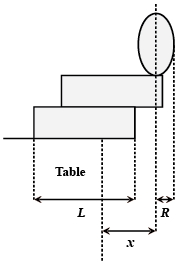
Two identical uniform rectangular blocks (with longest side $L$ ) and a solid sphere of radius $R$ are to be balanced at the edge of a heavy table such that the centre of the sphere remains at the maximum possible horizontal distance from the vertical edge of the table without toppling as indicated in the figure. If the mass of each block is $M$ and of the sphere is $M / 2$, then the maximum distance $x$ that can be achieved is
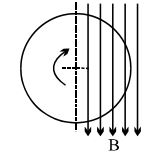
A thin non conducting disc of radius $R$ is rotating clockwise (see figure) with an angular velocity $w$ about its central axis, which is perpendicular to its plane. Both its surfaces carry $+ve$ charges of uniform surface density. Half the disc is in a region of a uniform, unidirectional magnetic field $B$ parallel to the plane of the disc, as shown. Then,
From a uniform wire, two circular loops are made $(i)$ $P$ of radius $r$ and $(ii)$ $Q$ of radius $nr$.  If the moment of inertia of $Q$ about an axis passing through its centre and perpendicular to its plane is $8$ times that of $P$ about a similar axis, the value of $n$ is (diameter of the wire is very much smaller than $r$ or $nr$) 
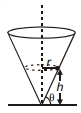
A particle describes a horizontal circle of radius $r$ on the smooth surface of an inverted cone as shown. The height of plane of circle above vertex is $h$. The speed of particle should be
If earth has a mass nine times and radius twice to the of a planet $P$. Then $\frac{v_e}{3} \sqrt{x}\; ms ^{-1}$ will be the minimum velocity required by a rocket to pull out of gravitational force of $P$, where $v_e$ is escape velocity on earth. The value of $x$ is
Water of volume $2$ litre in a container is heated with a coil of $1\,kW$ at $27\,^\circ C$. The lid of the container is open and energy dissipates at rate of $160\,J/s.$ In how much time temperature will rise from $27\,^\circ C$ to $77\,^\circ C$ [Given specific heat of water is $4.2\,kJ/kg$]
A particle of mass $5 \;\mathrm{m}$ at rest suddenly breaks on its own into three fragments. Two fragments of mass $m$ each move along mutually perpendicetion with speed $v$ each. The energy released during the process is
A beaker full of hot water is kept in a room. If it cools from $80^{\circ} C$ to $75^{\circ} C$ in $t_1$, minutes, from $75^{\circ} C$ to $70^{\circ} C$ in $t_2$ minutes and from $70^{\circ} C$ to $65^{\circ} C$ in $t_3$ minutes, then
Inside a uniform spherical shell

$(a)$ the gravitational field is zero

$(b)$ the gravitational potential is zero

$(c)$ the gravitational field is same everywhere

$(d)$ the gravitation potential is same everywhere

$(e)$ all of the above

Choose the most appropriate answer from the options given below
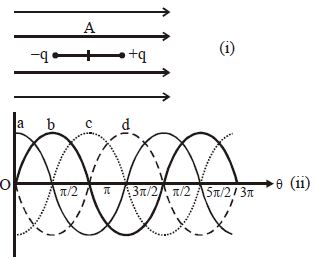
The electric dipole is situated in an electric field as shown in figure. The dipole and electric field vare both in the plane of paper. The dipole is rotated about an axis perpendicular to the paper at point $A$ in anticlockwise direction. If the angle of rotation is measured with respect to the direction of the electric field then the torque for different values of the angle of rotation $\theta $ will be as represented in Fig. $(ii)$