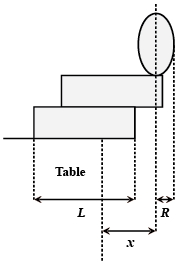
For system to be in equilibrium without toppling, following conditions must be fulfilled.
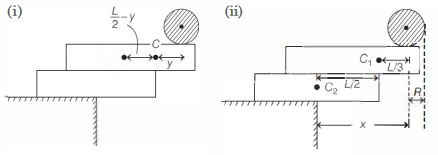
$(i)$ Centre of mass $C_1$ of sphere and upper block must lie inside the edge of lower block.
Taking origin of axes choosen at $C$, we have
$\frac{M}{2} \times y=M\left(\frac{L}{2}-y\right)$
$\Rightarrow \frac{y}{2}+y=\frac{L}{2} \text { or } y=\frac{L}{3}$
$(ii)$ Centre of mass of both of block and sphere must lie inside the edge of table.
So, again taking centre of mass $C_2$ as origin,
$\frac{3 M}{2}\left(x-\frac{L}{3}\right)+M\left(x-\frac{L}{3}-\frac{L}{2}\right)=0$
$\Rightarrow \frac{3 x}{2}-\frac{L}{2}+x-\frac{L}{3}-\frac{L}{2}=0$
$\Rightarrow \frac{5 x}{2}=\frac{4 L}{3}$
$\Rightarrow x =\frac{8 L}{15}$
Generate a complete, print-ready paper with questions like this in minutes — across 16+ boards, with answer keys.
${y}=1.0\, {mm} \cos \left(1.57 \,{cm}^{-1}\right) {x} \sin \left(78.5\, {s}^{-1}\right) {t}$
The node closest to the origin in the region ${x}>0$ will be at ${x}=\ldots \ldots \ldots\, {cm}$
$(A)$ decreasing the number of turns
$(B)$ increasing the magnetic field
$(C)$ decreasing the area of the coil
$(D)$ decreasing the torsional constant of the spring
Choose the most appropriate answer from the options given below.