MCQ
A sonometer wire of resonating length $90 \mathrm{~cm}$ has a fundamental frequency of $400 \mathrm{~Hz}$ when kept under some tension. The resonating length of the wire with fundamental frequency of $600 \mathrm{~Hz}$ under same tension________.$\mathrm{cm}$.
  • A
    $30$
  • B
    $40$
  • C
    $50$
  • $60$

Answer

Correct option: D.
$60$
d
$\mathrm{f}_0=400 \mathrm{~Hz} ; \mathrm{v}=\sqrt{\frac{\mathrm{T}}{\mu}}=\text { constant }$

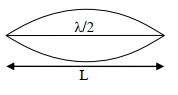
$\frac{\lambda}{2}=\mathrm{L} ; \mathrm{v}=\mathrm{f}_0 \lambda$

$\frac{\mathrm{v}}{2 \mathrm{f}_0}=\mathrm{L} \Rightarrow \mathrm{v}=2 \mathrm{Lf}_0$

$\mathrm{~L}^{\prime}=\frac{\mathrm{v}}{2 \mathrm{f}^{\prime}}=\frac{2 \mathrm{Lf}_0}{2 \mathrm{f}^{\prime}}$

$=\frac{L f_0}{\mathrm{f}^{\prime}}=\frac{90 \times 400}{600}=60$

Need a full question paper?

Generate a complete, print-ready paper with questions like this in minutes — across 16+ boards, with answer keys.

Start Generating Free

Similar questions

A reference frame attached to earth cannot be an inertial frame because
A particle moves along a straight line in such a way that it’s acceleration is increasing at the rate of $2 m/s^3$. It’s initial acceleration and velocity were $0,$ the distance covered by it in $t = 3$ second is  ........ $m$
A satellite of mass $\mathrm{m}$ is launched vertically upwards with an initial speed $u$ from the surface of the earth. After it reaches height $\mathrm{R}$ ($R =$ radius of the earth), it ejects a rocket of mass $\frac{\mathrm{m}}{10}$ so that subsequently the satellite moves in a circular orbit. The kinetic energy of the rocket is

($G$ is the gravitational constant: $\mathrm{M}$ is the mass of the earth)

The coordinates of a moving particle at any time $t$ are given by $x = a\, t^2$ and $y = b\, t^2$. The speed of the particle is
Two forces of $12 \,N$ and $8 \,N$ act upon a body. The resultant force on the body has maximum value of........$N$
A block of mass $5$ kg lies on a rough horizontal table. A force of $19.6\, N$ is enough to keep the body sliding at uniform velocity. The coefficient of sliding friction is
A body starts from rest with uniform acceleration $a,$  its velocity after $n\,seconds$ is $v$. The displacement of the body in last $3\,s$ is : (assume total time of journey from $0$ to $n\,seconds$ )
A sample of metal weighs $210 gm$  in air, $180 gm$  in water and $120 gm$  in liquid. Then relative density $(RD) $ of
Two discs of same thickness but of different radii are made of two different materials such that their masses are same. The densities of the materials are in the ratio $1 : 3$.  The moments of inertia of these discs about the respective axes passing through their centres and perpendicular to their planes will be in the ratio 
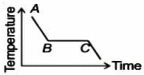
The portion $A B$ of the curve representing the state of matter denotes