MCQ
A sound is produced by plucking a string in a musical instrument, then
  • A
    The velocity of wave in the string is equal to the velocity of sound in the string
  • The frequency of the wave in the string is equal to the frequency of the sound produced
  • C
    The wave in the string is progressive
  • D
    the tension in the string varies from point to point
Answer

Correct option: B.
The frequency of the wave in the string is equal to the frequency of the sound produced
b
Frequency of the wave is the property which depends on source.

Need a full question paper?

Generate a complete, print-ready paper with questions like this in minutes — across 16+ boards, with answer keys.

Start Generating Free

Similar questions

When a capillary is dipped in water, water rises to a height $h$. If the length of the capillary is made less than $h$, then
A metal ball immersed in alcohol weighs ${W_1}$ at $0°C$ and ${W_2}$ at $59°C.$ The coefficient of cubical expansion of the metal is less than that of alcohol. Assuming that the density of metal is large compared to that of alcohol, it can be shown that
This question has Statement $1$ and Statement $2.$ Of the four choices given after the Statements, choose the one that best describes the two Statements.

Statement $1 :$ An inventor claims to have constructed an engine that has an efficiency of $30\%$ when operated between the boiling and freezing points of water. This is not possible.

Statement $2:$ The efficiency of a real engine is always less than the efficiency of a Carnot engine operating between the same two temperatures.

Vectors $a \hat{i}+b \hat{j}+\hat{k}$ and $2 \hat{i}-3 \hat{j}+4 \hat{k}$ are perpendicular to each other when $3 a+2 b=7$, the ratio of a to $b$ is $\frac{x}{2}$. The value of $x$ is $..............$
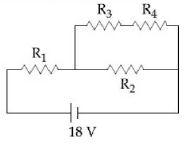
In the given circuit the internal resistance of the $18\,V$ cell is negligible. If $R_1 = 400 \,\Omega ,\,R_3 = 100\,\Omega $ and $R_4 = 500\,\Omega $ and the reading of an ideal voltmeter across $R_4$ is $5\,V,$ then the value of $R_2$ will be ........... $\Omega$
A current is flowing through a thin cylindrical shell of radius $R$. If energy density in the medium, due to magnetic field, at a distance $r$ from axis of the shell is equal to $U$ then which of the following graphs is correct
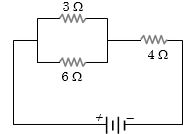
In the figure, current through the $3\,\Omega $ resistor is $0.8\, ampere$, then potential drop through $4\,\Omega $ resistor is ........... $V$
If $\overrightarrow {\rm A} = 2\hat i + 3\hat j - \hat k$ and $\overrightarrow B = - \hat i + 3\hat j + 4\hat k$ then projection of $\overrightarrow A $ on $\overrightarrow B $ will be
A block '$A$' takes $2\,s$ to slide down a frictionless incline of $30^{\circ}$ and length ' $l$ ', kept inside a lift going up with uniform velocity ' $v$ '. If the incline is changed to $45^{\circ}$, the time taken by the block, to slide down the incline, will be approximately $........\,s$
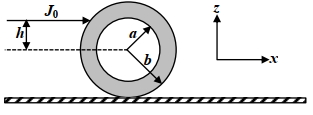
An annular disk of mass $M$, inner radius $a$ and outer radius $b$ is placed on a horizontal surface with coefficient of friction $\mu$, as shown in the figure. At some time, an impulse $J_0 \hat{x}$ is applied at a height $\mathrm{h}$ above the center of the disk. If $h=h_m$ then the disk rolls without slipping along the $x$-axis. Which of the following statement(s) is(are) correct?

(image)

($A$) For $\mu \neq 0$ and $a \rightarrow 0, h_m=b / 2$

($B$) For $\mu \neq 0$ and $a \rightarrow b, h_m=b$

($C$) For $h=h_m$, the initial angular velocity does not depend on the inner radius $a$.

($D$) For $\mu=0$ and $h=0$, the wheel always slides without rolling.