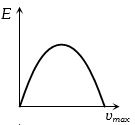
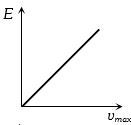
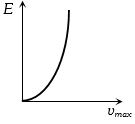
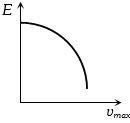
A sound source emits sound waves in a uniform medium. If energy density is $E$ and maximum speed of the particles of the medium is ${v_{\max }}.$The plot between $E$ and ${v_{\max }}$ is best represented by
A
B
C
D
Medium
Download our app for free and get started
C
c (c)Energy density $(E)$ $ = \frac{I}{v} = 2{\pi ^2}\rho {n^2}{A^2}$
${v_{\max }} = \omega A = 2\pi nA$==> $E \propto {({v_{\max }})^2}$
i.e., graph between $E$ and ${v_{\max }}$ will be a parabola symmetrical about $E$ axis.
Download our app
and get started for free
Experience the future of education. Simply download our apps or reach out to us for more information. Let's shape the future of learning together!No signup needed.*
A tuning fork vibrating with a sonometer having a wire of length $20 \,cm$ produces $5$ beats per second. The beats frequency does not change if the length of the wire is changed to $21 \,cm$. The frequency of the tuning fork must be ............ $Hz$
A pulse is generated at lower end of a hanging rope of uniform density and length $L$. The speed of the pulse when it reaches the mid point of rope is ......
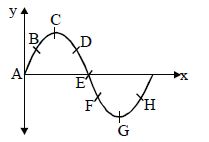
The figure represents the instantaneous picture of a transverse harmonic wave traveling along the negative $x$-axis. Choose the correct alternative $(s)$ related to the movement of the nine points shown in the figure. The points moving with maximum velocity is/are
Two tuning forks have frequencies $450\, Hz$ and $454\, Hz$ respectively. On sounding these forks together, the time interval between successive maximum intensities will be .... $sec$
A metallic wire of length $L$ is fixed between two rigid supports. If the wire is cooled through a temperature difference $\Delta T$ ($Y$ = young’s modulus, $\rho$ = density, $\alpha$ = coefficient of linear expansion) then the frequency of transverse vibration is proportional to :
A source of sound $S$ emitting waves of frequency $100\,\, Hz$ and an observer $O$ are ocated at some distance from each other. The source is moving with a speed of $19 .4\,\, m s^{-1}$ at an angle of $60^o $ with the source observer line as shown in the figure. The observer is at rest. The apparent frequency observed by the observer .... $Hz$ (velocity of sound in air $330 \,\, m s^{-1}$), is
$Assertion :$ Doppler formula for sound wave is symmetric with respect to the speed of source and speed of observer.
$Reason :$ Motion of source with respect to stationary observer is not equivalent to the motion of an observer with respect to stationary source.
On sounding tuning fork $A$ with another tuning fork $B$ of frequency $384 Hz, 6$ beats are produced per second. After loading the prongs of $A$ with some wax and then sounding it again with $B, 4$ beats are produced per second. What is the frequency of the tuning fork $A$ .... $Hz$