The ratio of frequencies of fundamental harmonic produced by an open pipe to that of closed pipe having the same length is
NEET 2023, Easy
Download our app for free and get started
$\frac{n_{\text {oop }}}{ n _{\text {cop }}}=\frac{\frac{ V }{2 L }}{\frac{ V }{4 L }}$
$\Rightarrow \frac{ n _{\text {oop }}}{ n _{\text {cop }}}=\frac{2}{1}$

Download our appand get started for free
Experience the future of education. Simply download our apps or reach out to us for more information. Let's shape the future of learning together!No signup needed.*
Similar Questions
- 1An observer standing at station observes frequency $219 Hz$ when a train approaches and $184 Hz$ when train goes away from him. If velocity of sound in air is $340\, m/s$, then velocity of train and actual frequency of whistle will beView Solution
- 2Fundamental frequency of pipe is $100 Hz$ and other two frequencies are $300 Hz$ and $500 Hz$ thenView Solution
- 3Speed of sound in mercury at a certain temperature is $1450 \,m/s$. Given the density of mercury as $13.6 × 10^3 kg / m^3$, the bulk modulus for mercury isView Solution
- 4The displacement at a point due to two waves are $y_1=4 \sin (500 \pi t)$ and $y_2=2 \sin (506 \pi t)$. The result due to their superposition will beView Solution
- 5The displacement y of a particle in a medium can be expressed as: $y = {10^{ - 6}}\sin (100t + 20x + \pi /4)m,$ where $t$ is in second and $x$ in meter. The speed of wave is ... $m/s$View Solution
- 6When a tuning fork $A$ of unknown frequency is sounded with another tuning fork $B$ of frequency $256 Hz$, then $3$ beats per second are observed. After that $A$ is loaded with wax and sounded, the again $3$ beats per second are observed. The frequency of the tuning fork $A$ is ..... $Hz$View Solution
- 7A wavelength $0.60 cm$ is produced in air and it travels at a speed of $300 ms^{-1}$. It will be anView Solution
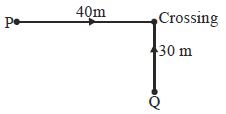
- 8A car $P$ approaching a crossing at a speed of $10\, m/s$ sounds a horn of frequency $700\, Hz$ when $40\, m$ in front of the crossing. Speed of sound in air is $340\, m/s$. Another car $Q$ is at rest on a road which is perpendicular to the road on which car $P$ is reaching the crossing (see figure). The driver of car $Q$ hears the sound of the horn of car $P$ when he is $30\, m$ in front of the crossing. The apparent frequency heard by the driver of car $Q$ is .... $Hz$View Solution
- 9Three waves of equal frequency having amplitudes $10 \,\mu \, m, 4 \, \mu \,m$ and $7 \mu m$ arrive at a given point with successive phase difference of $\frac{\pi }{2}$. The amplitude of the resulting wave in $\mu \,m$ is given byView Solution
- 10What should be the velocity of a sound source moving towards a stationary observer so that apparent frequency is double the actual frequency (Velocity of sound is $v$)View Solution