A sound source is moving towards a stationary observer with $1/10$ of the speed of sound. The ratio of apparent to real frequency is
Medium


Download our appand get started for free
Experience the future of education. Simply download our apps or reach out to us for more information. Let's shape the future of learning together!No signup needed.*
Similar Questions
- 1Consider the three wavesView Solution
${z_1},{z_2}$ and ${z_3}$ as${z_1} = A\sin (kx - \omega \,t)$, ${z_2} = A\sin (kx + \omega \,t)$ and ${z_3} = A\sin (ky - \omega \,t)$.
Which of the following represents a standing wave
- 2If $v$ is the speed of sound in air then the shortest length of the closed pipe which resonates to a frequency $n$View Solution
- 3View SolutionTwo wires are producing fundamental notes of the same frequency. Change in which of the following factors of one wire will not produce beats between them
- 4View SolutionIf the initial tension on a stretched string is doubled, then the ratio of the initial and final speeds of a transverse wave along the string is :
- 5A plane wave $y=A\,\, sin\,\, \omega \left( {t - \frac{x}{v}} \right)$ undergo a normal incidence on a plane boundary separating medium $M_1$ and $M_2$ and splits into a reflected and transmitted wave having speeds $v_1$ and $v_2$ thenView Solution
- 6View SolutionMechanical waves on the surface of a liquid are
- 7A source of sound $S$ emitting waves of frequency $100\,\, Hz$ and an observer $O$ are ocated at some distance from each other. The source is moving with a speed of $19 .4\,\, m s^{-1}$ at an angle of $60^o $ with the source observer line as shown in the figure. The observer is at rest. The apparent frequency observed by the observer .... $Hz$ (velocity of sound in air $330 \,\, m s^{-1}$), isView Solution
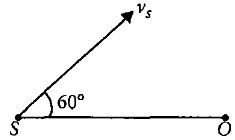
- 8A person speaking normally produces a sound intensity of $40\,dB$ at a distance of $1\,m$. If the threshold intensity for reasonable audibility is $20\,dB,$ the maximum distance at which he can be heard clearly is ... $m$View Solution
- 9Two strings $X$ and $Y$ of a sitar produce a beat frequency $4 Hz$. When the tension of the string $Y$ is slightly increased the beat frequency is found to be $2 Hz.$ If the frequency of $X$ is $300 Hz,$ then the original frequency of $Y$ was .... $Hz$View Solution
- 10View SolutionWhich of the following is not the transverse wave