Tuning fork ${F_1}$ has a frequency of $256 Hz$ and it is observed to produce $6$ beats/second with another tuning fork ${F_2}$. When ${F_2}$ is loaded with wax, it still produces $6$ beats/second with ${F_1}$. The frequency of ${F_2}$ before loading was ..... $Hz$
Medium
Download our app for free and get started
(b) $n_A$ = Known frequency $= 256 Hz, n_B = ?$
$x = 6\, bps$, which remains the same after loading.
Unknown tuning fork $F_2$ is loaded so $n_B\downarrow$
Hence $n_A -n_B\downarrow = x $... $(i)$ $\rightarrow$ Wrong
$n_B\downarrow -n_A = x$ ... $(ii)$ $\rightarrow$ Correct
==> $n-B = n_A + x = 256 + 6 = 262 Hz.$

Download our appand get started for free
Experience the future of education. Simply download our apps or reach out to us for more information. Let's shape the future of learning together!No signup needed.*
Similar Questions
- 1A closed organ pipe of length $L$ and an open organ pipe contain gases of densities ${\rho _1}$ and ${\rho _2}$ respectively. The compressibility of gases are equal in both the pipes. Both the pipes are vibrating in their first overtone with same frequency. The length of the open organ pipe isView Solution
- 2Two vibrating tuning forks produce progressive waves given by ${Y_1} = 4\sin 500\pi t$ and ${Y_2} = 2\sin 506\pi t.$ Number of beats produced per minute isView Solution
- 3Velocity of sound in airView Solution
$I.$ Increases with temperature
$II.$ Decreases with temperature
$III.$ Increase with pressure
$IV.$ Is independent of pressure
$V.$ Is independent of temperature
Choose the correct answer.
- 4If the velocity of sound in air is $336 m/s$. The maximum length of a closed pipe that would produce a just audible sound will beView Solution
- 5$Assertion :$ The change in air pressure affects the speed of sound.View Solution
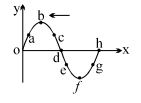
$Reason :$ The speed of sound in gases is proportional to the square of pressure. - 6The figure represents the instantaneous picture of a transverse harmonic wave traveling along the negative $x$-axis. Choose the correct alternative $(s)$ related to the movement of the nine points shown in the figure. The points moving upward is/areView Solution
- 7There are three sources of sound of equal intensity with frequencies $400, 401$ and $402\, vib/sec.$ The number of beats heard per second isView Solution
- 8View SolutionIf we study the vibration of a pipe open at both ends, then the following statement is not true.
- 9A stationary observer receives sound from two identical tuning forks, one of which approaches and the other one recedes with the same speed (much less than the speed of sound). The observer hears $2\; beats/sec$. The oscillation frequency of each tuning fork is $v_{0}=1400 \;\mathrm{Hz}$ and the velocity of sound in air is $350\; \mathrm{m} / \mathrm{s}$. The speed of each tuning fork is close toView Solution
- 10A train moving towards a hill at a speed of $72\ km/hr$ sounds a whistle of frequency $500\ Hz$ . A wind is blowing from the hill at a speed of $36\ km/hr$ . If the speed of sound in air is $340\ m/s$ , the frequency heard by a man on the hill (nearly) is ... $Hz$View Solution