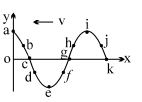
The figure represents the instantaneous picture of a longitudinal harmonic wave travelling along the negative $x$-axis. Identify the correct statement $(s)$ related to the movement of the points shown in the figure. The points of maximum compression are
Medium


Download our appand get started for free
Experience the future of education. Simply download our apps or reach out to us for more information. Let's shape the future of learning together!No signup needed.*
Similar Questions
- 1A string is clamed at both the ends and it is vibrating in its $4^{th}$ harmonic. The equation of the stationary wave is $Y =0.3\,sin\,(0.157\,x) \,cos\,(200\pi t)$. The length of the string is ..... $m$ (all quantities are in $SI$ units)View Solution
- 2The equations of two waves acting in perpendicular directions are given as $x=a \cos (\omega t+\delta)$ and $y=a \cos (\omega t+\alpha)$, where $\delta=\alpha+\frac{\pi}{2}$, the resultant wave representsView Solution
- 3Two identical strings $X$ and $Z$ made of same material have tension $T _{ x }$ and $T _{ z }$ in them. If their fundamental frequencies are $450\, Hz$ and $300\, Hz ,$ respectively, then the ratio $T _{ x } / T _{ z }$ is$.....$View Solution
- 4Source and observer both start moving simultaneously from origin, one along $x-$axis and the other along $y-$axis with speed of source = twice the speed of observer. The graph between the apparent frequency observed by observer $f$ and time $t$ would approximately be :View Solution
- 5When a car is approaching the observer, the frequency of horn is $100 Hz$. After passing the observer, it is $50\,Hz$. If the observer moves with the car, the frequency will be $\frac{ x }{3} Hz$ where $x =.....$View Solution
- 6View SolutionThe waves in which the particles of the medium vibrate in a direction perpendicular to the direction of wave motion is known as
- 7View SolutionOne Mach number is equal to
- 8A string on a musical instrument is $50 cm$ long and its fundamental frequency is $270 Hz$. If the desired frequency of $1000 Hz$ is to be produced, the required length of the string is .... $cm$View Solution
- 9The fundamental note produced by a closed organ pipe is of frequency $f.$ The fundamental note produced by an open organ pipe of same length will be of frequency .... $(f)$View Solution
- 10If in an experiment for determination of velocity of sound by resonance tube method using a tuning fork of $512 Hz$, first resonance was observed at $30.7 cm$ and second was obtained at $63.2 cm$, then maximum possible error in velocity of sound is .....$cm/sec$ (consider actual speed of sound in air is $332 m/s$)View Solution