A source of sound is moving with constant velocity of $20\, m/s$ emitting a note of frequency $1000 \,Hz.$ The ratio of frequencies observed by a stationary observer while the source is approaching him and after it crosses him will be
(Speed of sound $v = 340\, m/s$)
Medium
Download our app for free and get started
(a) When source is approaching the observer, the frequency heard
${n_a} = \left( {\frac{v}{{v - {v_S}}}} \right) \times n = \left( {\frac{{340}}{{340 - 20}}} \right) \times 1000 = 1063Hz$
When source is receding, the frequency heard
${n_r} = \left( {\frac{v}{{v + {v_S}}}} \right) \times n$=$\frac{{340}}{{340 + 20}} \times 1000 = 944$
$ \Rightarrow {n_a}:{n_r} = 9:8$
Short trick : $\frac{{{n_a}}}{{{n_r}}} = \frac{{v + {v_S}}}{{v - {v_S}}} = \frac{{340 + 20}}{{340 - 20}} = \frac{9}{8}.$

Download our appand get started for free
Experience the future of education. Simply download our apps or reach out to us for more information. Let's shape the future of learning together!No signup needed.*
Similar Questions
- 1Three waves of equal frequency having amplitudes $10\mu m,$ $4\mu m,$ $7\mu m$ arrive at a given point with successive phase difference of $\frac{\pi }{2},$ the amplitude of the resulting wave in $\mu m$ is given byView Solution
- 2There is a destructive interference between the two waves of wavelength $\lambda$ coming from two different paths at a point. To get maximum sound or constructive interference at that point, the path of one wave is to be increased byView Solution
- 3In a transverse wave the distance between a crest and neighbouring trough at the same instant is $4.0\, cm$ and the distance between a crest and trough at the same place is $1 .0\, cm$ . The next crest appears at the same place after a time interval of $0.4\,s$. The maximum speed of the vibrating particles in the medium isView Solution
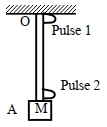
- 4A block $\mathrm{M}$ hangs vertically at the bottom end of a uniform rope of constant mass per unit length. The top end of the rope is attached to a fixed rigid support at $O$. A transverse wave pulse (Pulse $1$ ) of wavelength $\lambda_0$ is produced at point $O$ on the rope. The pulse takes time $T_{O A}$ to reach point $A$. If the wave pulse of wavelength $\lambda_0$ is produced at point $A$ (Pulse $2$) without disturbing the position of $M$ it takes time $T_{A 0}$ to reach point $O$. Which of the following options is/are correct?View Solution
(image)
[$A$] The time $\mathrm{T}_{A 0}=\mathrm{T}_{\mathrm{OA}}$
[$B$] The velocities of the two pulses (Pulse $1$ and Pulse $2$) are the same at the midpoint of rope.
[$C$] The wavelength of Pulse $1$ becomes longer when it reaches point $A$.
[$D$] The velocity of any pulse along the rope is independent of its frequency and wavelength.
- 5The correct graph between the frequency $n$ and square root of density ($\rho$) of a wire, keeping its length, radius and tension constant, isView Solution
- 6Two waves represented by,View Solution
${y_1} = 10\,\sin \,200\pi t$,
${y_2} = 20\,\sin \,\left( {2000\pi t + \frac{\pi }{2}} \right)$
are superimposed at any point at a particular instant. The amplitude of the resultant wave is
- 7If the velocity of sound in air is $350 m/s$. Then the fundamental frequency of an open organ pipe of length $50\,cm,$ will be ............... $\mathrm{Hz}$View Solution
- 8In resonance tube two successive positions of resonance are obtained at $15 \,cm$ and $48 \,cm$. If the frequency of the fork is $500 \,cps$, the velocity of sound is ......... $m / s$View Solution
- 9An open pipe of length $33\, cm$ resonates to a frequency of $1000\,Hz$. The mode of vibration is: (velocity of sound $= 330\, m/s$)View Solution
- 10Equation of a stationary wave is $y = 10\sin \frac{{\pi x}}{4}\cos 20\pi\, t.$ Distance between two consecutive nodes isView Solution