MCQ
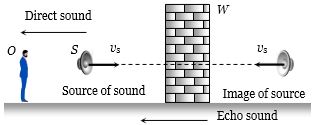
A source of sound $S$ of frequency $500 Hz$ situated between a stationary observer $O$ and a wall $W$, moves towards the wall with a speed of $2 m/s$. If the velocity of sound is $332 m/s$, then the number of beats per second heard by the observer is (approximately)
  • A
    $8$
  • $6$
  • C
    $4$
  • D
    $2$

Answer

Correct option: B.
$6$
b
(b) For direct sound source is moving away from the observes so frequency heard in this case

${n_1} = n\left( {\frac{v}{{v + {v_s}}}} \right) = 500\left( {\frac{{332}}{{332 + 2}}} \right) = 500\left( {\frac{{332}}{{334}}} \right)Hz$

The other sound is echo, reaching the observer from the wall and can be regarded as coming from the image of source formed by reflection at the wall. This image is approaching the observer in the direction of sound.

Hence for reflected sound, frequency heard by the observer is

${n_2} = n\,\left( {\frac{v}{{v - {v_S}}}} \right) = 500\,\left( {\frac{{332}}{{332 - 2}}} \right) = 500\,\left( {\frac{{332}}{{330}}} \right)Hz$

Beats frequency $ = {n_2} - {n_1} = 500 \times 332\left( {\frac{1}{{330}} - \frac{1}{{334}}} \right) = 6.$
Need a full question paper?

Generate a complete, print-ready paper with questions like this in minutes — across 16+ boards, with answer keys.

Start Generating Free

Similar questions

A particle moves in a circular path of radius $R$ with an angular velocity $\omega = a -bt$ where $a$ and $b$ are positive constants and $t$ is time. The magnitude of the acceleration of the particle after time $\frac {2a}{b}$ is
Displacement x , of a body moving in one-dimensional motion depends on time $t$ as follows : $x=a_0+a_1 t+a_2 t^2+a_3 t^3$ where $a_0, a_1, a_2, a_3$ are fixed.
Then the correct statement is :
Two trains are moving towards each other at speeds of $20 m/s$ and $15 m/s$ relative to the ground. The first train sounds a whistle of frequency $600 Hz.$ the frequency of the whistle heard by a passenger in the second train before the train meets is ...... $Hz$ (the speed of sound in air is $340\, m/s$)
Horizontal tube of non-uniform cross-section has radii of  $0.1\,m$ and  $0.05\,m$ respectively at $M$  and  $N.$  For a stream-line flow of liquid the rate of liquid flow is
A man standing on a road hold his umbrella at $30^° $ with the vertical to keep the rain away. He throws the umbrella and starts running at $10\, km/hr$. He finds that raindrops are hitting his head vertically, the speed of raindrops with respect to the road will be......... $km/hr$
One mole of monoatomic gas and three moles of diatomic gas are put together in a container. The molar specific heat (in $J\,{K^{ - 1}}\,mo{l^{ - 1}})$ at constant volume is $(R = 8.3\,J\,{K^{ - 1}}\,mo{l^{ - 1}})$
Huygens' principle of secondary wavelets may be used to:
  1. Find the velocity of light in vacuum.
  2. Explain the particle behaviour of light.
  3. Find the new position of a wavefront.
  4. Explain Snell's law.
A simple pendulum with a bob of mass $‘m’$ oscillates from $A$ to $ C$ and back to $A$ such that $PB$ is $H.$ If the acceleration due to gravity is $‘g’$, then the velocity of the bob as it passes through $B$ is
Body of mass $M$ is much heavier than the other body of mass $m$. The heavier body with speed $v$ collides with the lighter body which was at rest initially elastically. The speed of lighter body after collision is
Vapour is injected at a uniform rate in a closed veseel which was initially evacuated. The pressure in the vessel: