MCQ
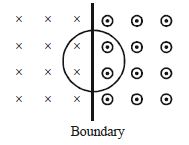
A space consists of two uniform magnetic fields, as shown. A conducting circular loop is placed symmetrically at the boundary 
  • A
    If loop is moved towards right current is initially anticlockwise
  • If loop is moved towards left current is initially anticlockwise
  • C
    If loop is moved towards right current is zero initially only
  • D
    Current will always be zero irrespective of direction of motion and time.
Answer

Correct option: B.
If loop is moved towards left current is initially anticlockwise
b
If loop moves towards right outward flux increases, so according to Faraday's law, current flow will oppose this change & direction of current will be clockwise.
If loop moves towards left then, inward flux increases, so to oppose this change, current direction will be anticlockwise.

Need a full question paper?

Generate a complete, print-ready paper with questions like this in minutes — across 16+ boards, with answer keys.

Start Generating Free

Similar questions

In Young's double slit experiment the $y-$ coordinates of central maxima and $10^{th}$ maxima are $2 \ cm$ and $5 \ cm$ respectively. When the $\text{YDSE}$ apparatus is immersed in a liquid of refractive index $1.5$ the corresponding $y-$ coordinates will be
To maintain a steady current through the conductor, some external device must do work. What does the external device provide?
A hollow metal sphere of radius $5\, cm$ is charged so that the potential on its surface is $10\, V$. The potential at the centre of the sphere is
The region between $y = 0$ and $y = d$ contains a magnetic field $\vec B = B\hat z$ A particle of mass $m$ and charge $q$ enters the region with a velocity $\vec v = v\hat i$. If $d = \frac{{mv}}{{2qB}}$ , the acceleration of the charged particle at the point of its emergence at the other side is
Product of resistivity and conductivity of any conductor depends on:
Microscope is an optical instrument which
$\text{AND}$ gate :
When a piece of aluminium wire of finite length is drawn through a series of dies to reduce its diameter to half its original value, its resistance will become ........ times
Let $K_1$ be the maximum kinetic energy of photoelectrons emitted by a light of wavelength $\lambda_1$ and $K_2$ corresponding to $\lambda_2$. If $\lambda_1$ $= 2\lambda_2$ , then :
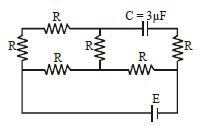
In steady state the potential difference across the capacitor is $10\,\, V.$ Each resistance is of $3\,\Omega $. The cell is ideal. The $emf$ of the cell is .............. $\mathrm{V}$