Questions

5 Marks Questions

Take a timed test

5 questions · self-marked practice — reveal the answer and mark yourself.

Question 15 Marks
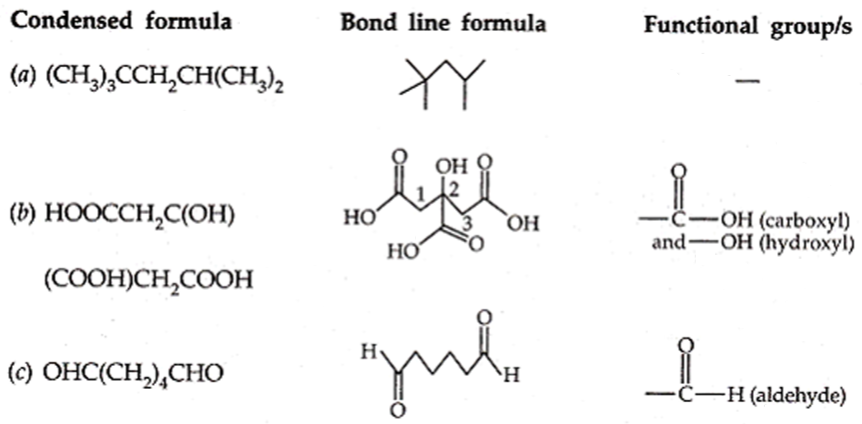
1. Give condensed and bond line structural formulas and identify the functional groups present, if any, for:
a. 2, 2, 4-Trimethylpentane
b. 2-Hydroxy-1, 2, 3-propanetricarboxylic acid
c. Hexanedial?
2. Give three points of differences between inductive effect and resonance effect.
Answer
1.
Image
2.
S.No.Inductive effectResonance effect
1.It involves displacement of σ electrons in saturated compounds.It involves displacement of $\pi$ electrons or lone pair of electrons in unsaturated and conjugated compounds.
2.Inductive effect can move only upto 3 to 4 carbons.In this case, movement of electrons all along the length of conjugated system takes place.
3.In inductive effect, there is slight displacement of $\sigma$ electrons and partial +ve or-ve charge develops.In this effect, there is complete transfer of $\pi$ electrons and as a result, complete +ve or -ve charge develops.
View full question & answer
Question 25 Marks
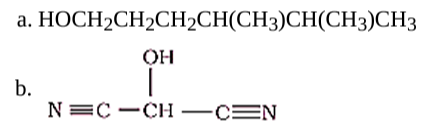
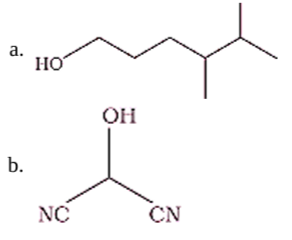
1. For each of the following compounds, write a condensed formula and also their bond-line formula.
Image
2. How does
i. an electron withdrawing group (EWG) and
ii. an electron donating group (EDG) influence the acid strength of carboxylic end?
Answer
1. Condensed formula of the compound:
a. $HO \left( CH _2\right)_3 CH \left( CH _3\right) CH \left( CH _3\right)_2$
b. $HOCH ( CN )$,
Bond-line formula of the compound:
Image
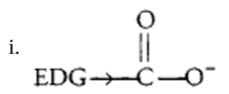
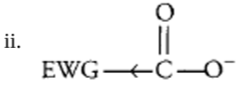
2. The influence of the inductive effect on acidity is best understood in terms of the conjugate base, $RCOO ^{-}$and can be summarised as follows
Image
Electron withdrawing group destabilises $RCOO ^{-}$because there exists a repulsion between electrons from EDG and negative charge of $O$. Hence, EDG weakens the acid.
Image
Electron withdrawing group stabilities $RCOO ^{-}$by taking negative charge from O . Hence, EWG strengthens the acid.
View full question & answer
Question 35 Marks
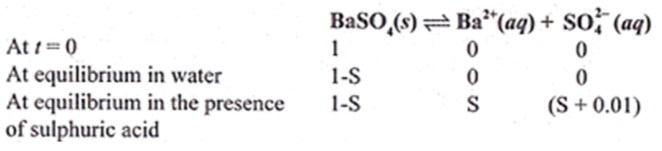
A sparingly soluble salt gets precipitated only when the product of the concentration of its ions in the solution $\left( Q _{ sp }\right)$ becomes greater than its solubility product. If the solubility of $BaSO _4$ in water is $8 \times 10^{-4} mol dm ^{-3}$, calculate its solubility in $0.01 mol dm ^{-3}$ of $H _2 SO _4$.
Answer

Image
Given solubility of $BaSO _4$ is $8 \times 10^{-4} mol dm ^{-3}$.
Therefore, for $BaSO _4$ in water, $K _{ sp }=\left[ Ba ^{2+}\right]\left[ SO _4^{2-}\right]=(S)(S)=S^2$
$
\therefore K_{s p}=\left(8 \times 10^{-4}\right)^2=64 \times 10^{-8} \ldots(1)
$
The expression for solubility product ( $K _{ sp }$ ) in the presence of sulphuric acid will be as follows:
$
K^{\prime} sp=(S)(S+0.01)\ldots(2)
$
Since the value of $K _{ sp }$ will not change in the presence of sulphuric acid.
Therefore, from (1) and (2), we have,
$
\begin{aligned}
& (S)(S+0.01)=64 \times 10^{-8} \\
& S^2+0.01 S=64 \times 10^{-8} \\
& S^2+0.01 S-64 \times 10^{-8}=0
\end{aligned}
$
$\begin{aligned} & \Rightarrow S=\frac{-0.01 \pm \sqrt{(0.01)^2+\left(4 \times 64 \times 10^{-8}\right)}}{2} \\ & \Rightarrow \frac{-0.01 \pm \sqrt{10^{-4}+\left(256 \times 10^{-8}\right)}}{2} \\ & \Rightarrow \frac{-0.01 \pm \sqrt{1.0256 \times 10^{-4}}}{2} \\ & \Rightarrow \frac{-0.01 \pm 1.0127 \times 10^{-2}}{2} \\ & \Rightarrow \frac{-0.01-1.0127 \times 10^{-2}}{2}, \frac{-0.01+1.0127 \times 10^{-2}}{2} \\ & \Rightarrow-1.006 \times 10^{-2}, 6.35 \times 10^{-5}\end{aligned}$
Concentration can never be negative. Hence required concentration is $6.35 \times 10^{-5} mol dm ^{-3}$
View full question & answer
Question 45 Marks
At 1127 K and 1 atmosphere pressure, a gaseous mixture of CO and $CO _2$ in equilibrium with solid carbon has 90.55\% CO by mass.
$
C(s)+CO_2(g) \rightleftharpoons 2 CO(g)
$
Calculate $K _{ c }$ for the reaction at the above temperature.
Answer
Calculation of $K_p$ for the reaction
Let the total mass of the gaseous mixture $=(100-90.55)=9.45 g$ 
No. of moles of $CO =\frac{90.55 g}{\left(28 gmol ^{-1}\right)}=3.24 mol$ 
No. of moles of $CO _2=\frac{90.55 g}{\left(44 g mol ^{-1}\right)}=0.215 mol$
$
\begin{aligned}
& pCO \text { in the mixture }=\frac{(3.234 mol)}{(3.234+0.215)} \times 1 atm=\frac{(3.234 mol)}{(3.449 mol)} \times 1 atm=0.938 atm \\
& pCO_2 \text { in the mixture }=\frac{(0.215 mol)}{(3.449 mol)} \times 1 atm=0.062 atm \\
& C(s)+CO_2(g) \rightleftharpoons 2 CO(g)
\end{aligned}
$
Equi. Pressure 0.062 atm 0.938 atm
$
K_p=\frac{p^2 CO}{p CO_2}=\frac{(0.938 atm)^2}{(0.062 atm)}=14.19 atm
$
Step II. Calculation of $K _{ c }$ for the reaction.
$
\begin{aligned}
& K_c=\frac{K_p}{(R T)^{\Delta n g}} \\
& K_{p}=1.419 atm, R=0.0821 L atm K^{-1} mol^{-1}, T=1127 K, \Delta n_g=2-1=1 \\
& K_c=\frac{(14.19 atm)}{\left(0.0821 L atm K{ }^{-1} mol^{-1}\right) \times(1127 K)^1}=0.153 mol L^{-1}
\end{aligned}
$
View full question & answer
Question 55 Marks
Attempt any five of the following:
1. Why are Alkenes called olefins?
2. Convert 1-bromopropane to 2-bromopropane.
3. If Qc < Kc, when we continuously remove the product, what would be the direction of the reaction?
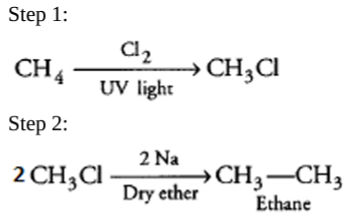
4. Convert methane into ethane.
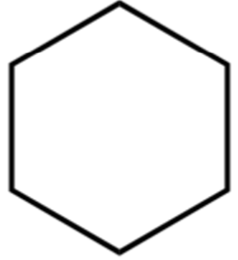
5. What are cycloalkanes?
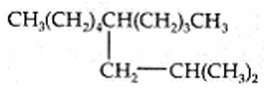
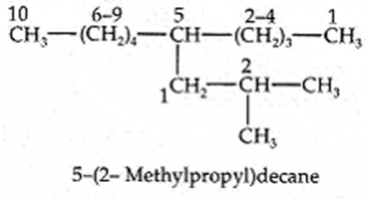
6. Write IUPAC name of following:
Image
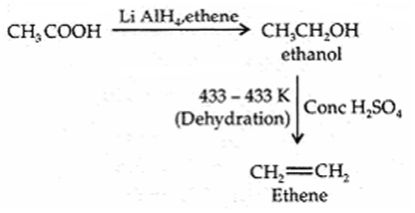
7. How will you convert ethanoic acid into ethene?
Answer
1. Alkenes are commonly known as olefins because the lower members form oily products on treatment with chlorine or bromine.
2. We can convert 1-Bromopropne into 2-Bromopropane in two steps. In the first step, the dehydrohalogenation of 1-bromo propane with alcoholic KOH gives propene which on reacting with HBr gives 2-bromo propane due to Markovnikov's rule for addition.
Image
3. Continuous removal of a product maintains Qc at a value less than Kc and reaction continues to move in the forward direction.
4. Conversion of methane into ethane:
Image
5. Cycloalkanes: When carbon atoms form a closed chain or ring structures, they are known as cycloalkanes.
Example: Cyclohexane
Image
6.
Image
7. 
Image
View full question & answer