MCQ
A spectral line $\lambda = 5000 Å$ in the light coming from a distant star is observed as a $5200 Å.$ What will be recession velocity of the star
  • A
    $1.15 \times {10^7}cm/\sec $
  • $1.15 \times {10^7}m/\sec $
  • C
    $1.15 \times {10^7}km/\sec $
  • D
    $1.15 \,km/sec$

Answer

Correct option: B.
$1.15 \times {10^7}m/\sec $
b
(b)$\Delta \lambda = 5200 - 5000 = 200Å$
Now $\frac{{\Delta \lambda }}{{\lambda '}} = \frac{v}{c} \Rightarrow v = \frac{{c\Delta \lambda }}{{\lambda '}} = \frac{{3 \times {{10}^8} \times 200}}{{5000}}$
$ = 1.2 \times {10^7}m/\sec \approx 1.15 \times {10^7}m/\sec $

Need a full question paper?

Generate a complete, print-ready paper with questions like this in minutes — across 16+ boards, with answer keys.

Start Generating Free

Similar questions

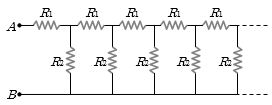
An infinite sequence of resistance is shown in the figure. The resultant resistance between $A$ and $B$ will be, when ${R_1} = 1\,ohm$ and ${R_2} = 2\,ohm$ ............. $\Omega$
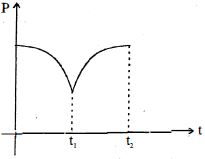
Graph between power and time is given below. Then which of the following option is correct for work done by force [from $t = 0$ to time $t$]
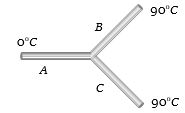
Three rods made of the same material and having the same cross section have been joined as shown in the figure. Each rod is of the same length. The left and right ends are kept at ${0^o}C$ and ${90^o}C$ respectively. The temperature of the junction of the three rods will be ...... $^oC$
Using Young's double slit experiment, a monochromatic light of wavelength $5000\,\mathring A$ produces fringes of fringe width $0.5 \,mm$. If another monochromatic light of wavelength $6000\,\mathring A$ is used and the separation between the slits is doubled, then the new fringe width will be ............... $mm$
A particle moving in the $xy$ plane experiences a velocity dependent force $\overrightarrow{ F }= k \left( v _{ y } \hat{ i }+ v _{ x } \hat{ j }\right),$ where $v _{ x }$ and $v _{ y }$ are the $x$ and $y$ components of its velocity $\overrightarrow{ v } .$ If $\overrightarrow{ a }$ be the acceleration of the particle, then which of the following statements is true for the particle$?$
A particle is performing simple harmonic motion along $x-$axis with amplitude $4 \,cm$ and time period $1.2\, sec$. The minimum time taken by the particle to move from $x =2 ,cm$ to $ x = + 4\, cm$ and back again is given by .... $\sec$
An aeroplane is flying with a uniform speed of $100\, m/s$ along a circular path of radius $100 m$. the angular speed of the aeroplane will be ......... $rad/sec$
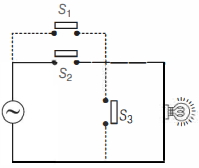
Consider the following circuit given below. The bulb will light up, if
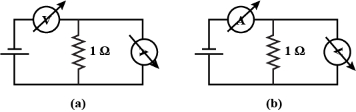
A student uses the resistance of a known resistor $(1 \,\Omega)$ to calibrate a voltmeter and an ammeter using the circuits shown below. The student measures the ratio of the voltage to current to be $1 \times 10^3 \,\Omega$ in circuit $(a)$ and $0.999 \,\Omega$ in circuit $(b)$. From these measurements, the resistance (in $\Omega$ ) of the voltmeter and ammeter are found to be close to
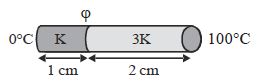
Two bars of thermal conductivities $K$ and $3K$ and lengths $1\,\, cm$ and $2\,\, cm$ respectively have equal cross-sectional area, they are joined lengths wise as shown in the figure. If the temperature at the ends of this composite bar is $0\,^oC$ and $100\,^oC$ respectively (see figure), then the temperature $\varphi $ of the interface is......... $^oC$