A sphere of radius $r$ is kept on a concave mirror of radius of curvature $R$. The arrangement is kept on a horizontal table (the surface of concave mirror is frictionless and sliding not rolling). If the sphere is displaced from its equilibrium position and left, then it executes $S.H.M.$ The period of oscillation will be
Diffcult
Download our app for free and get started
(b) Tangential acceleration, ${a_t} = - g\sin \theta = - g\theta $
${a_t} = - g\frac{x}{{(R - r)}}$
Motion is $S.H.M.$, with time period
${a_t} = - g\frac{x}{{(R - r)}}$
Motion is $S.H.M.$, with time period
$T = 2\pi \sqrt {\frac{{{\rm{displacement}}}}{{{\rm{acceleration}}}}} $
$ = 2\pi \sqrt {\frac{x}{{\frac{{gx}}{{(R - t)}}}}} = 2\pi \sqrt {\frac{{R - r}}{g}} $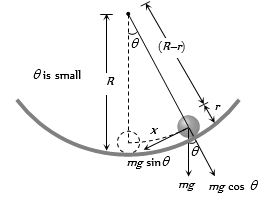

Download our appand get started for free
Experience the future of education. Simply download our apps or reach out to us for more information. Let's shape the future of learning together!No signup needed.*
Similar Questions
- 1The acceleration due to gravity at a place is ${\pi ^2}\,m/se{c^2}$. Then the time period of a simple pendulum of length one metre isView Solution
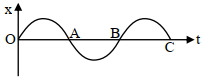
- 2The variation of displacement with time of a particle executing free simple harmonic motion is shown in the figure. The potential energy ${U}({x})$ versus time $({t})$ plot of the particle is correctly shown in figure:View Solution
- 3The displacement equation of a particle is $x = 3\sin 2t + 4\cos 2t.$ The amplitude and maximum velocity will be respectivelyView Solution
- 4Two masses ${m_1}$ and ${m_2}$ are suspended together by a massless spring of constant k. When the masses are in equilibrium, ${m_1}$ is removed without disturbing the system. Then the angular frequency of oscillation of ${m_2}$ isView Solution
- 5$m x^{2}-b x+k=0$View Solution
Find time after which to the energy will become half of initial maximum value in damped force oscillation.
- 6The angular velocity and the amplitude of a simple pendulum is $'\omega '$ and $'A'$ respectively. At a displacement $x$ from the mean position its kinetic energy is $'T'$ and potnetial energy is $'V'$. Then the ratio $\frac{V}{T}$ isView Solution
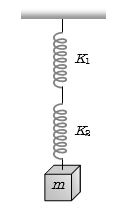
- 7View SolutionThe frequency of oscillation of the springs shown in the figure will be
- 8A particle executes linear simple harmonic motion with an ampilitude of $3\,cm$ . When the particle is at $2\,cm$ from the mean position , the magnitude of its velocity is equal to that of its acceleration. Then its time period in seconds isView Solution
- 9The displacement of a particle varies with time as $x = 12\sin \omega t - 16{\sin ^3}\omega t$ (in $cm$). If its motion is $S.H.M.$, then its maximum acceleration isView Solution
- 10Two particles are in $SHM$ on same straight line with amplitude $A$ and $2A$ and with same angular frequency $\omega .$ It is observed that when first particle is at a distance $A/\sqrt{2}$ from origin and going toward mean position, other particle is at extreme position on other side of mean position. Find phase difference between the two particlesView Solution