Question
A spherical ball of salt is dissolving in water in such a manner that the rate of decrease of the volume at any instant is propotional to the surface. Prove that the radius is decreasing at a constant rate.

Answer

We have, rate of decrease of the volume of spherical ball of salt at any instant is surface. Let the radius of the spherical ball of the salt be r.
$\therefore$ Volume of the ball $(\text{V})=\frac{4}{3}\pi\text{r}^3$
and surface area $(\text{S})=4\pi\text{r}^2$
$\because\ \frac{\text{dV}}{\text{dT}}\propto\text{S}$
$\Rightarrow\ \frac{\text{d}}{\text{dt}}\Big(\frac{4}{3}\pi\text{r}^3\Big)\propto4\pi\text{r}^2$
$\Rightarrow\ \frac{4}{3}\pi3\text{r}^2\frac{\text{dr}}{\text{dt}}\propto4\pi\text{r}^2$
$\Rightarrow\ \frac{\text{dr}}{\text{dt}}\propto\frac{4\pi\text{r}^2}{4\pi\text{r}^2}$
$\Rightarrow\ \frac{\text{dr}}{\text{dt}}=\text{k.1}$ [where, k is the proportionality constant]
$\Rightarrow\ \frac{\text{dr}}{\text{dt}}=\text{k}$
Hence, the radius of ball is decreasing at a constant rate.

Need a full question paper?

Generate a complete, print-ready paper with questions like this in minutes — across 16+ boards, with answer keys.
Start Generating Free

Similar questions

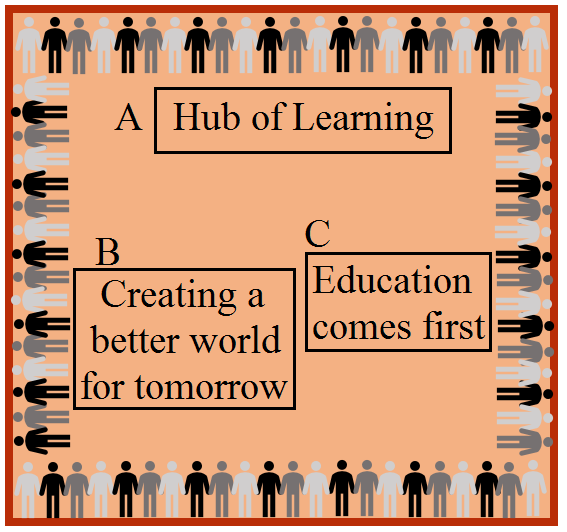
Three slogans on chart papers are to be placed on a school bulletin board at the points A, Band C displaying A (Hub of Learning), B (Creating a better world for tomorrow) and C (Education comes first). The coordinates of these points are (1, 4, 2), (3, -3, -2) and (-2, 2, 6) respectively.

Based on the above information, answer the following questions.
  1. Let $\vec{\text{a}},\vec{\text{b}}$ and $\vec{\text{c}}$ be the position vectors of points A, B and C respectively, then $\vec{\text{a}}+\vec{\text{b}}+\vec{\text{c}}$ is equal to:
  1. $2\hat{\text{i}}+3\hat{\text{j}}+6\hat{\text{k}}$
  2. $2\hat{\text{i}}-3\hat{\text{j}}-6\hat{\text{k}}$
  3. $2\hat{\text{i}}+8\hat{\text{j}}+3\hat{\text{k}}$
  4. $2(7\hat{\text{i}}+8\hat{\text{j}}+3\hat{\text{k}})$
  1. Which of the following is not true?
  1. $\overline{\text{AB}}+\overline{\text{BC}}+\overline{\text{CA}}=\vec{0}$
  2. $\overline{\text{AB}}+\overline{\text{BC}}-\overline{\text{AC}}=\vec{0}$
  3. $\overline{\text{AB}}+\overline{\text{BC}}-\overline{\text{CA}}=\vec{0}$
  4. $\overline{\text{AB}}-\overline{\text{CB}}+\overline{\text{CA}}=\vec{0}$
  1. Area of $\triangle\text{ABC}$ is:
  1. 19 sq. units
  2. $\sqrt{1937}\text{sq}.\text{units}$
  3. $\frac{1}{2}\sqrt{1937}\text{sq}.\text{units}$
  4. $\sqrt{1837}\text{sq}.\text{units}$
  1. Suppose, if the given slogans are to be placed on a straight line, then the value of $|\vec{\text{a}}\times\vec{\text{b}}+\vec{\text{b}}\times\vec{\text{c}}+\vec{\text{c}}\times\vec{\text{a}}|$ will be equal to:
  1. -1
  2. -2
  3. 2
  4. 0
  1. If $\vec{\text{a}}=2\hat{\text{i}}+3\hat{\text{j}}+6\hat{\text{k}},$ then unit vector in the direction of vector $\vec{\text{a}}$ is:
  1. $\frac{2}{7}\hat{\text{i}}-\frac{3}{7}\hat{\text{j}}-\frac{6}{7}\hat{\text{k}}$
  2. $\frac{2}{7}\hat{\text{i}}+\frac{3}{7}\hat{\text{j}}+\frac{6}{7}\hat{\text{k}}$
  3. $\frac{3}{7}\hat{\text{i}}+\frac{2}{7}\hat{\text{j}}+\frac{6}{7}\hat{\text{k}}$
  4. None of these
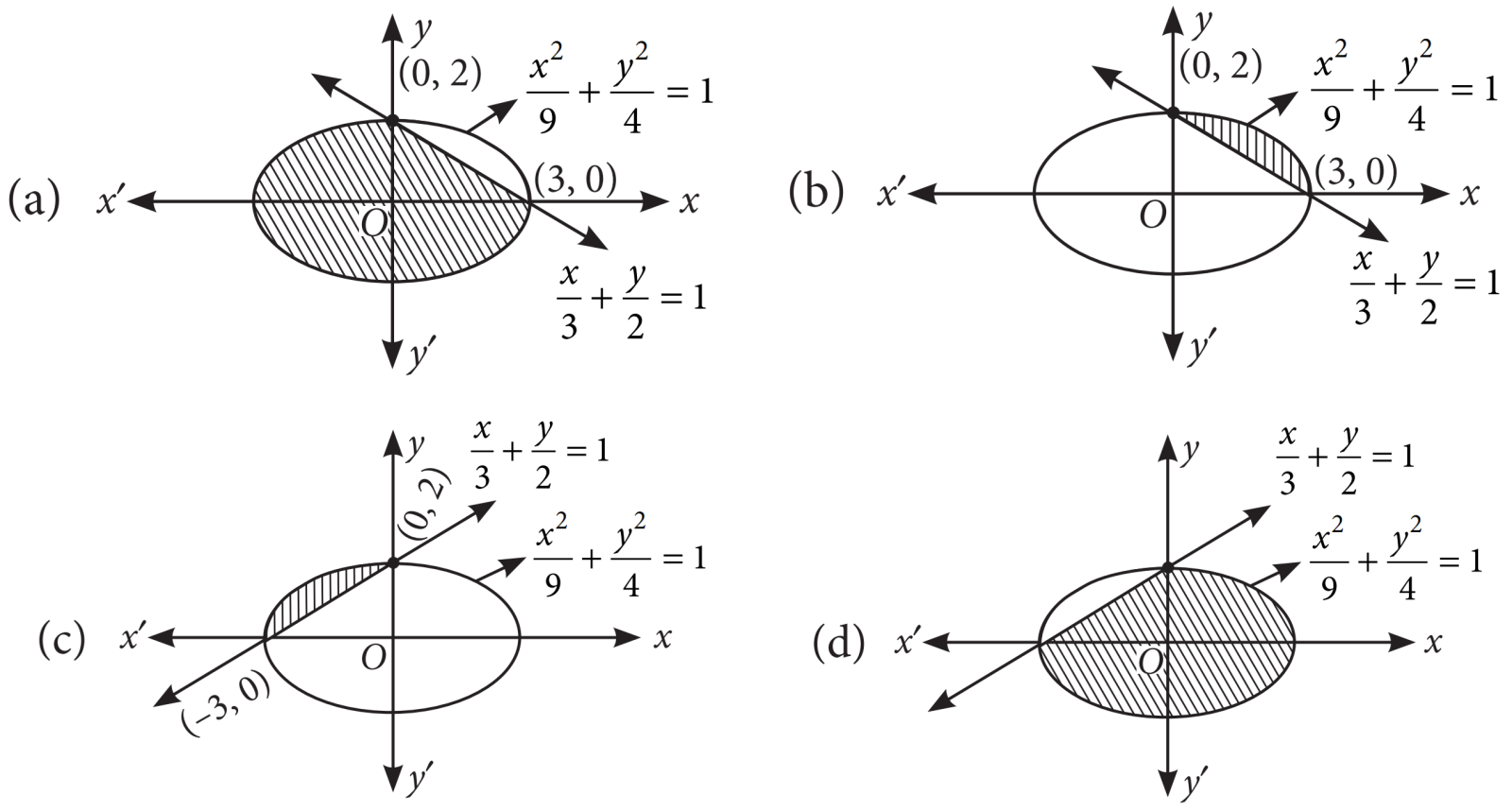
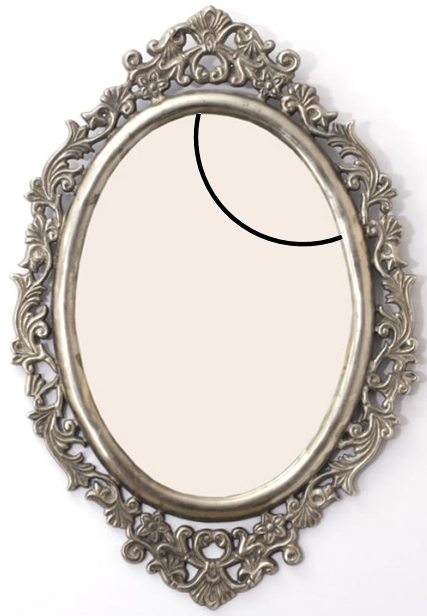
A mirror in the shape of an ellipse represented by $\frac{\text{x}^2}{9}+-\frac{\text{y}^2}{4}=1$ was hanging on the wall. Arun and his sister were playing with ball inside the house, even their mother refused to do so. All of sudden, ball hit the mirror and got a scratch in the shape of line represented by $\frac{\text{x}}{3}+\frac{\text{y}}{2}=1$

Based on the above information, answer the following questions.
  1. Point(s) of intersection of ellipse and scratch (straight line) is (are).
  1. (0, 2), (3, 0)
  2. (2, 0), (3, 0)
  3. (2, 3), (0, 0)
  4. (0, 3), (3, 0)
  1. Area of smaller region bounded by the ellipse and line is represented by.
  1. The value of $\frac{2}{3}\int\limits_{0}^{3}\sqrt{9-\text{x}^2}\text{dx}$ is.
    1. $\frac{\pi}{2}$
    2. $\pi$
    3. $\frac{3\pi}{2}$
    4. $\frac{\pi}{4}$
  1. The value of $2\int\limits_{0}^{3}\bigg(1-\frac{\text{x}}{3}\bigg)\text{dx}$ is.
    1. 0
    2. 1
    3. 2
    4. 3
  1. Area of the smaller region bounded by the mirror and scratch is.
  1. $3\Big(\frac{\pi}{2}+1\Big)\text{ sq.units}$
  2. $\Big(\frac{\pi}{2}+1\Big)\text{ sq.units}$
  3. $\Big(\frac{\pi}{2}-1\Big)\text{ sq.units}$
  4. $3\Big(\frac{\pi}{2}-1\Big)\text{ sq.units}$
The relation between the height of the plant ( $\mathrm{y}$ in $\mathrm{cm}$ ) with respect to exposure to sunlight is governed by the following equation $\mathrm{y}=4 \mathrm{x}-\frac{1}{2} \mathrm{x}^2$ where $\mathrm{x}$ is the number of days exposed to sunlight.

Image

(i) Find the rate of growth of the plant with respect to sunlight.

(ii) What is the number of days it will take for the plant to grow to the maximum height?

(iii) Verify that height of the plant is maximum after four days by second derivative test and find the maximum height of plant.

OR

What will be the height of the plant after 2 days?
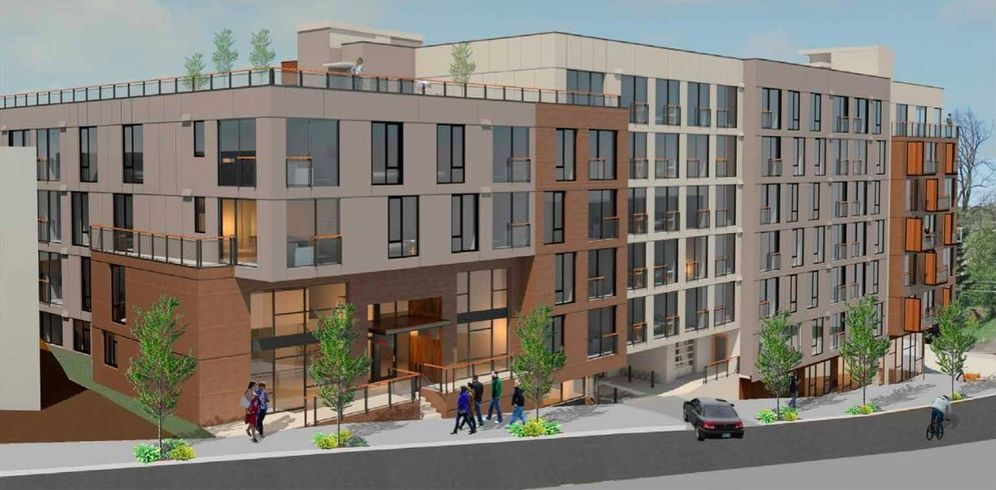
A real estate company is going to build a new residential complex. The land they have purchased can hold at most $4500$ apartments. Also, if they make x apartments, then the monthly maintenance cost for the whole complex would be as follows: Fixed cost $= ₹ 50,00,000$. Variable cost $= (160x - 0.04x^2)$

Based on the above information, answer the following questions.
  1. The maintenance cost as a function of $x$ will be.
  1. $160x - 0.04x^2$ 
  2. $5000000$
  3. $5000000 + 160x - 0.04x^2$ 
  4. None of these
  1. If $C(x)$ denote the maintenance cost function, then maximum value of $C(x)$ occur at $x =$
  1. $0$
  2. $2000$
  3. $4500$
  4. $5000$
  1. The maximum value of $C(x)$ would be.
  1. $₹\ 5225000$
  2. $₹\ 5160000$
  3. $₹\ 5000000$
  4. $₹\ 4000000$
  1. The number of apartments, that the complex should have in order to minimize the maintenance cost, is.
  1. $4500$
  2. $5000$
  3. $1750$
  4. $3500$
  1. If the minimum maintenance cost is attain, then the maintenance cost for each apartment would be.
  1. $₹\ 1091.11$
  2. $₹\ 1200$
  3. $₹\ 1000$
  4. $₹\ 2000$
To teach the application of probability a maths teacher arranged a surprise game for 5 of his students namely Govind, Girish, Vinod, Abhishek and Ankit. He took a bowl containing tickets numbered 1 to 50 and told the students go one by one and draw two tickets simultaneously from the bowl and replace it after noting the numbers.

Image

(i) Teacher ask Govind, what is the probability that tickets are drawn by Abhishek, shows a prime number on one ticket and a multiple of 4 on other ticket?

(ii) Teacher ask Girish, what is the probability that tickets drawn by Ankit, shows an even number on first ticket and an odd number on second ticket?

If an equation is of the form $\frac{\text{dy}}{\text{dx}}+\text{Py}=\text{Q},$ where P, Qare functions of x, then such equation is known as linear differential equation. Its solution is given by
$\text{y}\times\text{(I.F.)}=\int\text{Q}\times\text{(I.F.)}\text{dx}+\text{c},$ where $\text{I.F.}=\text{e}^{\int\text{pdx}}.$
Now, suppose the given equation is $(1+\sin\text{x})\frac{\text{dy}}{\text{dx}}+\text{y}\cos\text{x}+\text{x}=0.$
Based on the above information, answer the following questions.
  1. The value of P and Q respectively are:
  1. $\frac{\sin\text{x}}{1+\cos\text{x}},\ \frac{\text{x}}{1+\sin\text{x}}$
  2. $\frac{\cos\text{x}}{1+\sin\text{x}},\ \frac{\text{-x}}{1+\sin\text{x}}$
  3. $\frac{-\cos\text{x}}{1+\sin\text{x}},\ \frac{\text{x}}{1+\sin\text{x}}$
  4. $\frac{\cos\text{x}}{1+\sin\text{x}},\ \frac{\text{x}}{1+\sin\text{x}}$
  1. The value of I.F is:
  1. $1-\sin\text{x}$
  2. $\cos\text{x}$
  3. $1+\sin\text{x}$
  4. $1-\cos\text{x}$
  1. Solution of given equation is:
  1. $\text{y}(1-\sin\text{x})=\text{x+c}$
  2. $\text{y}(1+\sin\text{x})=-\text{x}^2+\text{c}$
  3. $\text{y}(1-\sin\text{x})=\frac{\text{-x}^2}{2}\text{+c}$
  4. $\text{y}(1+\sin\text{x})=\frac{\text{-x}^2}{2}\text{+c}$
  1. If y(0) = 1, then y equals
  1. $\frac{2-\text{x}^2}{2(1+\sin\text{x})}$
  2. $\frac{2+\text{x}^2}{2(1+\sin\text{x})}$
  3. $\frac{2-\text{x}^2}{2(1-\sin\text{x})}$
  4. $\frac{2+\text{x}^2}{2(1-\sin\text{x})}$
  1. Value of is $\text{y}\Big(\frac{\pi}{2}\Big)$ is:
  1. $\frac{4-\pi^2}{2}$
  2. $\frac{8-\pi^2}{16}$
  3. $\frac{8-\pi^2}{4}$
  4. $\frac{4+\pi^2}{2}$
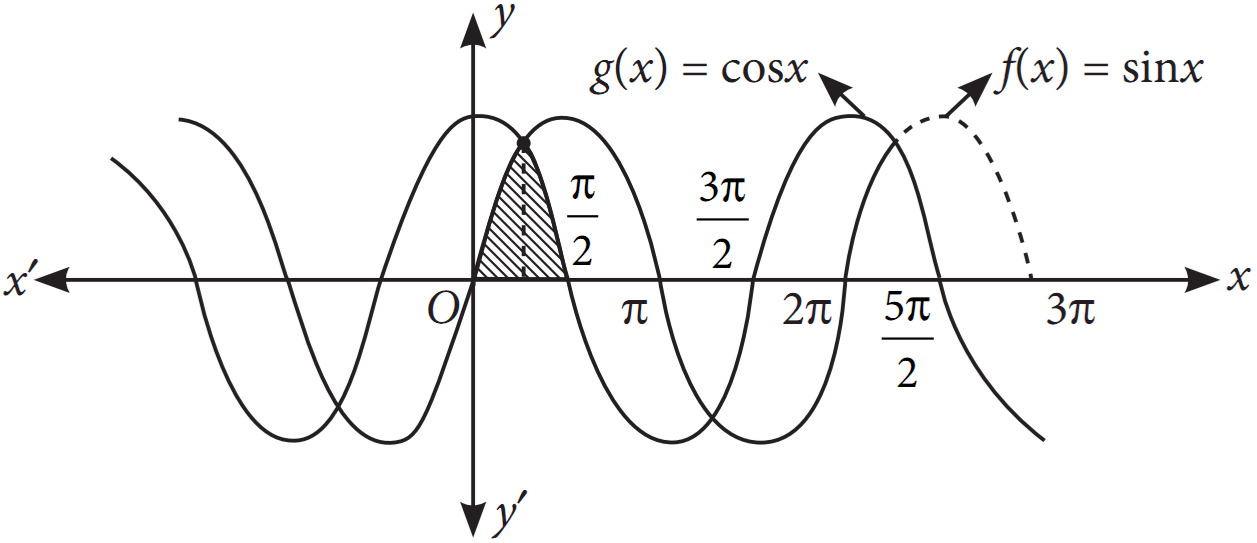
Graphs of two function $\text{f}(\text{x})=\text{sin}\text{ x}$ and $\text{(g)}\text{x}=\text{cos}\text{ x}$ is given below:

Based on the above information, answer the following questions.
  1. In $(0, \pi)$, the curves $\text{f}(\text{x})=\text{sin}\text{ x}$ and $\text{g}\text{ (x)}=\text{cos}\text{ x}$ at $\text{x}=$
    1. $\frac{\pi}{2}$
    2. $\frac{\pi}{3}$
    3. $\frac{\pi}{4}$
    4. ${\pi}$
  2. Value of $\int\limits_{0}^{\frac{\pi}{4}}\text{sin}\text{ x}\text{ dx}$ is.
    1. $1-\frac{1}{\sqrt{2}}$
    2. $1+\frac{1}{\sqrt{2}}$
    3. $2-\frac{1}{\sqrt{2}}$
    4. $2+\frac{1}{\sqrt{2}}$
  1. Value of $\int\limits_\frac{\pi}{4}^{\frac{\pi}{2}}\text{cos}\text{ x}\text{ dx}$ is.
    1. $1+\frac{1}{\sqrt{2}}$
    2. $1-\frac{1}{\sqrt{2}}$
    3. $2-\sqrt{2}$
    4. $2+\sqrt{2}$
  2. Value of $\int\limits_{0}^{\pi}\text{sin}\text{ x}\text{ dx}$ is.
  1. 0
  2. 1
  3. 2
  4. -2
  1. Value of $\int\limits_{0}^\frac{\pi}{2}\text{sin}\text{ x}\text{ dx}$ is.
  1. 0
  2. 1
  3. 3
  4. 4
Western music concert is organised every year in the stadium that can hold 36000 spectators. With ticket price of ₹ 10, the average attendance has been 24000. Some financial expert estimated that price of a ticket should be determined by the function.
$\text{p}(\text{x})=15-\frac{\text{x}}{3000}$ where x is the number of tickets sold.

Based on the above information, answer the following questions.
  1. The revenue, R as a function of x can be represented as.
  1. $15\text{x}-\frac{\text{x}^2}{3000}$
  2. $15-\frac{\text{x}^2}{3000}$
  3. $15\text{x}-\frac{1}{3000}$
  4. $15\text{x}-\frac{\text{x}}{3000}$
  1. The range of x is.
  1. [24000, 36000]
  2. [0, 24000]
  3. [0, 36000]
  4. None of these
  1. The value of x for which revenue is maximum, is.
  1. 20000
  2. 21000
  3. 22500
  4. 25000
  1. When the revenue is maximum, the price of the ticket is.
  1. ₹ 5
  2. ₹ 5.5
  3. ₹ 7
  4. ₹ 7.5
  1. How many spectators should be present to maximize the revenue?
  1. 21500
  2. 21000
  3. 22000
  4. 22500
Order: The order of a differential equation is the order of the highest order derivative appearing in the differential equation.
Degree: The degree of differential equation is the power of the highest order derivative, when differential coefficients are made free from radicals and fractions. Also, differential equation must be a polynomial equation in derivatives for the degree to be defined.
Based on the above information, answer the following questions.
  1. Find the degree of the differential equation $2\frac{\text{d}^2\text{y}}{\text{dx}^2}+3\sqrt{1-\Big(\frac{\text{dy}}{\text{dx}}\Big)^2-\text{y}=0}.$
  1. $3$
  2. $4$
  3. $3$
  4. $1$
  1. Order and degree of the differential equation $\text{y}\frac{\text{dy}}{\text{dx}}=\frac{\text{x}}{\frac{\text{dy}}{\text{dx}}+\Big(\frac{\text{dy}}{\text{dx}}\Big)^3}$ are respectively.
  1. $1, 1$
  2. $1, 2$
  3. $1, 3$
  4. $1, 4$
  1. Find order and degree of the equation $y'" + y^2 + e^{y'} = 0.$
  1. Order $= 3,$ degree $=$ undefined.
  2. Order $= 1,$ degree $= 3.$
  3. Order $= 2,$ degree $=$ undefined.
  4. Order $= 1,$ degree $= 2.$
  1. Determine degree of the differential equation $(\sqrt{\text{a+x}})\times\Big(\frac{\text{dy}}{\text{dx}}\Big)+\text{x}=0.$
  1. $3$
  2. Not defined
  3. $1$
  4. $2$
  1. Order and degree of the differential equation $\Bigg(1+\Big(\frac{\text{dy}}{\text{dx}}\Big)^3\Bigg)^\frac{7}{3}=7\frac{\text{d}^2\text{y}}{\text{dx}^2}$ are respectively.
  1. $2, 1$
  2. $2, 3$
  3. $1, 3$
  4. $1,\ \frac{7}{3}$
Three car dealers, say A, Band C, deals in three types of cars, namely Hatchback cars, Sedan cars, SUV cars. The sales figure of 2019 and 2020 showed that dealer A sold 120 Hatchback, 50 Sedan, 10 SUV cars in 2019 and 300 Hatchback, 150 Sedan, 20 SUV cars in 2020; dealer B sold 100 Hatchback, 30 Sedan, 5 SUV cars in 2019 and 200 Hatchback, 50 Sedan, 6 SUV cars in 2020; dealer C sold 90 Hatchback, 40 Sedan, 2 SUV cars in 2019 and 100 Hatchback, 60 Sedan, 5 SUV cars in 2020.

Based on the above information, answer the following questions.
  1. The matrix summarizing sales data of 2019 is:
  1. $\begin{matrix}&\text{Hatchback}&\text{Sedan}&\text{SUV}\end{matrix}\\\begin{matrix}\text{A}\\\text{B}\\\text{C}\end{matrix}\begin{bmatrix}\ \ \ \ \ \ 300\ \ \ &\ \ 150&\ \ \ \ \ 20\\\ \ \ 200&\ \ 50&\ \ \ \ \ 6\\\ \ \ 100&\ \ 30&\ \ \ \ \ 5\end{bmatrix}$
  2. $\begin{matrix}&\text{Hatchback}&\text{Sedan}&\text{SUV}\end{matrix}\\\begin{matrix}\text{A}\\\text{B}\\\text{C}\end{matrix}\begin{bmatrix}\ \ \ \ \ \ 120\ \ \ &\ \ 100&\ \ \ \ \ 20\\\ \ \ 100&\ \ 30&\ \ \ \ \ 5\\\ \ \ 90&\ \ 40&\ \ \ \ \ 2\end{bmatrix}$
  3. $\begin{matrix}&\text{Hatchback}&\text{Sedan}&\text{SUV}\end{matrix}\\\begin{matrix}\text{A}\\\text{B}\\\text{C}\end{matrix}\begin{bmatrix}\ \ \ \ \ \ 100\ \ \ &\ \ 30&\ \ \ \ \ 5\\\ \ \ 120&\ \ 50&\ \ \ \ \ 10\\\ \ \ 90&\ \ 40&\ \ \ \ \ 2\end{bmatrix}$
  4. $\begin{matrix}&\text{Hatchback}&\text{Sedan}&\text{SUV}\end{matrix}\\\begin{matrix}\text{A}\\\text{B}\\\text{C}\end{matrix}\begin{bmatrix}\ \ \ \ \ \ 200\ \ \ &\ \ 50&\ \ \ \ \ 6\\\ \ \ 100&\ \ 30&\ \ \ \ \ 5\\\ \ \ 300&\ \ 150&\ \ \ \ \ 20\end{bmatrix}$
  1. The matrix summarizing sales data of 2020 is:
  1. $\begin{matrix}&\text{Hatchback}&\text{Sedan}&\text{SUV}\end{matrix}\\\begin{matrix}\text{A}\\\text{B}\\\text{C}\end{matrix}\begin{bmatrix}\ \ \ \ \ \ 300\ \ \ &\ \ 150&\ \ \ \ \ 20\\\ \ \ 200&\ \ 50&\ \ \ \ \ 6\\\ \ \ 100&\ \ 60&\ \ \ \ \ 5\end{bmatrix}$
  2. $\begin{matrix}&\text{Hatchback}&\text{Sedan}&\text{SUV}\end{matrix}\\\begin{matrix}\text{A}\\\text{B}\\\text{C}\end{matrix}\begin{bmatrix}\ \ \ \ \ \ 120\ \ \ &\ \ 50&\ \ \ \ \ 10\\\ \ \ 100&\ \ 60&\ \ \ \ \ 5\\\ \ \ 90&\ \ 40&\ \ \ \ \ 2\end{bmatrix}$
  3. $\begin{matrix}&\text{Hatchback}&\text{Sedan}&\text{SUV}\end{matrix}\\\begin{matrix}\text{A}\\\text{B}\\\text{C}\end{matrix}\begin{bmatrix}\ \ \ \ \ \ 100\ \ \ &\ \ 60&\ \ \ \ \ 5\\\ \ \ 120&\ \ 50&\ \ \ \ \ 10\\\ \ \ 90&\ \ 40&\ \ \ \ \ 2\end{bmatrix}$
  4. $\begin{matrix}&\text{Hatchback}&\text{Sedan}&\text{SUV}\end{matrix}\\\begin{matrix}\text{A}\\\text{B}\\\text{C}\end{matrix}\begin{bmatrix}\ \ \ \ \ \ 200\ \ \ &\ \ 50&\ \ \ \ \ 6\\\ \ \ 100&\ \ 60&\ \ \ \ \ 5\\\ \ \ 300&\ \ 150&\ \ \ \ \ 20\end{bmatrix}$
  1. The cost incurred by the organisation on village Z is:
  1. $\begin{matrix}&\text{Hatchback}&\text{Sedan}&\text{SUV}\end{matrix}\\\begin{matrix}\text{A}\\\text{B}\\\text{C}\end{matrix}\begin{bmatrix}\ \ \ \ \ \ 190\ \ \ &\ \ 100&\ \ \ \ \ 7\\\ \ \ 300&\ \ 80&\ \ \ \ \ 11\\\ \ \ 420&\ \ 200&\ \ \ \ \ 30\end{bmatrix}$
  2. $\begin{matrix}&\text{Hatchback}&\text{Sedan}&\text{SUV}\end{matrix}\\\begin{matrix}\text{A}\\\text{B}\\\text{C}\end{matrix}\begin{bmatrix}\ \ \ \ \ \ 300\ \ \ &\ \ 80&\ \ \ \ \ 11\\\ \ \ 190&\ \ 100&\ \ \ \ \ 7\\\ \ \ 420&\ \ 200&\ \ \ \ \ 30\end{bmatrix}$
  3. $\begin{matrix}&\text{Hatchback}&\text{Sedan}&\text{SUV}\end{matrix}\\\begin{matrix}\text{A}\\\text{B}\\\text{C}\end{matrix}\begin{bmatrix}\ \ \ \ \ \ 420\ \ \ &\ \ 200&\ \ \ \ \ 30\\\ \ \ 300&\ \ 80&\ \ \ \ \ 11\\\ \ \ 190&\ \ 100&\ \ \ \ \ 7\end{bmatrix}$
  4. None of these
  1. The increase in sales from 2019 to 2020 is given by the matrix.
  1. $\begin{matrix}&\text{Hatchback}&\text{Sedan}&\text{SUV}\end{matrix}\\\begin{matrix}\text{A}\\\text{B}\\\text{C}\end{matrix}\begin{bmatrix}\ \ \ \ \ \ 180\ \ \ &\ \ 100&\ \ \ \ \ 10\\\ \ \ 10&\ \ 20&\ \ \ \ \ 1\\\ \ \ 100&\ \ 20&\ \ \ \ \ 3\end{bmatrix}$
  2. $\begin{matrix}&\text{Hatchback}&\text{Sedan}&\text{SUV}\end{matrix}\\\begin{matrix}\text{A}\\\text{B}\\\text{C}\end{matrix}\begin{bmatrix}\ \ \ \ \ \ 10\ \ \ &\ \ 20&\ \ \ \ \ 3\\\ \ \ 100&\ \ 20&\ \ \ \ \ 1\\\ \ \ 180&\ \ 100&\ \ \ \ \ 10\end{bmatrix}$
  3. $\begin{matrix}&\text{Hatchback}&\text{Sedan}&\text{SUV}\end{matrix}\\\begin{matrix}\text{A}\\\text{B}\\\text{C}\end{matrix}\begin{bmatrix}\ \ \ \ \ \ 180\ \ \ &\ \ 100&\ \ \ \ \ 10\\\ \ \ 100&\ \ 20&\ \ \ \ \ 1\\\ \ \ 10&\ \ 20&\ \ \ \ \ 3\end{bmatrix}$
  4. $\begin{matrix}&\text{Hatchback}&\text{Sedan}&\text{SUV}\end{matrix}\\\begin{matrix}\text{A}\\\text{B}\\\text{C}\end{matrix}\begin{bmatrix}\ \ \ \ \ \ 100\ \ \ &\ \ 20&\ \ \ \ \ 3\\\ \ \ 180&\ \ 100&\ \ \ \ \ 10\\\ \ \ 10&\ \ 20&\ \ \ \ \ 3\end{bmatrix}$
  1. If each dealer receive profit of ₹ 50000 on sale of a Hatchback. ₹ 100000 on sale of a Sedan and ₹ 200000 on sale of a SUV, then amount of profit received in the year 2020 by each dealer is given by the matrix.
  1. $\begin{matrix}\text{A}\\\text{B}\\\text{C}\end{matrix}\begin{bmatrix}30000000\\15000000\\12000000\end{bmatrix}$
  2. $\begin{matrix}\text{A}\\\text{B}\\\text{C}\end{matrix}\begin{bmatrix}12000000\\16200000\\34000000\end{bmatrix}$
  3. $\begin{matrix}\text{A}\\\text{B}\\\text{C}\end{matrix}\begin{bmatrix}34000000\\16200000\\12000000\end{bmatrix}$
  4. $\begin{matrix}\text{A}\\\text{B}\\\text{C}\end{matrix}\begin{bmatrix}15000000\\30000000\\12000000\end{bmatrix}$