Question
Graphs of two function $\text{f}(\text{x})=\text{sin}\text{ x}$ and $\text{(g)}\text{x}=\text{cos}\text{ x}$ is given below:
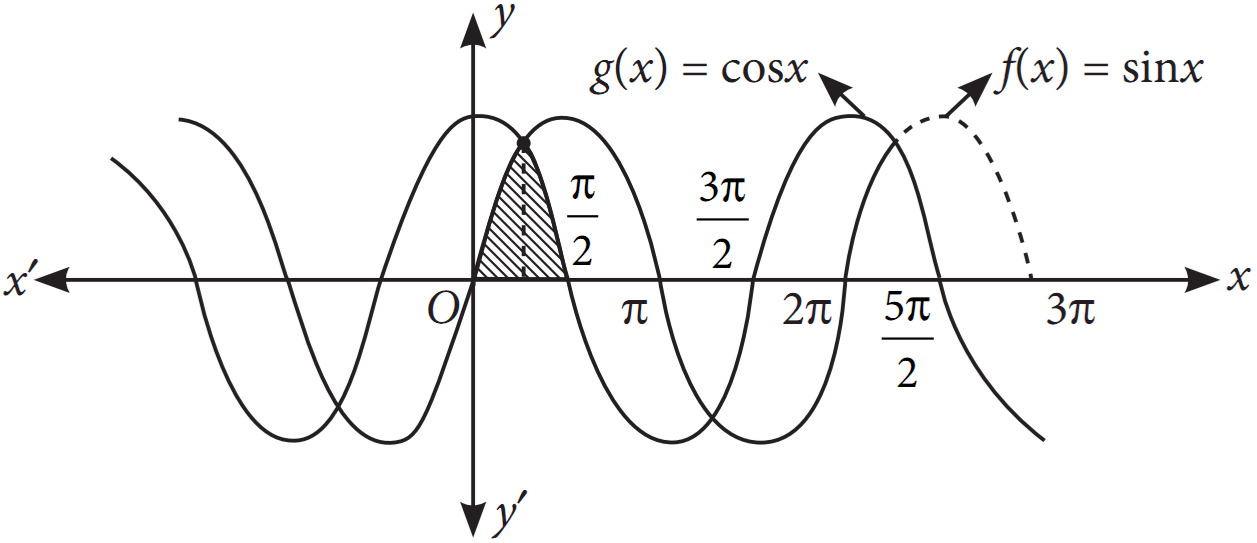
Based on the above information, answer the following questions.
  1. In $(0, \pi)$, the curves $\text{f}(\text{x})=\text{sin}\text{ x}$ and $\text{g}\text{ (x)}=\text{cos}\text{ x}$ at $\text{x}=$
    1. $\frac{\pi}{2}$
    2. $\frac{\pi}{3}$
    3. $\frac{\pi}{4}$
    4. ${\pi}$
  2. Value of $\int\limits_{0}^{\frac{\pi}{4}}\text{sin}\text{ x}\text{ dx}$ is.
    1. $1-\frac{1}{\sqrt{2}}$
    2. $1+\frac{1}{\sqrt{2}}$
    3. $2-\frac{1}{\sqrt{2}}$
    4. $2+\frac{1}{\sqrt{2}}$
  1. Value of $\int\limits_\frac{\pi}{4}^{\frac{\pi}{2}}\text{cos}\text{ x}\text{ dx}$ is.
    1. $1+\frac{1}{\sqrt{2}}$
    2. $1-\frac{1}{\sqrt{2}}$
    3. $2-\sqrt{2}$
    4. $2+\sqrt{2}$
  2. Value of $\int\limits_{0}^{\pi}\text{sin}\text{ x}\text{ dx}$ is.
  1. 0
  2. 1
  3. 2
  4. -2
  1. Value of $\int\limits_{0}^\frac{\pi}{2}\text{sin}\text{ x}\text{ dx}$ is.
  1. 0
  2. 1
  3. 3
  4. 4

Answer

  1. (c) $\frac{\pi}{4}$
Solution:

for point of intersection, we have

$\text{sin}\text{ x}=\text{cos}\text{ x}$

$\Rightarrow\frac{\text{sin}\text{ x}}{\text{cos}\text{ x}}=1$

$\Rightarrow\text{tan}\text{ x}=1$

$\Rightarrow\text{x}=\frac{\pi}{4}$
  1. (a) $1-\frac{1}{\sqrt{2}}$
Solution:

$\int\limits_{0}^{\frac{\pi}{4}}\text{sin}\text{ x}\text{ dx}=\big[-\text{cos x}\big]^\frac{\pi}{4}_0=-\text{cos}\frac{\pi}{4}+\text{cos}0$

$=1-\frac{1}{\sqrt{2}}$
  1. (b) $1-\frac{1}{\sqrt{2}}$
Solution:

$\int\limits_{\frac{\pi}{2}}^{\frac{\pi}{4}}\text{cos}\text{ x}\text{ dx}=\big[\text{sin x}\big]^\frac{\pi}{2}_\frac{\pi}{4}=\text{sin}\frac{\pi}{2}-\text{sin}\frac{\pi}{4}$

$=1-\frac{1}{\sqrt{2}}$
  1. (c) 2
Solution:

$\int\limits_{0}^{\pi}\text{sin}\text{ x}\text{ dx}=\big[-\text{cos x}\big]^{\pi}_0=\big[-\text{cos}{\pi}+\text{cos}0\big]=2$
  1. (b) 1
Solution:

$\int\limits_{0}^\frac{\pi}{2}\text{sin}\text{ x}\text{ dx}=\big[-\text{cos x}\big]^\frac{\pi}{2}_0=\Big[-\text{cos}\frac{\pi}{2}+\text{cos}0\Big]$

$=0+1+1$

Need a full question paper?

Generate a complete, print-ready paper with questions like this in minutes — across 16+ boards, with answer keys.

Start Generating Free

Similar questions

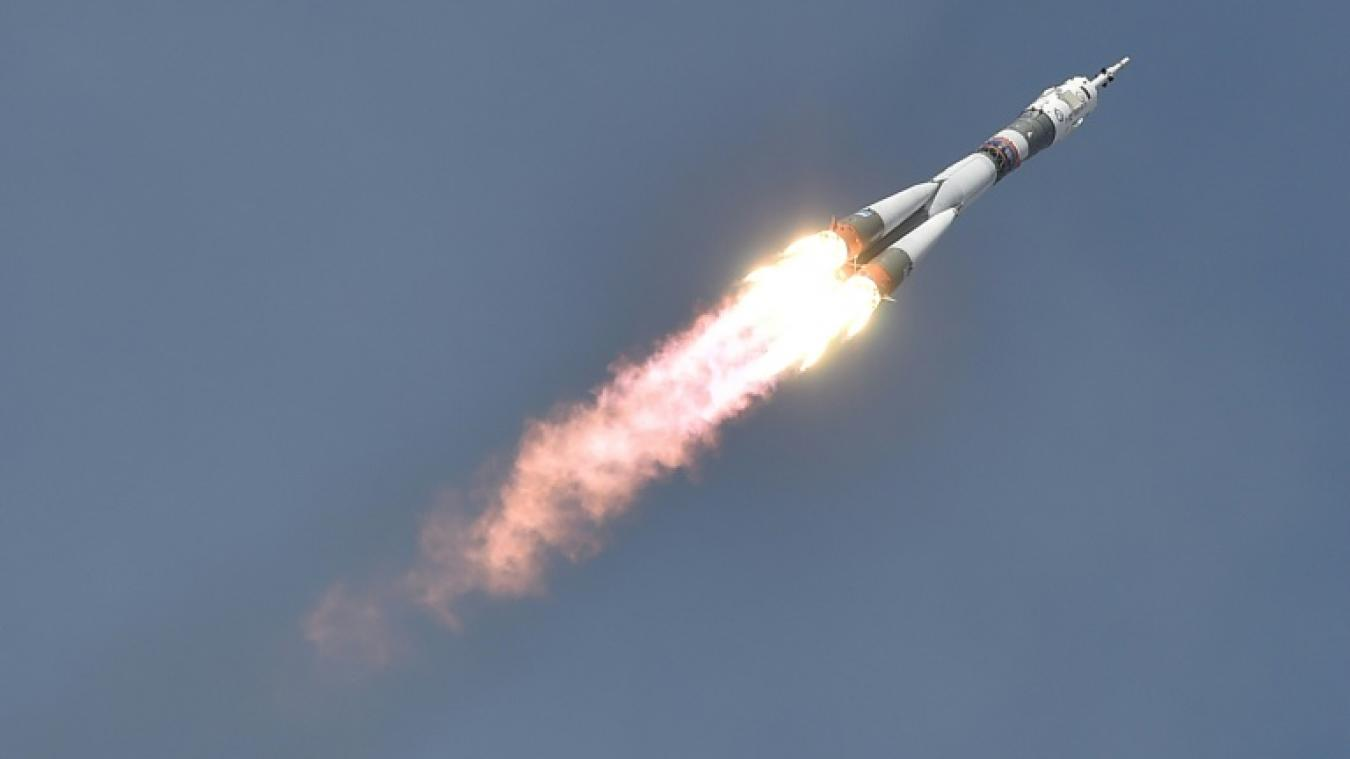
The upward speed v(I) of a rocket at time I is approximated by $\text{v}(\text{t})=\text{at}^2+\text{bt}+\text{c},0\leq\text{t}\leq100,$ here $a, b$ and $c$ are constants. It has been found that the speed at times $t = 3, t = 6$ and $t = 9$ seconds are respectively $64, 133$ and $208$ miles per second..

If $\begin{bmatrix}9&3&1\\36&6&1\\81&9&1\end{bmatrix}^{-1}=\frac{1}{18}\begin{bmatrix}1&-2&1\\-15&24&-9\\54&-54&18\end{bmatrix},$ then answer the following questions.
  1. The value of $b + c$ is:
  1. $20$
  2. $21$
  3. $\frac{3}{4}$
  4. $\frac{4}{3}$
  1. The value of $a + c$ is:
  1. $1$
  2. $20$
  3. $\frac{4}{3}$
  4. None of these.
  1. v(t) is given by:
  1. $\text{t}^2+20\text{t}+1$
  2. $\frac{1}{3}\text{t}^2+20\text{t}+1$
  3. $\text{t}^2+\frac{1}{3}\text{t}+20$
  4. $\text{t}^2+\text{t}+1$
  1. The speed at time $1 = 15$ seconds is:
  1. $346$ miles/ sec
  2. $356$ miles/ sec
  3. $366$ miles/ sec
  4. $376$ miles/ sec
  1. The time at which the speed of rocket is $784$ miles/ sec is:
  1. $20$ seconds
  2. $30$ seconds
  3. $25$ seconds
  4. $27$ seconds
Three shopkeepers $A, B$ and $C$ go to a store to buy stationary. $A $ purchase $12$ dozen notebooks, $5$ dozen pens and $6$ dozen pencils. $B$ purchases $10$ dozen notebooks, $6$ dozen pens and $7$ dozen pencils. $C$ purchases $11$ dozen notebooks, $13$ dozen pens and $8$ dozen pencils. $A$ notebook costs ₹ $40$, a pen costs ₹ $12$ and a pencil costs ₹ $3.$

Based on the above information, answer the following questions.
  1. The number of items purchased by shopkeepers $A, B$ and $C$ represented in matrix form as:
  1. $\begin{matrix}\text{Notebooks}&\text{Pens}&\text{Pencils}\end{matrix}\\\begin{bmatrix}144&\ \ \ \ \ \ \ \ 60&\ \ \ \ \ 72\\120&\ \ \ \ \ \ \ \ \ 720&\ \ \ \ \ 84\\132&\ \ \ \ \ \ \ \ \ 156&\ \ \ \ \ 96\end{bmatrix}\begin{matrix}\text{A}\\\text{B}\\\text{C}\end{matrix}$
  2. $\begin{matrix}\text{Notebooks}&\text{Pens}&\text{Pencils}\end{matrix}\\\begin{bmatrix}144&\ \ \ \ \ \ \ \ 72&\ \ \ \ \ 60\\120&\ \ \ \ \ \ \ \ \ 84&\ \ \ \ \ 72\\132&\ \ \ \ \ \ \ \ \ 156&\ \ \ \ \ 96\end{bmatrix}\begin{matrix}\text{A}\\\text{B}\\\text{C}\end{matrix}$
  3. $\begin{matrix}\text{Notebooks}&\text{Pens}&\text{Pencils}\end{matrix}\\\begin{bmatrix}144&\ \ \ \ \ \ \ \ 72&\ \ \ \ \ 72\\120&\ \ \ \ \ \ \ \ \ 156&\ \ \ \ \ 84\\132&\ \ \ \ \ \ \ \ \ 84&\ \ \ \ \ 96\end{bmatrix}\begin{matrix}\text{A}\\\text{B}\\\text{C}\end{matrix}$
  4. $\begin{matrix}\text{Notebooks}&\text{Pens}&\text{Pencils}\end{matrix}\\\begin{bmatrix}144&\ \ \ \ \ \ \ \ 60&\ \ \ \ \ 60\\120&\ \ \ \ \ \ \ \ \ 84&\ \ \ \ \ 72\\132&\ \ \ \ \ \ \ \ \ 156&\ \ \ \ \ 96\end{bmatrix}\begin{matrix}\text{A}\\\text{B}\\\text{C}\end{matrix}$
  1. If $Y$ represents the matrix formed by the cost of each item, then $XY$ equals.
  1. $\begin{bmatrix}5741\\6780 \\8040\end{bmatrix}$
  2. $\begin{bmatrix}6696\\5916 \\7440\end{bmatrix}$
  3. $\begin{bmatrix}5916\\6696 \\7440\end{bmatrix}$
  4. $\begin{bmatrix}6740\\5740 \\8140\end{bmatrix}$
  1. Bill of A is equal to:
  1. ₹ $6740$
  2. ₹ $8140$
  3. ₹ $5740$
  4. ₹ $6696$
  1. If $A^2 = A,$ then $(A + 1)^3- 7A =$
  1. $A$
  2. $A - I$
  3. $I$
  4. $A + I$
  1. If $A$ and $B$ are $3 × 3$ matrices such that $A^2 - B^2 = (A - B) (A+ B),$ then
  1. Either $A$ or $B$ is zero matrix.
  2. Either $A$ or $B$ is unit matrix.
  3. $A = B$
  4. $AB = BA$
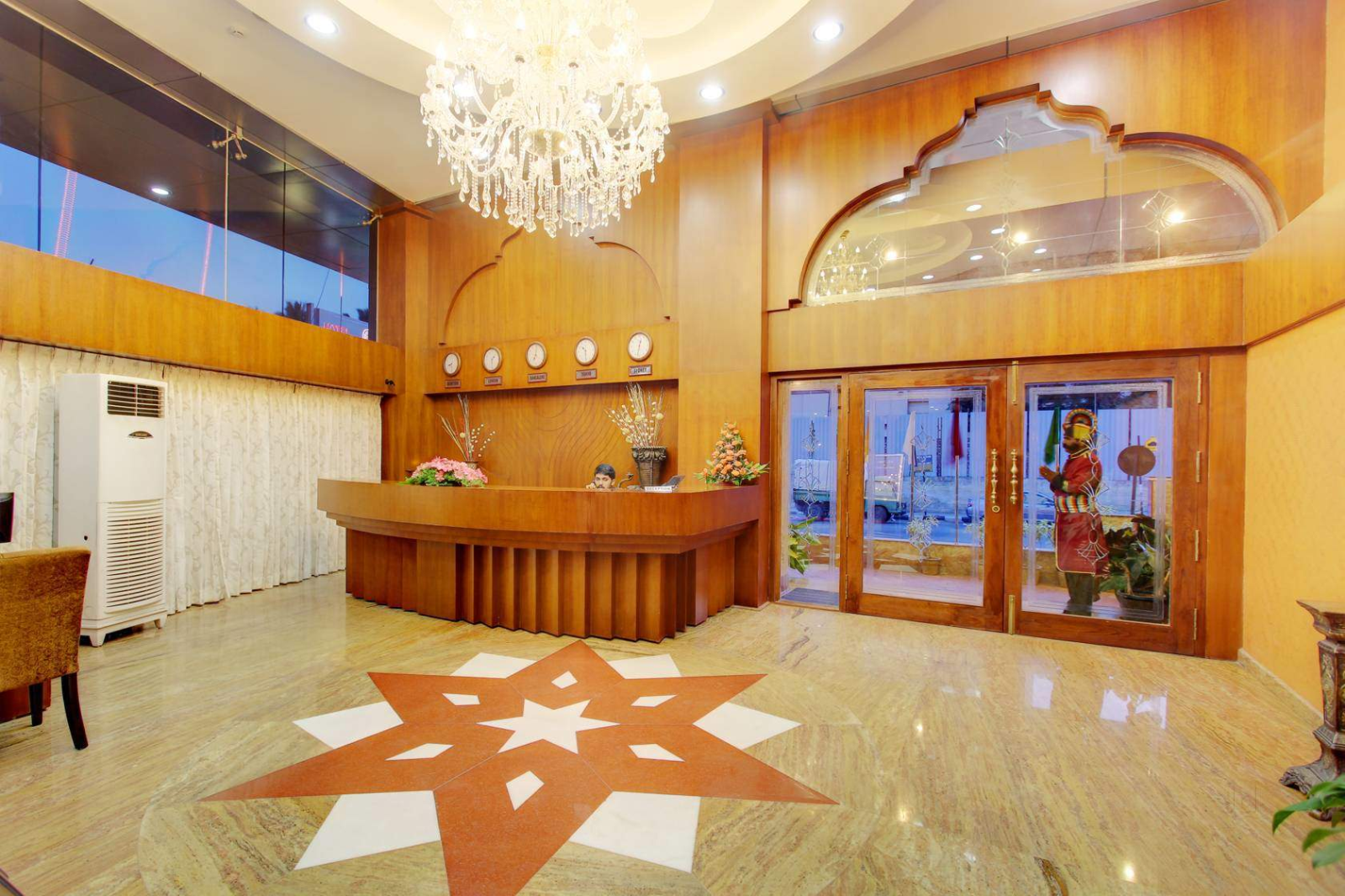
Suppose the floor of a hotel is made up of mirror polished Kota stone. Also, there is a large crystal chandelier attached at the ceiling of the hotel. Consider the floor of the hotel as a plane having equation $x - 2y + 2z = 3$ and crystal chandelier at the point $(3, -2, 1)$.

Based on the above information, answer the following questions.
  1. The d.r'.s of the perpendicular from the point $(3, -2, 1)$ to the plane $x - 2y + 2z = 3,$ is:
  1. $< 1, 2, 2 >$
  2. $< 1, -2, 2 >$
  3. $< 2, 1, 2 >$
  4. $< 2, -1, 2 >$
  1. The length of the perpendicular from the point $(3, -2, 1)$ to the plane $x - 2y + 2z = 3,$ is:
  1. $\frac{2}{3}\text{units}$
  2. $3$ units
  3. $2$ units
  4. None of these
  1. The equation of the perpendicular from the point $(3, -2, 1)$ to the plane $x - 2y + 2z = 3$, is:
  1. $\frac{\text{x}-3}{1}=\frac{\text{y}-2}{-2}=\frac{\text{z}-1}{2}$
  2. $\frac{\text{x}-3}{1}=\frac{\text{y}+2}{-2}=\frac{\text{z}-1}{2}$
  3. $\frac{\text{x}+3}{1}=\frac{\text{y}+2}{-2}=\frac{\text{z}-1}{2}$
  4. None of these
  1. The equation of plane parallel to the plane $x - 2y + 2z = 3,$ which is at a unit distance from the point $(3, -2, 1)$ is:
  1. $x - 2y + 2z = 0$
  2. $x - 2y + 2z = 6$
  3. $x - 2y + 2z = 12$
  4. Both $(b)$ and $(c)$
  1. The image of the point $(3, -2, 1)$ in the given plane is:
  1. $\Big(\frac{5}{3},\frac{2}{3},\frac{-5}{3}\Big)$
  2. $\Big(\frac{-5}{3},\frac{-2}{3},\frac{5}{3}\Big)$
  3. $\Big(\frac{-5}{3},\frac{2}{3},\frac{5}{3}\Big)$
  4. None of these
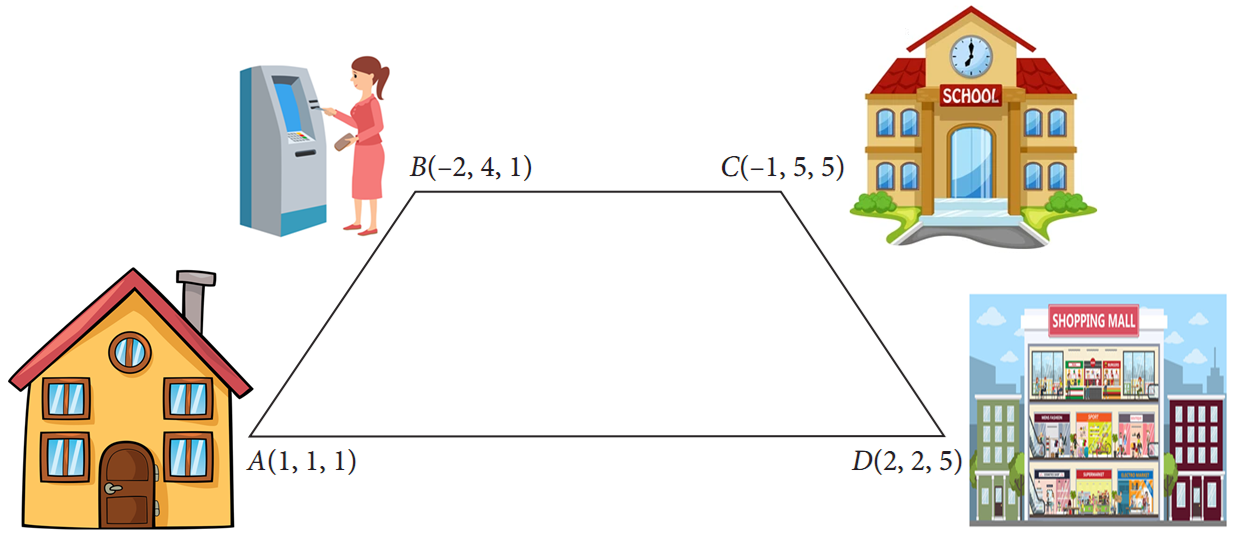
Ritika starts walking from his house to shopping mall. Instead of going to the mall directly, she first goes to a ATM, from there to her daughter's school and then reaches the mall. ln the diagram, A, B, C, and D represent the coordinates of House, ATM, School and Mall respectively.

Based on the above information, answer the following questions.
  1. Distance between House (A) and ATM (B) is:
  1. $3\text{ units}$
  2. $3\sqrt{2}\text{ units}$
  3. $\sqrt{2}\text{ units}$
  4. $4\sqrt{2}\text{ units}$
  1. Distance between ATM (B) and School (C) is:
  1. $\sqrt{2}\text{ units}$
  2. $2\sqrt{2}\text{ units}$
  3. $3\sqrt{2}\text{ units}$
  4. $4\sqrt{2}\text{ units}$
  1. Distance between School (C) and Shopping mall (D) is:
  1. $3\sqrt{2}\text{ units}$
  2. $5\sqrt{2}\text{ units}$
  3. $7\sqrt{2}\text{ units}$
  4. $10\sqrt{2}\text{ units}$
  1. What is the total distance travelled by Ritika:
  1. $4\sqrt{2}\text{ units}$
  2. $6\sqrt{2}\text{ units}$
  3. $8\sqrt{2}\text{ units}$
  4. $9\sqrt{2}\text{ units}$
  1. What is the extra distance travelled by Ritika in reaching the shopping mall?
  1. $3\sqrt{2}\text{ units}$
  2. $5\sqrt{2}\text{ units}$
  3. $6\sqrt{2}\text{ units}$
  4. $7\sqrt{2}\text{ units}$
If a real valued function $f(x)$ is finitely derivable at any point of its domain, it is necessarily continuous at that point. But its converse need not be true.
For example, every polynomial, constant function are both continuous as well as differentiable and inverse trigonometric functions are continuous and differentiable in its domains etc.
Based on the above information, answer the following questions.
  1. If $\text{f}(\text{x})=\begin{cases}\text{x},\text{for x}\leq0\\0,\text{for x}>0\end{cases},$ then at $x = 0$
  1. $f(x)$ is differentiable and continuous.
  2. $f(x)$ is neither continuous nor differentiable.
  3. $f(x)$ is continuous but not differentiable.
  4. None of these.
  1. If $\text{f}(\text{x})=|\text{x}-1|,\text{x }\in\text{ R},$ then at $x = 1$
  1. $f(x)$ is not continuous.
  2. $f(x)$ is continuous but not differentiable.
  3. $f(x)$ is continuous and differentiable.
  4. None of these.
  1. $f(x) = x^3$ is:
  1. Continuous but not differentiable at $x = 3$
  2. Continuous but not differentiable at $x = 3$
  3. Neither continuous nor differentiable at $x = 3$
  4. None of these.
  1. If $\text{f}(\text{x})=[\sin\text{x}],$ then which of the following is true?
  1. $f(x)$ is continuous and differentiable at $x = 0.$
  2. $f(x)$ is discontinuous at $x = 0.$
  3. $f(x)$ is continuous at $x = 0$ but not differentiable.
  4. $f(x)$ is differentiable but not continuous at $\text{x}=\frac{\pi}{2}.$
  1. If $\text{f}(\text{x})=\sin^{-1}\text{x},-1\leq\text{x}\leq1,$ then:
  1. $f(x)$ is both continuous and differentiable.
  2. $f(x)$ is neither continuous nor differentiable.
  3. $f(x)$ is continuous but not differentiable.
  4. None of these.
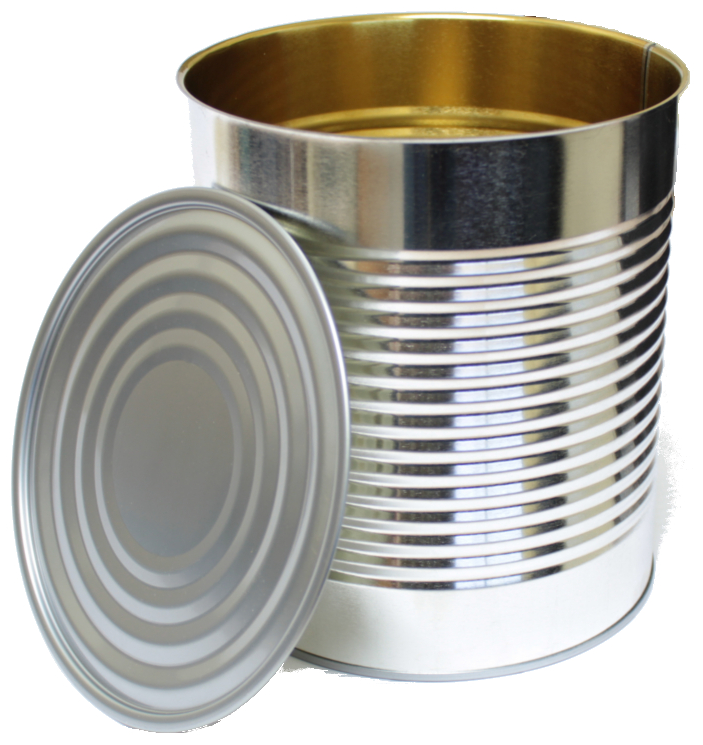
A tin can manufacturer designs a cylindrical tin can for a company making sanitizer and disinfector. The tin can is made to hold $3$ litres of sanitizer or disinfector.

Based on the above in formation, answer the following questions.
  1. If $r$ cm be the radius and h cm be the height of the cylindrical tin can, then the surface area expressed as a function of $r$ as.
  1. $2\pi\text{r}^2$
  2. $2\pi\text{r}^2+6000$
  3. $2\pi\text{r}^2+\frac{5000}{\text{r}}$
  4. $2\pi\text{r}^2+\frac{6000}{\text{r}}$
  1. The radius that will minimize the cost of the material to manufacture the tin can is.
  1. $\sqrt[3]{\frac{600}{\pi}}\text{cm}$
  2. $\sqrt{\frac{500}{\pi}}\text{cm}$
  3. $\sqrt[3]{\frac{1500}{\pi}}\text{cm}$
  4. $\sqrt{\frac{1500}{\pi}}\text{cm}$
  1. The height that will minimize the cost of the material to manufacture the tin can is.
  1. $\sqrt[3]{\frac{600}{\pi}}\text{cm}$
  2. $2\sqrt[3]{\frac{1500}{\pi}}\text{cm}$
  3. $\sqrt{\frac{1500}{\pi}}$
  4. $2\sqrt{\frac{1500}{\pi}}$
  1. If the cost of material used to manufacture the tin can is $₹\frac{100}{\text{m}^2}$ and $\sqrt[3]{\frac{1500}{\pi}}\approx7.8,$ then minimum cost is approximately.
  1. $₹\ 11.538$
  2. $₹\ 12$
  3. $₹\ 13$
  4. $₹\ 14$
  1. To minimize the cost of the material used to manufacture the tin can, we need to minimize the.
  1. Volume.
  2. Curved surface area.
  3. Total surface area.
  4. Surface area of the base.
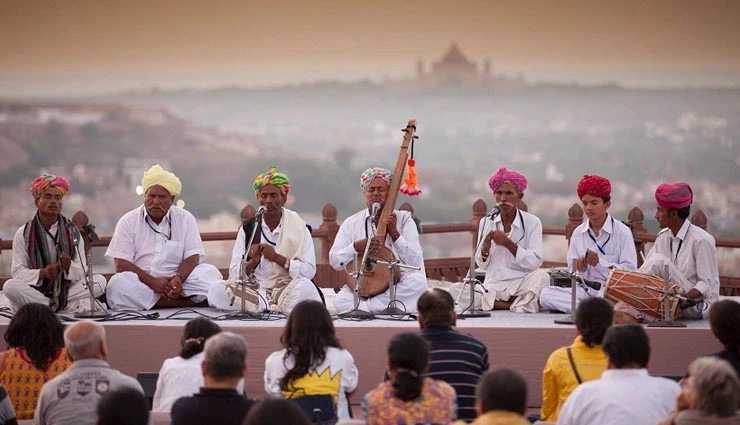
One day, a sangeet mahotsav is to be organised in an open area of Rajasthan. ln recent years, it has rained only $6$ days each year. Also, it is given that when it actually rains, the weatherman correctly forecasts rain 80% of the time. When it doesn't rain, he incorrectly forecasts rain $20\%$ of the time.

If leap year is considered, then answer the following questions.
  1. The probability that it rains on chosen day is:
  1. $\frac{1}{366}$
  2. $\frac{1}{73}$
  3. $\frac{1}{60}$
  4. $\frac{1}{61}$
  1. The probability that it does not rain on chosen day is:
  1. $\frac{1}{366}$
  2. $\frac{5}{366}$
  3. $\frac{360}{366}$
  4. None of these.
  1. The probability that the weatherman predicts correctly is:
  1. $\frac{5}{6}$
  2. $\frac{7}{8}$
  3. $\frac{4}{5}$
  4. $\frac{1}{5}$
  1. The probability that it will rain on the chosen day, if weatherman predict rain for that day, is:
  1. $0.0625$
  2. $0.0725$
  3. $0.0825$
  4. $0.0925$
  1. The probability that it will not rain on the chosen day, if weatherman predict rain for that day, is:
  1. $0.94$
  2. $0.84$
  3. $0.74$
  4. $0.64$
Read the following text carefully and answer the questions that follow:
A building contractor undertakes a job to construct 4 flats on a plot along with parking area. Due to strike the probability of many construction workers not being present for the job is 0.65 . The probability that many are not present and still the work gets completed on time is 0.35 . The probability that work will be completed on time when all workers are present is 0.80 .
Let: $E _1$ : represent the event when many workers were not present for the job;
$E _2$ : represent the event when all workers were present; and
E: represent completing the construction work on time.
i. What is the probability that all the workers are present for the job? (1)
ii. What is the probability that construction will be completed on time? (1)
iii. What is the probability that many workers are not present given that the construction work is completed on time? (2)
OR
What is the probability that all workers were present given that the construction job was completed on time?(2)
Read the following text carefully and answer the questions that follow:
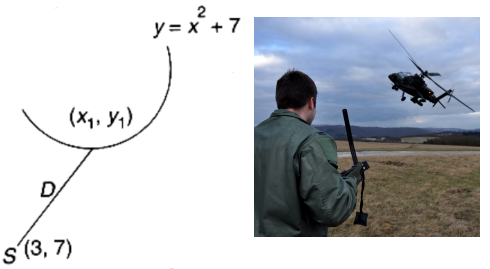
An Apache helicopter of the enemy is flying along the curve given by $y=x^2+7$. A soldier, placed at $(3,7)$ want to shoot down the helicopter when it is nearest to him.
Image
$i.$ If $P \left( x _1, y _1\right)$ be the position of a helicopter on curve $y=x^2+7$ then find distance $D$ from $P$ to soldier place at $(3.7).(1)$
$ii.$ Find the critical point such that distance is minimum. $(1)$
$iii$. Verify by second derivative test that distance is minimum at $(1, 8). (2)$
OR
Find the minimum distance between soldier and helicopter? $(2)$
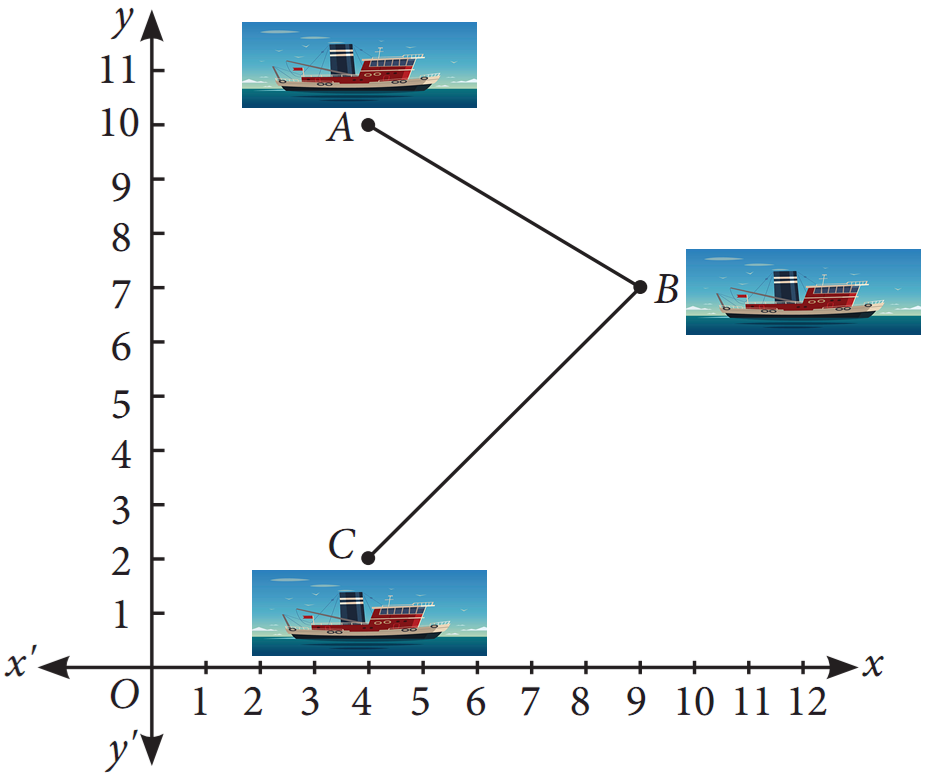
A barge is pulled into harbour by two tug boats as shown in the figure.
Based on the above information, answer the following questions.
  1. Position vector of A is:
  1. $4\hat{\text{i}}+2\hat{\text{j}}$
  2. $4\hat{\text{i}}+10\hat{\text{j}}$
  3. $4\hat{\text{i}}-10\hat{\text{j}}$
  4. $4\hat{\text{i}}-2\hat{\text{j}}$
  1. Position vector of B is:
  1. $4\hat{\text{i}}+4\hat{\text{j}}$
  2. $6\hat{\text{i}}+6\hat{\text{j}}$
  3. $9\hat{\text{i}}+7\hat{\text{j}}$
  4. $3\hat{\text{i}}+3\hat{\text{j}}$
  1. Find the vector $\overline{\text{AC}}$ in terms of $\hat{\text{i}},\hat{\text{j}}.$
  1. $8\hat{\text{j}}$
  2. $-8\hat{\text{j}}$
  3. $8\hat{\text{i}}$
  4. None of these
  1. If $\vec{\text{A}}=\hat{\text{i}}+2\hat{\text{j}}+3\hat{\text{k}},$ then its unit vector is:
  1. $\frac{\hat{\text{i}}}{\sqrt{14}}+\frac{2\hat{\text{j}}}{\sqrt{14}}+\frac{3\hat{\text{k}}}{\sqrt{14}}$
  2. $\frac{3\hat{\text{i}}}{\sqrt{14}}+\frac{2\hat{\text{j}}}{\sqrt{14}}+\frac{\hat{\text{k}}}{\sqrt{14}}$
  3. $\frac{2\hat{\text{i}}}{\sqrt{14}}+\frac{3\hat{\text{j}}}{\sqrt{14}}+\frac{\hat{\text{k}}}{\sqrt{14}}$
  4. None of these
  1. If $\vec{\text{A}}=4\hat{\text{i}}+3\hat{\text{j}}$ and $\vec{\text{B}}=3\hat{\text{i}}+4\hat{\text{j}},$ then $|\vec{\text{A}}|+|\vec{\text{B}}|=$
  1. 12
  2. 13
  3. 14
  4. 10