MCQ
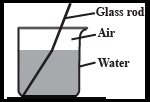
Why does a straight rod appear bent in water?
  • A
    Due to reflection of light
  • Due to refraction of light
  • C
    Due to variable refractive index of water.
  • D
    None of the above

Answer

Correct option: B.
Due to refraction of light

This phenomenon occurs due to the property of light called refraction of light. When a stick is immersed in water, in actually we are putting it from rarer medium to denser medium. So, when the rays of light pass from a rarer medium to the denser medium they move towards the normal, the part of stick immersed in water appears to bend when immersed in water and this refraction causes an apparent shift in the position of the part of the rod within the water.
Need a full question paper?

Generate a complete, print-ready paper with questions like this in minutes — across 16+ boards, with answer keys.

Start Generating Free

Similar questions

An $e.m.f$. of $12$ $volts$ is induced in a given coil when the current in it changes at the rate of $48$ $amperes/ minute$. The self inductance of the coil is.....$henry$
The minimum distance between an object and its real image formed by a convex lens is
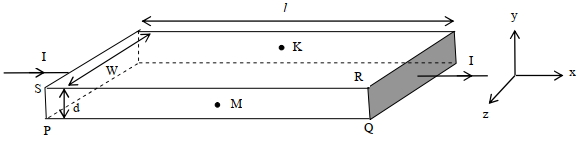
In a thin rectangular metallic strip a constant current $I$ flows along the positive $x$-direction, as shown in the figure. The length, width and thickness of the strip are $\ell$, w and $d$, respectively. A uniform magnetic field $\vec{B}$ is applied on the strip along the positive $y$-direction. Due to this, the charge carriers experience a net deflection along the $z$ direction. This results in accumulation of charge carriers on the surface $P Q R S$ and appearance of equal and opposite charges on the face opposite to $PQRS$. A potential difference along the $z$-direction is thus developed. Charge accumulation continues until the magnetic force is balanced by the electric force. The current is assumed to be uniformly distributed on the cross section of the strip and carried by electrons.

$1.$ Consider two different metallic strips ($1$ and $2$) of the same material. Their lengths are the same, widths are $w_1$ and $w_2$ and thicknesses are $d_1$ and $d_2$, respectively. Two points $K$ and $M$ are symmetrically located on the opposite faces parallel to the $x$ - $y$ plane (see figure). $V _1$ and $V _2$ are the potential differences between $K$ and $M$ in strips $1$ and $2$ , respectively. Then, for a given current $I$ flowing through them in a given magnetic field strength $B$, the correct statement$(s)$ is(are)

$(A)$ If $w _1= w _2$ and $d _1=2 d _2$, then $V _2=2 V _1$

$(B)$ If $w_1=w_2$ and $d_1=2 d_2$, then $V_2=V_1$

$(C)$ If $w _1=2 w _2$ and $d _1= d _2$, then $V _2=2 V _1$

$(D)$ If $w _1=2 w _2$ and $d _1= d _2$, then $V _2= V _1$

$2.$ Consider two different metallic strips ($1$ and $2$) of same dimensions (lengths $\ell$, width w and thickness $d$ ) with carrier densities $n_1$ and $n_2$, respectively. Strip $1$ is placed in magnetic field $B_1$ and strip $2$ is placed in magnetic field $B_2$, both along positive $y$-directions. Then $V_1$ and $V_2$ are the potential differences developed between $K$ and $M$ in strips $1$ and $2$, respectively. Assuming that the current $I$ is the same for both the strips, the correct option$(s)$ is(are)

$(A)$ If $B_1=B_2$ and $n_1=2 n_2$, then $V_2=2 V_1$

$(B)$ If $B_1=B_2$ and $n_1=2 n_2$, then $V_2=V_1$

$(C)$ If $B _1=2 B _2$ and $n _1= n _2$, then $V _2=0.5 V _1$

$(D)$ If $B_1=2 B_2$ and $n_1=n_2$, then $V_2=V_1$

Give the answer question $1$ and $2.$ 
A battery has $e.m.f.$ $4\, V$ and internal resistance $r$. When this battery is connected to an external resistance of $2\, ohms$, a current of $1\, amp$. flows in the circuit. How much current will flow if the terminals of the battery are connected directly .......... $amp$
For the given reaction, the particle $X$ is $_6{C^{11}}{ \to _5}{B^{11}} + {\beta ^ + } + X$


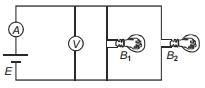
Two identical bulbs are connected in parallel across an ideal source of emf $E$. The ammeter $A$ and voltmeter $V$ are ideal. If bulb $B_2$ gets fused, then
What is the magnetic field at a distance $R$ from a coil of radius $r$ carrying current $I$ ?
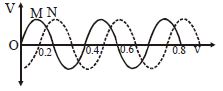
Two sinusoidal voltages of the same frequency are shown in the diagram. What is the frequency, and the phase relationship between the voltages Frequency in $Hz$    $\to $  Phase lead of $N$ over $M$ in radian
The electrostatic potential on the surface of a charged conducting sphere is $100 V$ . Two statments are made in this regard: $S_1$ : At any point inside the sphere, electric intensity is zero. $S_2$ : At any point inside the sphere, the electrostatic potential is $100 V$ . Which of the following is a correct statement?
A magnetic needle oscillates in a horizontal plane with a period $T$ at a place where the angle of dip is $60^{\circ}$. When the same needle is made to oscillate in a vertical plane coinciding with the magnetic meridian, its period will be