Question
A spring having with a spring constant $1200 N m ^{-1}$ is mounted on a horizontal table as shown in Fig. A mass of 3 kg is attached to the free end of the spring. The mass is then pulled sideways to a distance of 2.0 cm and released.
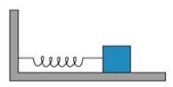
Image

Take the position of mass when the spring is unstreched as $x=0$, and the direction from left to right as the positive direction of $x$-axis. Give $x$ as a function of time $t$ for the oscillating mass if at the moment we start the stopwatch $(t=0)$, the mass is
a. at the mean position,
b. at the maximum stretched position, and
c. at the maximum compressed position.
In what way do these functions for SHM differ from each other, in frequency, in amplitude or the initial phase?

Need a full question paper?

Generate a complete, print-ready paper with questions like this in minutes — across 16+ boards, with answer keys.

Start Generating Free

Similar questions

A ball is thrown from a point in level with and at a horizontal distance r from the top of a tower of height H. How must the speed and angle of projection of the ball be related to r in order that the ball may just go grazing past the top edge of the tower? At what horizontal distance x from the foot of the tower does the ball hit the ground ? For a given speed of projection, obtain an equation for finding the angle of projection so that x is at a minimum.
A capacitance C, a resistance R and an emf $\in$ are connected in series at t = 0. What is the maximum value of (a) the potential difference across the resistor (b) the current in the circuit (c) the potential difference across the capacitor (d) the energy stored in the capacitor (e) the power delivered by the battery and (f) the power converted into heat?
A block whose mass is $1 kg$ is fastened to a spring. The spring has a spring constant of $50 N m ^{-1}$. The block is pulled to a distance $x=10 cm$ from its equilibrium position at $x=0$ on a frictionless surface from rest at $t=0$. Calculate the kinetic, potential and total energies of the block when it is $5 cm$ away from the mean position.
In an experiment to estimate the size of a molecule of oleic acid 1mL of oleic acid is dissolved in 19mL of alcohol. Then 1mL of this solution is diluted to 20mL by adding alcohol. Now 1 drop of this diluted solution is placed on water in a shallow trough. The solution spreads over the surface of water forming one molecule thick layer. Now, lycopodium powder is sprinkled evenly over the film and its diameter is measured. Knowing the volume of the drop and area of the film we can calculate the thickness of the film which will give us the size of oleic acid molecule.
Read the passage carefully and answer the following questions:
  1. Why do we dissolve oleic acid in alcohol?
  2. What is the role of lycopodium powder?
  3. What would be the volume of oleic acid in each mL of solution prepared?
  4. How will you calculate the volume of n drops of this solution of oleic acid?
  5. What will be the volume of oleic acid in one drop of this solution?
A solid cylinder of mass M and radius R has a light flexible rope wound around it. The rope carries a mass m at its free end. The mass is rest at a height h above the floor. Find the angular velocity of the cylinder at the instant the mass m, after release, strikes the floor. Assume friction to be absent and the cylinder to rotate about its own axis.
Potassium-40 can decay in three modes. It can decay by $\beta^-$-emission, $\beta^+$-emission of electron capture.
  1. Write the equations showing the end products.
  2. Find the Q-values in each of the three cases. Atomic masses of $\text{ }^{40}_{18}\text{Ar},\text{ }^{40}_{19}\text{K}$ and $\text{ }^{40}_{20}\text{Ca}$ are 39.9624u 39.9640u and 39.9626u respectively.
Doubly-ionised helium ions are projected with a speed of 10km/s-1 in a direction perpendicular to a uniform magnetic field of magnitude 1.0T. Find
  1. The force acting on an ion.
  2. The radius of the circle in which it circulates.
  3. The time taken by an ion to complete the circle.
A ball is dropped from a height of 5m onto a sandy floor and penetrates the sand up to 10cm before coming to rest. Find the retardation of the ball in sand assuming it to be uniform.
Two masses M1 and M2 are connected by a light rod and the system is slipping down a rough incline of angle $\theta$ with the horizontal. The friction coefficient at both the contacts is $\mu.$ Find the acceleration of the system and the force by the rod on one of the blocks.
What is the ideal gas equation? Derive the equation of state for an ideal gas from the molecular kinetic theory of gases.