Question types

Model Paper 10 question types

38 questions across 6 question groups — pick any mix to generate a Physics paper with step-by-step answer keys.

38
Questions
6
Question groups
5
Question types
Sample Questions

Model Paper 10 questions

One sample from each question group in this chapter. Select any group above to see the full set with answer keys.

As observed from earth, the sun appears to move in an approximate circular orbit. For the motion of another planet like mercury as observed from earth, this would
  • A
    not be true because the major gravitational force on mercury is due to sun
  • B
    not be true because mercury is influenced by forces other than gravitational forces
  • C
    be similarly true
  • D
    not be true because the force between earth and mercury is not inverse square law
View full solution
The motor of an engine is rotating about its axis with an angular velocity of $100 rev / m$. It comes to rest in 15 s , after being switched off. Assuming constant angular deceleration, what are the number of revolutions made by it before coming to rest?
  • A
    40
  • B
    15.6
  • C
    12.5
  • D
    32.6
View full solution
Consider two rods of same length and different specific heats $\left( c _1, c _2\right)$, thermal conductivities $\left( K _1, K_2\right)$ and area of cross-sections $\left(A_1, A_2\right)$ and both having temperatures $\left(T_1, T_2\right)$ at their ends. If their rate of loss of heat due to conduction is equal, then:
  • A
    $\frac{K_2 A_1}{c_2}=\frac{K_1 A_2}{c_1}$
  • B
    $K _1 A_1= K _2 A_2$
  • C
    $K _2 A_1= K _1 A_2$
  • D
    $\frac{K_1 A_1}{c_1}=\frac{K_2 A_2}{c_2}$
View full solution
A Merry-go-round, made of a ring-like platform of radius $R$ and mass $M$, is revolving with angular speed $\omega$. A person of mass M is standing on it. At one instant, the person jumps off the round, radially away from the centre of the round (as seen from the round). The speed of the round afterwards is
  • A
    $2 \omega$
  • B
    $0$
  • C
    $\frac{\omega}{2}$
  • D
    $\omega$
View full solution
A steel ball is dropped in oil, then
  • A
    the speed of ball will keep on decreasing
  • B
    the ball stops
  • C
    the ball attains constant velocity after some time
  • D
    the speed of ball will keep on increasing
View full solution
The wavelength $\lambda$ associated with a moving particle depends upon its mass m , its velocity v and Planck's constant h. Show dimensional relation between them.
View full solution
Q 143 Marks Question3 Marks
A soap bubble of radius 4 cm and surface tension 30 dyne $cm ^{-1}$ is blown at the end of a tube of length 10 cm and internal radius 0.20 cm . If the viscosity of air is $1.89 \times 10^{-4}$ poise, find the time taken by the bubble to be reduced to a radius of 2 cm .
View full solution
Q 153 Marks Question3 Marks
A body of mass 15 kg is hung by a spring balance in a lift. What would be the reading of the balance when
i. the lift is ascending with an acceleration of $2 ms^{-2}$
ii. descending with the same acceleration
iii. descending with a constant velocity of $2 ms^{-1}$ ?
Take $g =10 ms^{-2}$.
View full solution
Q 164 Marks Question4 Marks
View full solution
Q 174 Marks Question4 Marks
View full solution
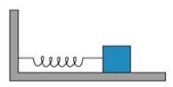
A spring having with a spring constant $1200 N m ^{-1}$ is mounted on a horizontal table as shown in Fig. A mass of 3 kg is attached to the free end of the spring. The mass is then pulled sideways to a distance of 2.0 cm and released.
Image

Take the position of mass when the spring is unstreched as $x=0$, and the direction from left to right as the positive direction of $x$-axis. Give $x$ as a function of time $t$ for the oscillating mass if at the moment we start the stopwatch $(t=0)$, the mass is
a. at the mean position,
b. at the maximum stretched position, and
c. at the maximum compressed position.
In what way do these functions for SHM differ from each other, in frequency, in amplitude or the initial phase?
View full solution
At what angle should a body be projected with a velocity $24 ms^{-1}$ just to pass over the obstacle 16 m high at a horizontal distance of 32 m ? Take $g =10 ms^{-2}$.
View full solution
Assertion: The time period of revolution of a satellite close to surface of earth is smaller than that revolving away from surface of earth.
Reason: The square of time period of revolution of a satellite is directly proportional to cube of its orbital radius.
  • A
    Assertion and reason both are correct statements and reason is correct explanation for assertion.
  • B
    Assertion and reason both are correct statements but reason is not correct explanation for assertion.
  • C
    Assertion is correct statement but reason is wrong statement.
  • D
    Assertion is wrong statement but reason is correct statement.
View full solution
Assertion (A): A quick collision between two bodies is more violent than slow collision, even when initial and final velocities are identical.
Reason (R): The rate of change of momentum determines that the force is small or large.
  • A
    Both A and R are true and R is the correct explanation of A.
  • B
    Both A and R are true but R is not the correct explanation of A.
  • C
    A is true but R is false.
  • D
    A is false but R is true.
View full solution
Assertion (A): Two vectors are equal when their magnitude and direction both are equal.
Reason (R): For any two vectors $\overrightarrow{ A }$ and $\overrightarrow{ B }$, if angle between them is $\frac{\pi}{4}$ rad, then $\overrightarrow{ A } \times \overrightarrow{ B }=\overrightarrow{ A } \cdot \overrightarrow{ B }$.
  • A
    Both A and R are true and R is the correct explanation of A.
  • B
    Both A and R are true but R is not the correct explanation of A.
  • C
    A is true but R is false.
  • D
    A is false but R is true.
View full solution
Assertion (A): Efficiency of a Carnot engine increases on reducing the temperature of sink.
Reason (R): The efficiency of a Carnot engine is defined as ratio of net mechanical work done per cycle by the gas to the amount of heat energy absorbed per cycle from the source.
  • A
    Both A and R are true and R is the correct explanation of A.
  • B
    Both A and R are true but R is not the correct explanation of A.
  • C
    A is true but R is false.
  • D
    A is false but R is true.
View full solution

Generate a Model Paper 10 paper free

Pick question groups from the list above, set marks and difficulty, and export a branded PDF with step-by-step answer keys. First 3 chapters free — no signup.

Download App