Question 15 Marks
View full question & answer→Questions
5 Marks Questions
🎯
Test yourself on this topic
6 questions · timed · auto-graded
Question 25 Marks
A spring having with a spring constant $1200 N m ^{-1}$ is mounted on a horizontal table as shown in Fig. A mass of 3 kg is attached to the free end of the spring. The mass is then pulled sideways to a distance of 2.0 cm and released.
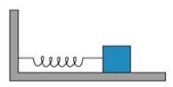
Take the position of mass when the spring is unstreched as $x=0$, and the direction from left to right as the positive direction of $x$-axis. Give $x$ as a function of time $t$ for the oscillating mass if at the moment we start the stopwatch $(t=0)$, the mass is
a. at the mean position,
b. at the maximum stretched position, and
c. at the maximum compressed position.
In what way do these functions for SHM differ from each other, in frequency, in amplitude or the initial phase?
View full question & answer→Take the position of mass when the spring is unstreched as $x=0$, and the direction from left to right as the positive direction of $x$-axis. Give $x$ as a function of time $t$ for the oscillating mass if at the moment we start the stopwatch $(t=0)$, the mass is
a. at the mean position,
b. at the maximum stretched position, and
c. at the maximum compressed position.
In what way do these functions for SHM differ from each other, in frequency, in amplitude or the initial phase?
Question 35 Marks
Define moment of inertia of a body. Give its units and dimensions. What is the physical significance of moment of inertia?
Answer
View full question & answer→The moment of inertia is defined as the quantity expressed by the body resisting angular acceleration, which is the sum of the product of the mass of every particle with its square of the distance from the axis of rotation.
The units of M. l are $kgm ^2$ and its dimensional formula is $\left[ M ^1 L^2 T^0\right]$.
The moment of inertia has the same physical significance as a mass in translational motion. The mass of a body is used to calculate inertia in translational motion.
The units of M. l are $kgm ^2$ and its dimensional formula is $\left[ M ^1 L^2 T^0\right]$.
The moment of inertia has the same physical significance as a mass in translational motion. The mass of a body is used to calculate inertia in translational motion.
Question 45 Marks
Answer
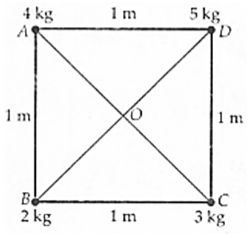
View full question & answer→Here $AB = BC = CD = DA =1 m$
$
O A=O B=O C=O D=\frac{1}{2} \sqrt{1^2+1^2}=\frac{1}{\sqrt{2}} m
$
i. M.I. of the system about an axis through O and perpendicular to the plane of the square,
$
\begin{aligned}
& I=4(OA)^2+2(O B)+3(OC)^2+5(OD)^2 \\
& =(4+2+3+5) \times\left(\frac{1}{\sqrt{2}}\right)^2=14 \times \frac{1}{2}=7 kg m^2
\end{aligned}
$
ii. M.I. of the system about the side AB ,
$
I=3(BC)^2+5(AD)^2=3 \times 1+5 \times 1=8 kg m^2
$
iii. M.I. of the system about the diagonal BD,
$
\begin{aligned}
& I=4(OA)^2+3(OC)^2 \\
& =4 \times \frac{1}{2}+3 \times \frac{1}{2}=3.5 kg m^2
\end{aligned}
$
$
O A=O B=O C=O D=\frac{1}{2} \sqrt{1^2+1^2}=\frac{1}{\sqrt{2}} m
$
i. M.I. of the system about an axis through O and perpendicular to the plane of the square,
$
\begin{aligned}
& I=4(OA)^2+2(O B)+3(OC)^2+5(OD)^2 \\
& =(4+2+3+5) \times\left(\frac{1}{\sqrt{2}}\right)^2=14 \times \frac{1}{2}=7 kg m^2
\end{aligned}
$
ii. M.I. of the system about the side AB ,
$
I=3(BC)^2+5(AD)^2=3 \times 1+5 \times 1=8 kg m^2
$
iii. M.I. of the system about the diagonal BD,
$
\begin{aligned}
& I=4(OA)^2+3(OC)^2 \\
& =4 \times \frac{1}{2}+3 \times \frac{1}{2}=3.5 kg m^2
\end{aligned}
$
Question 55 Marks
At what angle should a body be projected with a velocity $24 ms^{-1}$ just to pass over the obstacle 16 m high at a horizontal distance of 32 m ? Take $g =10 ms^{-2}$.
View full question & answer→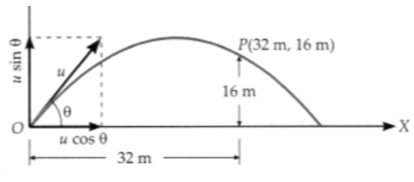
Question 65 Marks
The motion of a particle executing simple harmonic motion is described by the displacement function, $x ( t )= A \cos (\omega t$ $+\phi)$ If the initial $(t=0)$ position of the particle is 1 cm and its initial velocity is $\omega cm / s$, then what are its amplitude and initial phase angle? The angular frequency of the particle is $\pi s ^{-1}$. If instead of the cosine function, we choose the sine function to describe the $SHM , x = B \sin (\omega t +\phi)$, then what are the amplitude and initial phase of the particle with the above initial conditions?
Answer
View full question & answer→Given, displacement equation $x ( t )= A \cos (\omega t+\phi) \ldots$ (i)
At $t =0 ; x (0)=1 cm$, velocity of the particle $v=\omega cm / s$
Angular frequency $\omega=\pi s ^{-1}$
$\Rightarrow 1=A \cos (\omega t+\phi)$
For $t =0,1= A \cos \phi$$\ldots(i)$
$
\begin{aligned}
& \text { Now, } v(t)=\frac{d x(t)}{d t}=\frac{d}{d t} A \cos (\omega t+\phi) \\
& =-A \omega \sin (\omega t+\phi)
\end{aligned}
$
Again at $t =0, v=\omega cm / s$
$
\begin{aligned}
& \Rightarrow \omega=-A \omega \sin \phi \\
& \Rightarrow-1=A \sin \phi \ldots(ii)
\end{aligned}
$
Squaring and adding eqs.(i) and (ii),
$
\begin{aligned}
& A^2 \cos ^2 \phi+A^2 \sin ^2 \phi=(1)^2+(-1)^2 \\
& A^2=2 \Rightarrow A= \pm \sqrt{2} cm
\end{aligned}
$
Hence, the amplitude of the $SHM =\sqrt{2} cm$
Dividing Eq. (ii) by (i), we get
$
\begin{aligned}
& \frac{A \sin \phi}{A \cos \phi}=\frac{-1}{1} \text { or } \tan \phi=-1 \\
& \Rightarrow \phi=-\frac{\pi}{4} \text { or } \frac{7 \pi}{4}
\end{aligned}
$
Now, if instead of cosine, we choose the sine function in the displacement equation, then $x ( t )= B \sin (\omega t+\alpha)$
At $t =0, x =1 cm, \Rightarrow 1=B \sin (0+\alpha)$
or $B \sin \alpha=1$ $\ldots(iii)$
Velocity $v ( t )=\frac{d x(t)}{d t}=\frac{d}{d t}[B \sin (\omega t+\alpha)]$
$
=+B \omega \cos (\omega t+\alpha)
$
Again at $t =0, v ( t )=\omega cm / s$
$B \cos \alpha=+1$$\ldots(iv)$
Squaring and adding Eqs.(iii) and (iv),
$
\begin{aligned}
& B^2 \sin ^2 \alpha+B^2 \cos ^2 \alpha=(1)^2+(+1)^2 \\
& \Rightarrow B^2 \sin ^2 \alpha+B^2 \cos ^2 \alpha=2 \\
& B^2\left(\sin ^2 \alpha+\cos ^2 \alpha\right)=2 \\
& B^2 1=2 \Rightarrow B= \pm \sqrt{2} cm
\end{aligned}
$
Hence, amplitude of the simple harmonic motion in both types of trigonometric wave equation expression $=\sqrt{2} cm$ Dividing Eq. (iii) by (iv), we get
$\frac{B \sin \alpha}{B \cos \alpha}=\frac{1}{1}$ or $\tan \alpha=1$
$\therefore \alpha=\frac{\pi}{4}$, only the phase angle differs for sine and cosine wave equation.
At $t =0 ; x (0)=1 cm$, velocity of the particle $v=\omega cm / s$
Angular frequency $\omega=\pi s ^{-1}$
$\Rightarrow 1=A \cos (\omega t+\phi)$
For $t =0,1= A \cos \phi$$\ldots(i)$
$
\begin{aligned}
& \text { Now, } v(t)=\frac{d x(t)}{d t}=\frac{d}{d t} A \cos (\omega t+\phi) \\
& =-A \omega \sin (\omega t+\phi)
\end{aligned}
$
Again at $t =0, v=\omega cm / s$
$
\begin{aligned}
& \Rightarrow \omega=-A \omega \sin \phi \\
& \Rightarrow-1=A \sin \phi \ldots(ii)
\end{aligned}
$
Squaring and adding eqs.(i) and (ii),
$
\begin{aligned}
& A^2 \cos ^2 \phi+A^2 \sin ^2 \phi=(1)^2+(-1)^2 \\
& A^2=2 \Rightarrow A= \pm \sqrt{2} cm
\end{aligned}
$
Hence, the amplitude of the $SHM =\sqrt{2} cm$
Dividing Eq. (ii) by (i), we get
$
\begin{aligned}
& \frac{A \sin \phi}{A \cos \phi}=\frac{-1}{1} \text { or } \tan \phi=-1 \\
& \Rightarrow \phi=-\frac{\pi}{4} \text { or } \frac{7 \pi}{4}
\end{aligned}
$
Now, if instead of cosine, we choose the sine function in the displacement equation, then $x ( t )= B \sin (\omega t+\alpha)$
At $t =0, x =1 cm, \Rightarrow 1=B \sin (0+\alpha)$
or $B \sin \alpha=1$ $\ldots(iii)$
Velocity $v ( t )=\frac{d x(t)}{d t}=\frac{d}{d t}[B \sin (\omega t+\alpha)]$
$
=+B \omega \cos (\omega t+\alpha)
$
Again at $t =0, v ( t )=\omega cm / s$
$B \cos \alpha=+1$$\ldots(iv)$
Squaring and adding Eqs.(iii) and (iv),
$
\begin{aligned}
& B^2 \sin ^2 \alpha+B^2 \cos ^2 \alpha=(1)^2+(+1)^2 \\
& \Rightarrow B^2 \sin ^2 \alpha+B^2 \cos ^2 \alpha=2 \\
& B^2\left(\sin ^2 \alpha+\cos ^2 \alpha\right)=2 \\
& B^2 1=2 \Rightarrow B= \pm \sqrt{2} cm
\end{aligned}
$
Hence, amplitude of the simple harmonic motion in both types of trigonometric wave equation expression $=\sqrt{2} cm$ Dividing Eq. (iii) by (iv), we get
$\frac{B \sin \alpha}{B \cos \alpha}=\frac{1}{1}$ or $\tan \alpha=1$
$\therefore \alpha=\frac{\pi}{4}$, only the phase angle differs for sine and cosine wave equation.