Question
A spring having with a spring constant $1200N m^{-1}$ is mounted on a horizontal table as shown in Fig. A mass of $3kg$ is attached to the free end of the spring. The mass is then pulled sideways to a distance of $2.0cm$ and released.
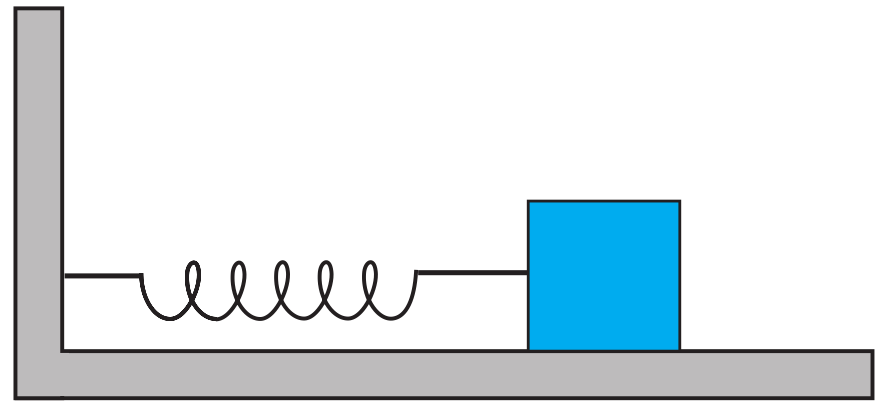
Determine (i) the frequency of oscillations, (ii) maximum acceleration of the mass, and (iii) the maximum speed of the mass.
Answer

Spring constant, $k = 1200N m^{-1}$
Mass, m = 3kg
Displacement, A = 2.0cm = 0.02cm
  1. Frequency of oscillation v, is given by the relation:
$\upsilon=\frac{1}{\text{T}}=\frac{1}{2\pi}\sqrt{\frac{\text{k}}{\text{m}}}$
where, T is time period
$\therefore\ \upsilon=\frac{1}{2\times3.14}\sqrt{\frac{1200}{3}}$
= 3.18m/s
Hence, the frequency of oscillations is 3.18 cycles per second.
  1. Maximum acceleration (a) is given by the relation:
$\text{a}=\omega^2\text{A}$
where,
$\omega=$ Angular frequency $=\sqrt{\frac{\text{k}}{\text{m}}}$
A = maximum displacement
$\therefore\ \text{a}=\frac{\text{k}}{\text{m}}\text{A}=\frac{1200\times0.02}{3}=8\text{ ms}^{-2}$
Hence, the maximum acceleration of the mass is $8.0m/s^2$.
Maximum velocity, $\text{v}_\text{max}=\text{A}\omega$
$=\text{A}\sqrt{\frac{\text{k}}{\text{m}}}=0.02\times\sqrt{\frac{1200}{3}}=0.4\text{ m/s}$
Hence, the maximum velocity of the mass is 0.4m/s.

Need a full question paper?

Generate a complete, print-ready paper with questions like this in minutes — across 16+ boards, with answer keys.

Start Generating Free

Similar questions

A bulb with rating 250V, 100W is connected to a power supply of 220V situated 10m away using a copper wire of area of cross-section $5mm^2$. How much power will be consumed by the connecting wires? Resistivity of copper $1.7\times10^{-8}\Omega-\text{m}$.
Define coefficient of viscosity and give its SI unit. On what factors does the terminal velocity of a spherical ball falling through a viscous liquid depend? Derive the formula:$\text{v}_\text{t}=\frac{2}{9}\frac{\text{a}^2\text{g}}{\eta}(\text{r}-\text{r}')$
where the symbols have their usual meaning.
When a Coolidge tube is operated for some time it becomes hot. Where does the heat come from?
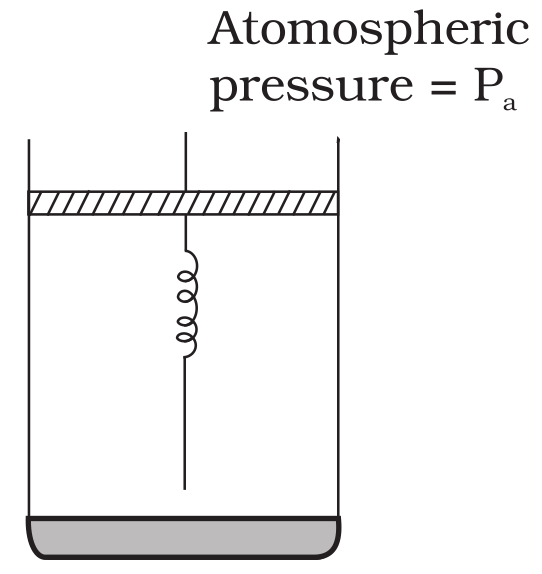
Consider one mole of perfect gas in a cylinder of unit cross section with a piston attached (Fig.) A spring (spring constant k) is attached (unstretched length L) to the piston and to the bottom of the cylinder. Initially the spring is unstretched and the gas is in equilibrium. A certain amount of heat Q is supplied to the gas causing an increase of volume from $V_o$ to $V_1$.
  1. What is the initial pressure of the system.
  2. What is the final pressure of the system.
  3. Uing the first law of thermodynamics, write down a relation between $Q, P_a, V, V_o$ and $k$.
A chain of length l and mass m lies on the surface of a smooth sphere of radius R>1 with one end tied to the top of the sphere.
  1. Find the gravitational potential energy of the chain with reference level at the centre of the sphere.
  2. Suppose the chain is released and slides down the sphere. Find the kinetic energy of the chain, when it has slid through an angle $\theta.$
  3. Find the tangential acceleration $\frac{\text{dv}}{\text{dt}}$ of the chain when the chain starts sliding down.
Calculate the electric field in a copper wire of cross-sectional area $2.0mm^2$ carrying a current of 1A.
The resistivity of copper $=1.7\times10^{-8}\Omega\text{-m}.$
A long, straight wire carrying a current of 30A is placed in an external, uniform magnetic field of $4.0 \times 10^{-4}T$ parallel to the current. Find the magnitude of the resultant magnetic field at a point 2.0cm away from the wire.
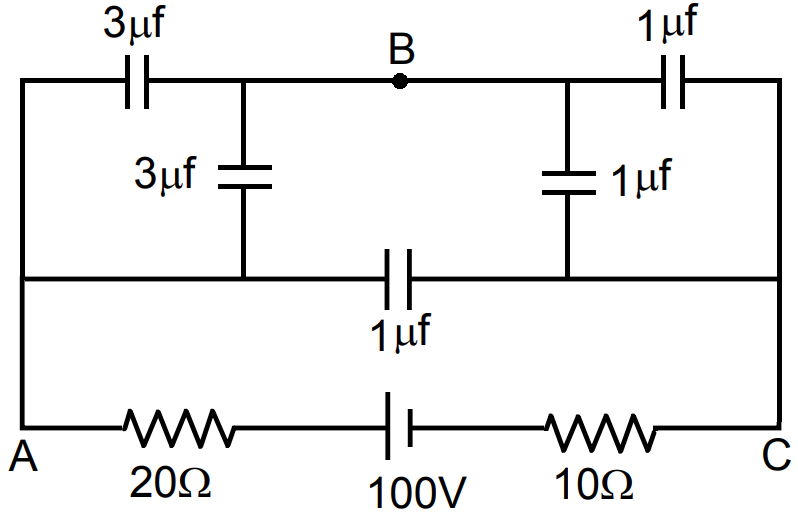
Find the potential difference between the points A and B and between the points B and C of the figure. in steady state.
Two coils A and B have inductances 1.0H and 2.0H respectively. The resistance of each coil is $10\Omega.$ Each coil is connected to an ideal battery of emf $2.0V$ at $t = 0$ Let $i_A$ and $i_B$ be the currents in the two circuit at time t. Find the ratio $\frac{\text{i}_\text{A}}{\text{i}_\text{B}}$
  1. t = 100ms
  2. t = 200ms
  3. t = 1s.
The amount of charge that passes in time t through a cross-section of a wire is,
$Q(t) = At^2 + Bt + C$.
  1. Write the dimensional formulae for A, B and C.
  2. If the numerical values of A, B and C are 5, 3 and 1, respectively, in S.I units, find the value of the current at t = 5s.