Question
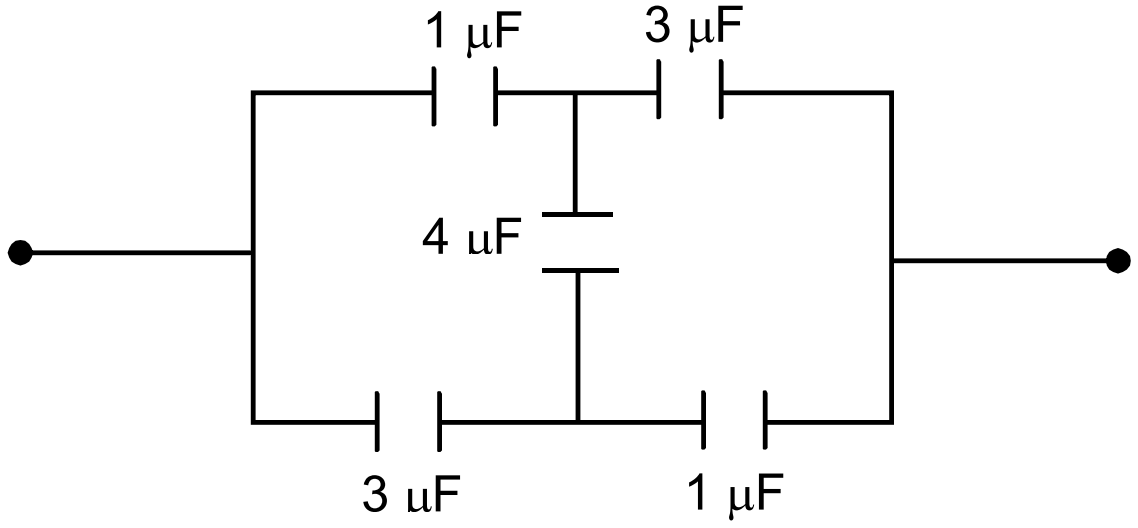
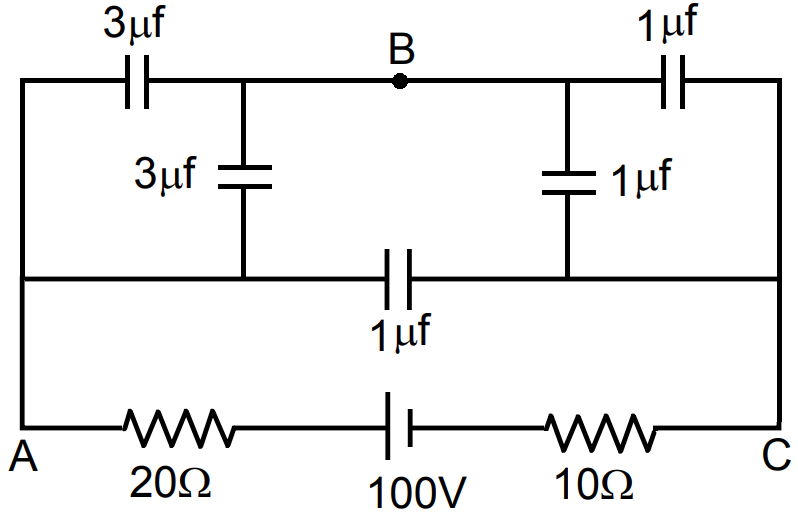
Find the potential difference between the points A and B and between the points B and C of the figure. in steady state.

Answer


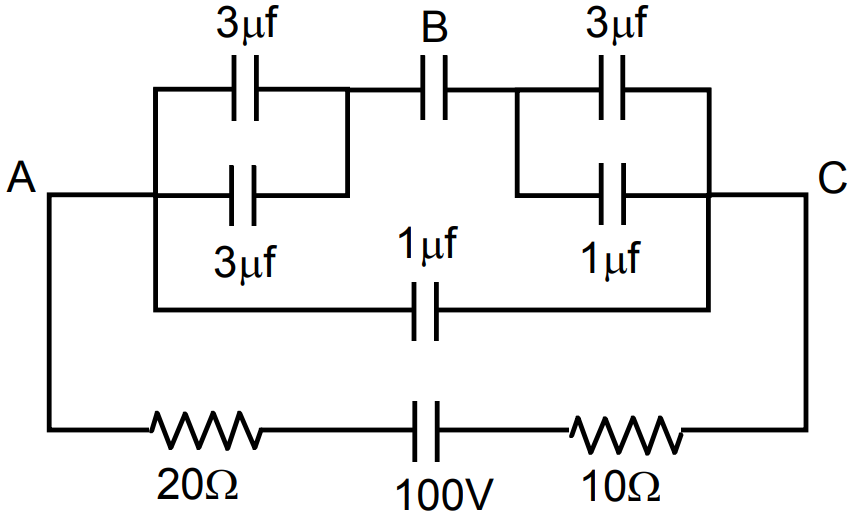
$\text{C}_\text{eq}=\big[(3\mu\text{fp}\ 3\mu\text{f})\text{s}(1\mu\text{f p}1\mu\text{f})\big]\text{p}(1\mu\text{f})$
$=\big[(3+3)\mu\text{f s}(2\mu\text{f})\big]\text{p}1\mu\text{f}$
$=\frac{3}{2}+1=\frac{5}{2}\mu\text{f}$
$\text{V}=100\text{V}$
$\text{Q}=\text{CV}=\frac{5}{2}\times100=250\mu\text{c}$
Charge stored across $1\mu\text{f}$ capacitor $=100\mu\text{C}$
$C_{eq}$ between A and B is $=6\mu\text{f}=\text{C}$
Potential drop across $\text{AB}=\text{V}=\frac{\text{Q}}{\text{C}}=25\text{V}$
Potential drop across BC = 75V.

Need a full question paper?

Generate a complete, print-ready paper with questions like this in minutes — across 16+ boards, with answer keys.
Start Generating Free

Similar questions

A sonometer wire is vibrating in resonance with a tuning fork. Keeping the tension applied same, the length of the wire is doubled. Under what conditions would the tuning fork still be is resonance with the wire?
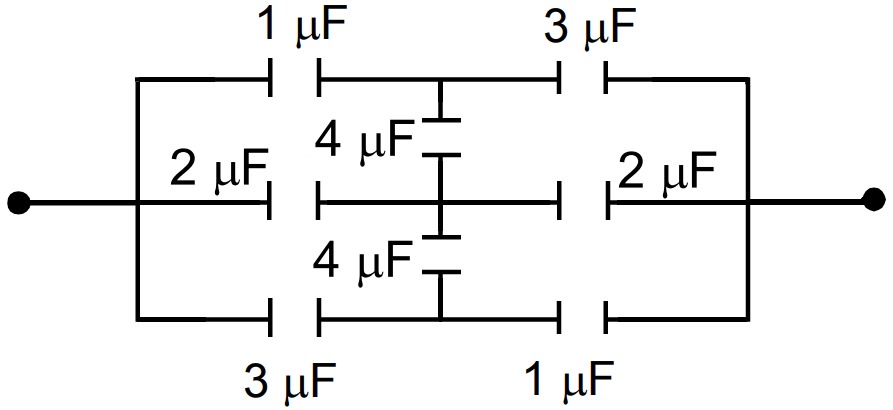
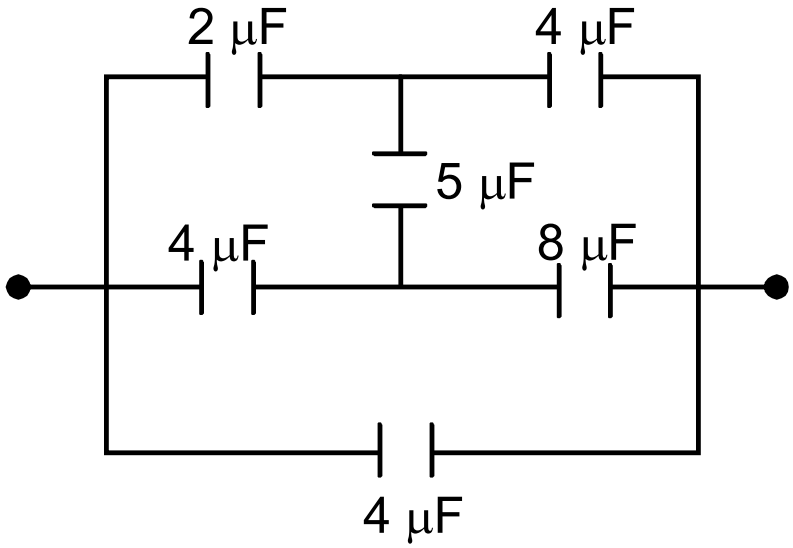
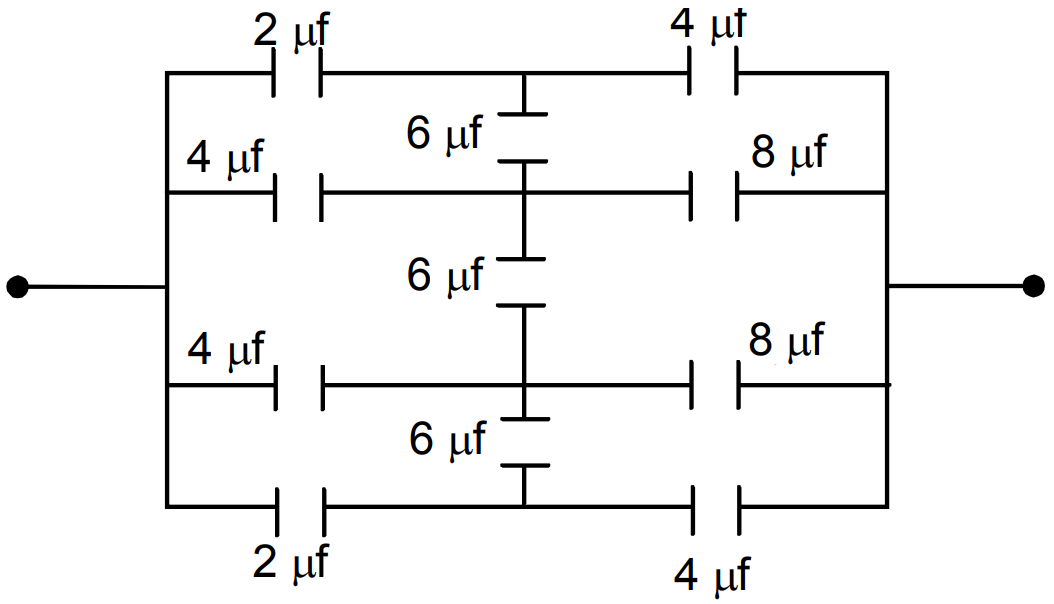
Find the equivalent capacitances of the combinations shown in figure between the indicated points.


A cricketer can throw a ball to a maximum horizontal distance of 100m. How much high above the ground can the cricketer throw the same ball?
A metal block of heat capacity $800^{\circ} \mathrm{C}^{-1}$ placed in a room at $20^{\circ} \mathrm{C}$ is heated electrically. The heater is switched off when the temperature reaches $30^{\circ} \mathrm{C}$. The temperature of the block rises at the rate of $2^{\circ} \mathrm{Cs}^{-1}$ just after the heater is switched on and falls at the rate of $0.2^{\circ} \mathrm{Cs}^{-1}$ just after the heater is switched off. Assume Newton's law of cooling to hold.
  1. Find the power of the heater.
  2. Find the power radiated by the block just after the heater is switched off.
  3. Find the power radiated by the block when the temperature of the block is $25^\circ C$.
  4. Assuming that the power radiated at $25^\circ C$ represents the average value in the heating process, find the time for which the heater was kept on.
Figure shows a small block of mass m kept at the left end of a larger block of mass M and length l. The system can slide on a horizontal road. The system is started towards right with an initial velocity v. The friction coefficient between the road and the bigger block is g and that between the block is $\frac{\mu}{2}.$ Find the time elapsed before the smaller blocks separates from the bigger block.
Explain static friction and dynamic friction in detail.
A horizontal cesium plate ($\phi$ = l.9 eV) is moved vertically downward at a constant speed u in a room full of radiation of wavelength 250 run and above. What should be the minimum value of u so that the vertically upward component of velocity is nonpositive for each photoelectron?
A hollow metallic sphere of radius 20cm surrounds a concentric metallic sphere of radius 5cm. The space between the two spheres is filled with a nonmetallic material. The inner and outer spheres are maintained at 50°C and 10°C respectively and it is found that 100J of heat passes from the inner sphere to the outer sphere per second. Find the thermal conductivity of the material between the spheres.
A rocket is launched vertically from the surface of the earth with an initial speed of 10km/s. How far above the surface of the earth would it go? Ignore the atmospheric resistance. Radius of the earth = 6400km.
The bob A of a pendulum released from horizontal to the vertical hits another bob B of the same mass at rest on a table as shown in.
If the length of the pendulum is 1m, calculate.
  1. The height to which bob A will rise after collision.
  2. The speed with which bob B starts moving. Neglect the size of the bobs and assume the collision to be elastic.