Question
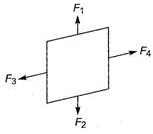
A square current carrying loop is suspended in a uniform magnetic field acting in the plane of the loop. If the force on one arm of the loop is $\overrightarrow F$ the net force on the remaining three arms of  the loop is

Answer

Let $ABCD$ is a square loop carrying current placed in a uniform magnetic field,

Due to this field the conductors of the loop will experience force.

The direction and magnitude of the force is directly proportional to the current carried in the conductor.

Given,

Force in one arm $AB = F$

since opposite branches of this loop carry current in opposite direction

$==>$ force in the opposite arm $CD = -F$

Similarly The force in in the branches $AD$ and $BC$ will be opposite in direction and cancel out when added.

Hence net force on the remaining three arms of the loop will be $(b)$ $-F$
Need a full question paper?

Generate a complete, print-ready paper with questions like this in minutes — across 16+ boards, with answer keys.
Start Generating Free

Similar questions

At what distance from the centre of the earth, the value of acceleration due to gravity $g$ will be half that on the surface ($R =$ radius of earth)
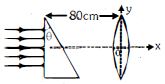
A parallel beam oflight is incident on a thin prism of prism angle of $\frac{4}{\pi }$ degrees. The refractive index of the prism is $1.5$. The focal length of the lens is $60\ cm$. The coordinates of converging point of the beam is
In a Young's double slit experiment, the width of the one of the slit is three times the other slit. The amplitude of the light coming from a slit is proportional to the slit-width. Find the ratio of the maximum to the minimum intensity in the interference pattern.
Eight dipoles of charges of magnitude $e$ are placed inside a cube. The total electric flux coming out of the cube will be
Four spheres $A, B, C$ and $D$ are of same radius but made of different metals. Their densities are in ratio $6 : 3 : 4 : 5$ and specific heats are in ratio $2 : 5 : 4 : 6$ . These are initially kept at the same temperature and placed in the same surroundings. The sphere which has the slowest rate of cooling is
A pellet carrying charge of $0.5\, coulombs$ is accelerated through a potential of $2,000\, volts$. It attains a kinetic energy equal to
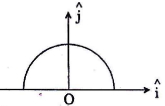
A thin semi-circular ring ofradius $r$ has a positive charge $q$ distributed uniformly over it. The net field $\vec E$ at the centre $O$ is
A process is shown in the diagram. Which of the following curves may represent the same process ?
A container with $1 kg$ of water in it is kept in sunlight, which causes the water to get warmer than the surroundings. The average energy per unit time per unit area received due to the sunlight is $700 Wm ^{-2}$ and it is absorbed by the water over an effective area of $0.05 m ^2$. Assuming that the heat loss from the water to the surroundings is governed by Newton's law of cooling, the difference (in ${ }^{\circ} C$ ) in the temperature of water and the surroundings after a long time will be. . . . . . . . (Ignore effect of the container, and take constant for Newton's law of cooling $=0.001 s ^{-1}$, Heat capacity of water $\left.=4200 J kg ^{-1} K ^{-1}\right)$
A satellite of mass $m$ is in circular orbit of radius $3 R_E$ about earth (mass of earth $M_{E}$, radius of earth $R_{E}$). How much additional energy is required to transfer the satellite to an orbit of radius $9 R_{E}$?