Four spheres $A, B, C$ and $D$ are of same radius but made of different metals. Their densities are in ratio $6 : 3 : 4 : 5$ and specific heats are in ratio $2 : 5 : 4 : 6$ . These are initially kept at the same temperature and placed in the same surroundings. The sphere which has the slowest rate of cooling is
Medium
Download our app for free and get started
$\mathrm{R}_{\mathrm{F}}=\frac{\mathrm{d} \theta}{\mathrm{dt}} \propto \frac{\mathrm{A}}{\mathrm{ms}}$
$\mathrm{R}_{\mathrm{F}} \propto \frac{1}{\mathrm{ms}}$

Download our appand get started for free
Experience the future of education. Simply download our apps or reach out to us for more information. Let's shape the future of learning together!No signup needed.*
Similar Questions
- 1View SolutionWhich of the following is best close to an ideal black body
- 2View SolutionA block of metal is heated to a temperature much higher than the room temperature and allowed to cool in a room free from air currents. Which of the following curves correctly represents the rate of cooling
- 3A calorimeter of mass $0.2$ kg and specific heat $900 J/kg-K$ . Containing $0.5$ kg of a liquid of specific heat $2400J /kg-K$ . Its temperature falls from ${60^o}C\,{\rm{to}}\,\,{\rm{5}}{{\rm{5}}^{\rm{o}}}C$ in one minute. The rate of cooling is ....... $J/s$View Solution
- 4A container contains hot water at ${100^o}C$. If in time ${T_1}$ temperature falls to ${80^o}C$ and in time ${T_2}$ temperature falls to ${60^o}C$ from ${80^o}C$, thenView Solution
- 5Consider two rods of same length and different specific heats $\left(S_{1}, S_{2}\right)$, conductivities $\left(K_{1}, K_{2}\right)$ and area of cross-sections $\left(A_{1}, A_{2}\right)$ and both having temperatures $T_{1}$ and $T_{2}$ at their ends. If rate of loss of heat due to conduction is equal, thenView Solution
- 6A spherical black body with a radius of $24\;cm$ radiates $440\;W$ power at $500\;K$. If the radius were halved and the temperature doubled, the power radiated in watt would beView Solution
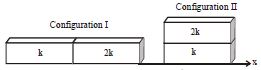
- 7Two rectangular blocks, having identical dimensions, can be arranged either in configuration $I$ or in configuration $II$ as shown in the figure. One of the blocks has thermal conductivity $k$ and the other $2k$. The temperature difference between the ends along the $x-$ axis is the same in both the configurations. It takes $9s$ to transport a certain amount of heat from the hot end to the cold end in the configuration $I$. The time to transport the same amount of heat in the configuration $II$ is .......... $\sec$View Solution
- 8Rate of cooling at $600K$ , if surrounding temperature is $300K$ is $R$ . The rate of cooling at $900K$ isView Solution
- 9View SolutionOne likes to sit under sunshine in winter season, because
- 10Three stars $A, B, C$ have surface temperatures $T _{A} ,T _{B}, T _{C}$ respectively. Star $A$ appears bluish, star $B$ appears reddish and star $C$ yellowish. Hence,View Solution