MCQ
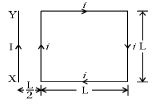
A square loop $ABCD$ carrying a current $i,$ is placed near and coplanar with a long straight conductor $XY$ carrying a current $I,$ the net force on the loop will be
  • A
    $\frac{{{\mu _0}Ii}}{{2\pi }}$
  • B
    $\;\frac{{2{\mu _0}IiL}}{{3\pi }}$
  • C
    $\;\frac{{{\mu _0}IiL}}{{2\pi }}$
  • $\;\frac{{2{\mu _0}Ii}}{{3\pi }}$

Answer

Correct option: D.
$\;\frac{{2{\mu _0}Ii}}{{3\pi }}$
d
Force on arm $A B$ due to current in conductor $X Y$ is

${F_1} = \frac{{{\mu _0}}}{{4\pi }}\frac{{2IiL}}{{(L/2)}} = \frac{{{\mu _0}Ii}}{\pi }$

acting towards $X Y$ in the plane of loop. Force on arm $C D$ due to current in conductor $X Y$ is

${F_2} = \frac{{{\mu _0}}}{{4\pi }}\frac{{2IiL}}{{3(L/2)}} = \frac{{{\mu _0}Ii}}{{3\pi }}$

acting away from $X Y$ in the plane of loop.

$\therefore$ Net force on the loop $=F_{1}-F_{2}$

$=\frac{\mu_{0} I i}{\pi}\left[1-\frac{1}{3}\right]=\frac{2}{3} \frac{\mu_{0} I i}{\pi}$

Need a full question paper?

Generate a complete, print-ready paper with questions like this in minutes — across 16+ boards, with answer keys.

Start Generating Free

Similar questions

Light considering of wavelengths $6000\,\mathop A\limits^o $ and $5500\,\mathop A\limits^o $ falls on the double slits in $YDSE$ . $n^{th}$ order bright fringe of $\lambda = 6000\,\mathop A\limits^o $  is found to coincide with the $m^{th}$ order bright fringe of $\lambda = 5500\,\mathop A\limits^o $ . Smallest values of $n$ and $m$ are respectively
An $\alpha - $ particle travels in a circular path of radius $0.45\, m$ in a magnetic field $B = 1.2\,Wb/{m^2}$ with a speed of $2.6 \times {10^7}\,m/\sec $. The period of revolution of the $\alpha - $ particle is
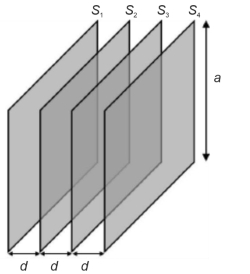
Four identical thin, square metal sheets, $S_1, S_2, S_3$, and $S_4$, each of side $a$ are kept parallel to each other with equal distance $d( < < a)$ between them, as shown in the figure. Let $C_0=\varepsilon_0 a^2 / d$, where $\varepsilon_0$ is the permittivity of free space.

Match the quantities mentioned in $List-I$ with their values in $List-II$ and choose the correct option.

$List-I$ $List-II$
($P$) The capacitance between $S_1$ and $S_4$, with $S_2$ and $S_3$ not connected, is ($1$) $3 C_0$
($Q$) The capacitance between $S_1$ and $S_4$, with $S_2$ shorted to $S_3$, is ($2$) $C_0 / 2$
($R$) The capacitance between $S_1$ and $S_3$, with $S_2$ shorted to $S_4$, is ($3$) $C_0 / 3$
($S$) The capacitance between $S_1$ and $S_2$, with $S_3$ shorted to $S_1$, and $S_2$ shorted to $S_4$, is ($4$) $2 C_0 / 3$
  ($5$) $2 C_0$

Microscope is an optical instrument which
Four wires of the same diameter are connected in turn between two points, maintained at a constant potential difference. Their resistivities are; $\rho $ and $L$ (wire $1$ )., $1.2\,\rho $ and $1.2\,L$ (wire $2$ ), $0.9\,\rho $ and $0.9\,L$ (wire $3$ ) and $\rho $ and $1.5\,L$ (wire $4$ ). Rank the wires according to the rates at which energy is dissipated as heat, greatest first
A $220\, volt$, $1000\, W$ bulb is connected across a $110\, volt$ mains supply. The power consumed will be ............ $W$
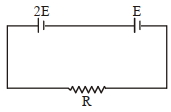
Two cells of emf $2\, E$ and $E$ with internal resistance $r _{1}$ and $r _{2}$ respectively are connected in series to an external resistor $R$ (see $figure$). The value of $R ,$ at which the potential difference across the terminals of the first cell becomes zero is
Half life of a radioactive substance is $T$. The time taken for all the nuclei to disintegrate will be
The aperture diameter of a telescope is $5\; \mathrm{m} .$ The separation between the moon and the earth is $4 \times 10^{5} \;\mathrm{km} .$ With light of wavelength of $5500\;\mathring A$, the minimum separation between objects on the surface of moon, so that they are just resolved, is close to......$m$
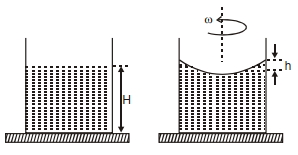
A beaker of radius $r$ is filled with water (refractive index $\frac{4}{3}$ ) up to a height $H$ as shown in the figure on the left. The beaker is kept on a horizontal table rotating with angular speed $\omega$. This makes the water surface curved so that the difference in the height of water level at the center and at the circumference of the beaker is $h(h \ll H, h \ll r)$, as shown in the figure on the right. Take this surface to be approximately spherical with a radius of curvature $R$. Which of the following is/are correct? ( $g$ is the acceleration due to gravity)

$(A)$ $R=\frac{h^2+r^2}{2 h}$

$(B)$ $R=\frac{3 r^2}{2 h}$

$(C)$ Apparent depth of the bottom of the beaker is close to $\frac{3 H }{2}\left(1+\frac{\omega^2 H }{2 g }\right)^{-1}$

$(D)$ Apparent depth of the bottom of the beaker is close to $\frac{3 H }{4}\left(1+\frac{\omega^2 H}{4 g }\right)^{-1}$