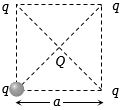
A square of side ‘$a$’ has charge $Q$ at its centre and charge ‘$q$’ at one of the corners. The work required to be done in moving the charge ‘$q$’ from the corner to the diagonally opposite corner is
Easy
Download our app for free and get started
(a) From symmetry of the figure all corner have same electric potential. Therefore work done in moving the charge $q$ from the corner to the diagonally opposite corner is zero.

Download our appand get started for free
Experience the future of education. Simply download our apps or reach out to us for more information. Let's shape the future of learning together!No signup needed.*
Similar Questions
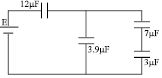
- 1Four capacitors and a battery are connected as shown. The potential drop across the $7$ $ \mu F$ capacitor is $ 6$ $ V$. Then the :View Solution
- 2Electric potential in a region is varying according to the relation $V=\frac{3 x^2}{2}-\frac{y^2}{4}$, where $x$ and $y$ are in metre and $V$ is in volt. Electric field intensity (in $N/C$) at a point $(1 \,m , 2 \,m$ ) is ......View Solution
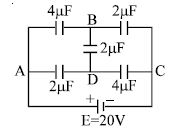
- 3The figure shows a diagonal symmetric arrangement of capacitors and a battery. The potential of the point $B$ and $D$ areView Solution
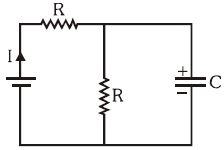
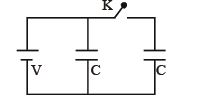
- 4Consider the arrangement shown in figure. The total energy stored is $U_1$ when key is closed. Now the key $K$ is made off (opened) and two dielectric slabs of relative permittivity ${ \in _r}$ are introduced between the plates of the two capacitors. The slab tightly fit in between the plates. The total energy stored is now $U_2$. Then the ratio of $U_1/U_2$ isView Solution
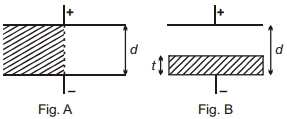
- 5A capacitor is half filled with a dielectric $(K=2)$ as shown in figure A. If the same capacitor is to be filled with same dielectric as shown, what would be the thickness of dielectric so that capacitor still has same capacity?View Solution
- 6Twenty seven drops of water of the same size are equally and similarly charged. They are then united to form a bigger drop. By what factor will the electrical potential changes.........$times$View Solution
- 7When a proton is accelerated through $1\,V$, then its kinetic energy will be.....$eV$View Solution
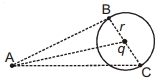
- 8A point charge $q$ is held at the centre of a circle of radius $r . B, C$ are two points on the circumference of the circle and $A$ is a point outside the circle. If $W_{A B}$ represents work done by electric field in taking a charge $q_0$ from $A$ to $B$ and $W_{A C}$ represents the workdone from $A$ to $C$, thenView Solution
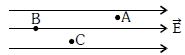
- 9$A, B$ and $C$ are three points in a uniform electric field. The electric potential isView Solution
- 10In the given figure initially the capacitor is uncharged. Ratio of current at $t = 0$ & $t = \infty$ will beView Solution