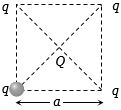
A square of side ‘$a$’ has charge $Q$ at its centre and charge ‘$q$’ at one of the corners. The work required to be done in moving the charge ‘$q$’ from the corner to the diagonally opposite corner is
Easy


Download our appand get started for free
Experience the future of education. Simply download our apps or reach out to us for more information. Let's shape the future of learning together!No signup needed.*
Similar Questions
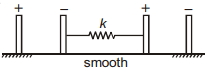
- 1Two charged capacitors have their outer plates fixed and inner plates connected by a spring of force constant ' $k$ '. The charge on each capacitor is q. Find the extension in the spring at equilibriumView Solution
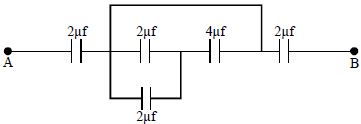
- 2Find the equivalent capacitance between $A$ and $B$.......$\mu f$View Solution
- 3Capacitance of a parallel plate capacitor becomes $4/3$ times its original value if a dielectric slab of thickness $t = d/2$ is inserted between the plates ($d$ is the separation between the plates). The dielectric constant of the slab isView Solution
- 4An infinite number of charges each equal to $0.2\,\mu C$ are arranged in a line at distances $1\,m, 2\,m, 4\,m, 8\,m......$ from a fixed point. The potential at fixed point is ......$kV$View Solution
- 5If the capacity of a spherical conductor is $1$ picofarad, then its diameter, would beView Solution
- 6A metallic sphere has a charge of $10\,\mu C$. A unit negative charge is brought from $A$ to $B$ both $100\,cm$ away from the sphere but $A$ being east of it while $B$ being on west. The net work done is........$joule$View Solution
- 7View SolutionIf a unit positive charge is taken from one point to another over an equipotential surface, then
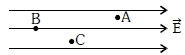
- 8$A, B$ and $C$ are three points in a uniform electric field. The electric potential isView Solution
- 9A solid conducting sphere having a charge $Q$ is surrounded by an uncharged concentric conducting hollow spherical shell. Let the potential difference between the surface of the solid sphere and that of the outer surface of the hollow shell be $V$. If the shell is now given a charge of $-3Q$, the new potential difference between the same two surfaces is......$V$View Solution
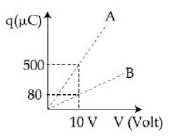
- 10Figure shows charge $(q)$ versus voltage $(V)$ graph for series and parallel combination of to given capacitors. The capacitances areView Solution