A square plate of $0.1 \;m$ side moves parallel to a second plate with a velocity of $ 0.1\; m/s$, both plates being immersed in water. If the viscous force is $0.002\; N$ and the coefficient of viscosity is $ 0.01 $ poise, distance between the plates in $m$ is
Medium


Download our appand get started for free
Experience the future of education. Simply download our apps or reach out to us for more information. Let's shape the future of learning together!No signup needed.*
Similar Questions
- 1A capillary tube is attached horizontally to a constant head arrangement. If the radius of the capillary tube is increased by $10\%$ then the rate of flow of liquid will change nearly by ......... $\%$View Solution
- 2In Guericke's experiment to show the effect of atmospheric pressure, two copper hemispheres were tightly fitted to each other to form a hollow sphere and the air from the sphere was pumped out to create vacuum inside. If the radius of each hemisphere is $R$ and the atmospheric pressure is $p$, then the minimum force required (when the two hemispheres are pulled apart by the same force) to separate the hemispheres isView Solution
- 3A balloon of mass $m$ contains water of mass $M$ . If it is completely immersed in water, find the apparent mass of the balloon with water in itView Solution
- 4A wooden block floating in a bucket of water has $\frac{4}{5}$ of its volume submerged. When certain amount of an oil is poured into the bucket, it is found that the block is just under the oil surface with half of its volume under water and half in oil. The density of oil relative to that of water isView Solution
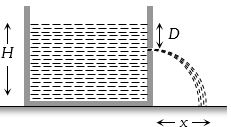
- 5A tank is filled with water up to a height $H$. Water is allowed to come out of a hole $ P$ in one of the walls at a depth $ D $ below the surface of water. Express the horizontal distance $x$ in terms of $ H $ and $D$View Solution
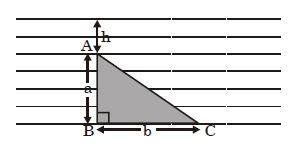
- 6A solid metallic sphere of radius $r$ is allowed to fall freely through air. If the frictional resistance due to air is proportional to the cross-sectional area and to the square of the velocity, then the terminal velocity of the sphere is proportional to which of the following?View Solution
- 7View SolutionThe pressure at the bottom of a tank containing a liquid does not depend on
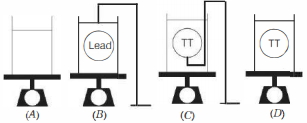
- 8Four identical beakers contain same amount of water as shown below. Beaker $A$ contains only water. A lead ball is held submerged in the beaker $B$ by string from above. A same sized plastic ball, say a table tennis $(TT)$ ball, is held submerged in beaker $C$ by a string attached to a stand from outside. Beaker $D$ contains same sized $TT$ ball which is held submerged from a string attached to the bottom of the beaker. These beakers (without stand) are placed on weighing pans and register readings $w_{A}, w_{B}, w_{C}$ and $w_{D}$ for $A, B, C$ and $D$, respectively. Effects of the mass and volume of the stand and string are to be neglected.View Solution
- 9A solid sphere, of radius $R$ acquires a terminal velocity $\nu_1 $ when falling (due to gravity) through a viscous fluid having a coefficient of viscosity $\eta $. The sphere is broken into $27$ identical solid spheres. If each of these spheres acquires a terminal velocity, $\nu_2$, when falling through the same fluid, the ratio $(\nu_1/\nu_2)$ equalsView Solution
- 10A vertical triangular plate $ABC$ is placed inside water with side $BC$ parallel to water surface as shown. The force on one surface of plate by water is (density of water is $\rho $ and atmospheric pressure $P_0$ )View Solution